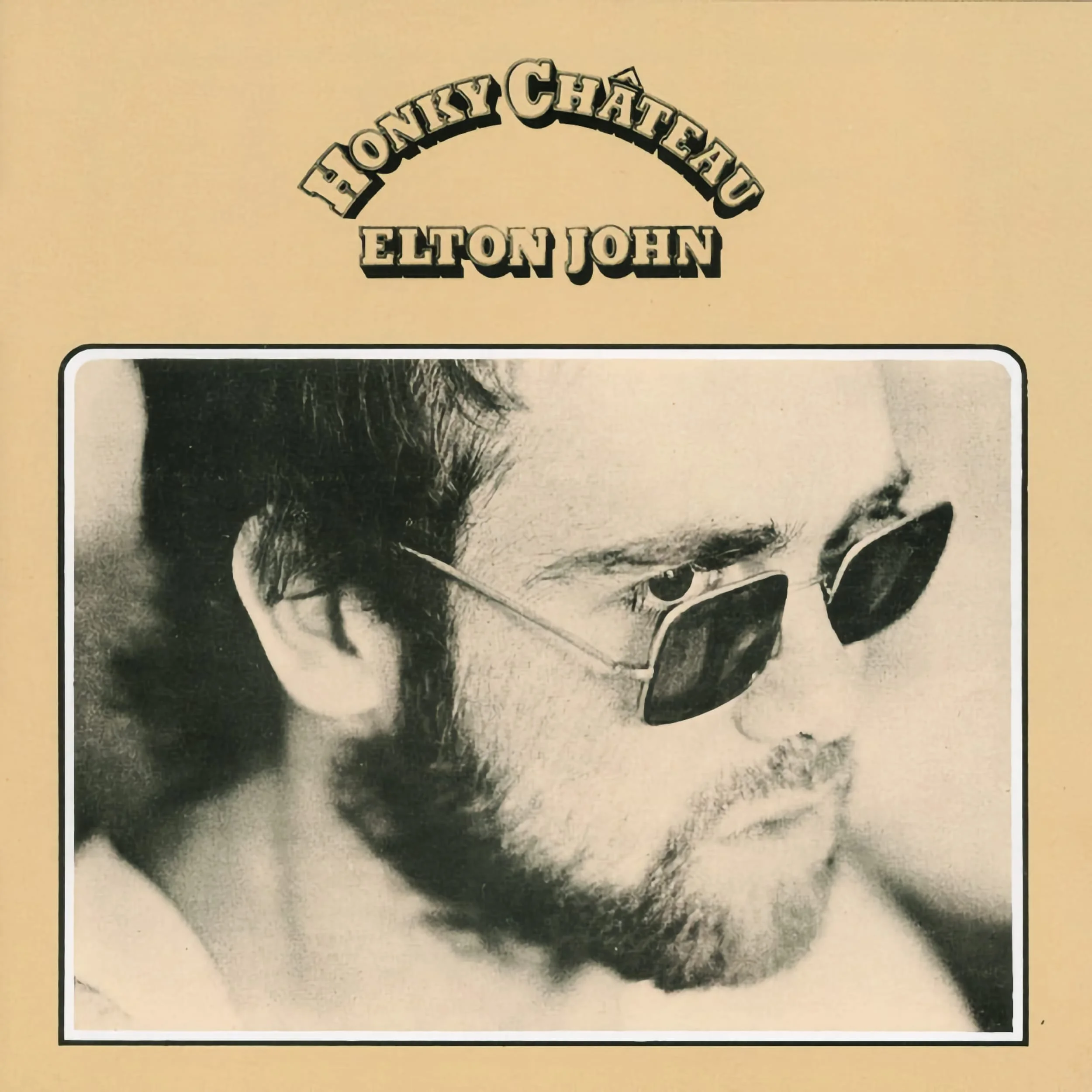
Honky Château, despite being a chart-topping success, remains one of Elton John’s most underrated records of the 70s, even with the immense popularity of “Rocket Man (I Think It's Going to Be a Long Long Time)”. Positioned between Madman Across The Water (1971) and Don’t Shoot Me I’m Only The Piano Player (1973), this 1972 release, Elton John’s fifth studio album, sees Elton John experiment with rock, pop, jazz, country-rock, and touches of funk. The result is a diversely pleasing album that becomes more appealing with repeat listens.
What isn’t as pleasing is the album’s artwork, for Honky Château is amongst Elton John’s least intriguing, as it fails to offer a mystique or represent the somewhat playful nature of the music contained within. The chosen artwork, for the 50th Anniversary Pink & Yellow Splattered edition, is much more desirable as it offers a better visualisation of the tone of the album.
While Honky Château has incredible songwriting, performances, and overall production values, there are, arguably, too many different masterings available, all offering slight variances in the album’s tonality and sonic clarity. While going through every master goes beyond the scope of this review, I will say that I feel the 1995 remaster remains superior to the 2017 remaster that is available via the 50th Anniversary Edition. My reasoning is twofold. Firstly, from a purely subjective standpoint, it is the version of the album I am most familiar with. Secondly, as it pertains to the Lossless Apple Digital Master, from Apple Music, it’s lost the sonic sparkle in the top end of the audible spectrum, instead focusing on a mid-to-low end range. That chosen styling adds a little oomph, yes, but it also muddies the clarity of the recording. Of particular note is the near-loss of "Legs" Larry Smith's tap dance on I Think I'm Going To Kill Myself via the 2017 remaster. While one can still thoroughly enjoy the music, and some may even prefer the new remaster, it’s best to give them both a listen and decide for yourself.
Honky Cat has a lively funk-jazz feel and is an ideal album opener. Its strength lies in the song’s compelling composition, and despite being initially straightforward, if you take the time to listen to the mix and the varying sonic elements contained throughout, you’ll undoubtedly come away amazed, as Honky Cat is a real humdinger.
Mellow, as the name implies, slows the tempo slightly, but its mellow styling is pure genius as the song is not only exceptional, but if Honky Cat was New Orleans jazz-club inspired, Mellow would be ideal in any piano bar with it’s laid back and relaxed approach.
I Think I'm Going To Kill Myself returns the album to the upbeat tempo and is one of the most appealing and memorable songs from the record. Its tongue-in-cheek lyrical approach may cause division amongst listeners, but it offers a different perspective when discussing a serious and sometimes controversial topic. That can be especially true when you consider the era in which Honky Château was released, for issues relating to suicide, or suicidal thoughts and mental illness, were somewhat taboo and not spoken about as freely as they are in the modern era.
Susie (Dramas) is a thoroughly enjoyable album-only tune. You likely won’t find yourself returning to the album specifically to listen to this song, but it’s got a compelling rhythm that will get you toe-tapping and head-bopping throughout. There is a standout, however, and that is Nigel Olsson’s drumming for it’s some of the very best on any Elton John release.
Rocket Man (I Think It's Going To Be A Long Long Time) is one of the greatest songs ever recorded and a trademark for Elton John. If you’re not singing along to the chorus, even in your mind, you’re listening wrong, for “Rocket Man” is an absolute masterpiece.
Salvation is a beautiful song and a hidden gem.
Slave is a killer tune, but John’s vocal delivery (and the overall musical styling) is simply too reminiscent of The Rolling Stones to make it purely original.
Amy picks up the toe-tapping, head-bopping, groove and is perfectly positioned within the album’s linear structure, but it’s most certainly an album-only number that is unlikely to be anyone’s favourite.
Mona Lisas And Mad Hatters is simply magnificent and should have been released as a single, for I dare say it would have been a chart-topper. While it has made its way beyond the constraints of Honky Château, onto career perspective releases, “Mona Lisas And Mad Hatters” remains somewhat of a deep cut in Elton John’s extensive catalogue, but a highly memorable one that will see you coming back to the album time and time again just to hear this classic tune.
Hercules closes out the album in the same way it started, with an upbeat number. While it’s a great song, and most certainly encourages me to play the record again, I can’t help but wish that “Mona Lisas And Mad Hatters” had been the album closer, for the compelling nature of that song, along with the relaxed styling, would have ensured it was a quintessential closer; one that also allows for contemplation of the music that’s just been heard.
From start to finish, Elton John’s Honky Château delights. The songs, for the most part, have an upbeat vibe, but it’s the incredible songwriting and layered compositions that really make Honky Château memorable within Elton John’s vast body of work. While many will be drawn to the album for the hits, “Rocket Man” and “Honky Cat”, Honky Château is far more than a collection of songs; for the more you listen to it, the more you come to appreciate this humble release, one that could very well be considered Elton John’s greatest musical achievement.