Viewing entries in
'70s

Aerosmith – Get Your Wings (Album Review)

2 Comments

Aerosmith – Get Your Wings (Album Review)

The rawness is gone. So is Steven Tyler’s faux vocal style. Instead, Aerosmith’s Get Your Wings, their 1974 sophomore release, focuses on a more polished production with vocal licks from Tyler that are arguably some of his greatest. Unlike many, I never disliked Tyler’s vocal delivery on the eponymous debut for that album is 100% Aerosmith, but even I have to admit that his natural singing voice, as we heard on Dream On, is far more appealing, thereby making Get Your Wings a stellar release that would further refine the band’s unique sound and style. 

It wasn’t just the band that would refine their sound and be truer to themselves, for Jack Douglas’ role as Producer, and overall collaborator, really positions him as the sixth member of Aerosmith; certainly throughout the 70s. From an observer’s standpoint, I wouldn’t suggest that Adrian Barber did a poor job producing their eponymous debut, but it is fair to say that he didn’t quite capture their sound; Dream On being the exception. Nevertheless, Douglas would guide Aerosmith through their classic era until tensions and substance abuse, during the recording of Night In The Ruts, meant he was no longer in control and Columbia Records ultimately decided to replace him with Gary Lyons; not a bad choice by any means but Douglas was as important to Aerosmith as Bob Ezrin was to Alice Cooper. Douglas would go on to produce Aerosmith’s Rock In A Hard Place, Honkin’ On Bobo, and Music From Another Dimension! but as with Ezrin and Cooper, the flow was never quite the same on post-prime releases. Speaking of Ezrin, he acted as Executive Producer for Get Your Wings; a role that focuses on the business decisions relating to the production of the album rather than the musical output commonly associated with the producer’s role. It makes you wonder what Get Your Wings would have sounded like if he was the producer.

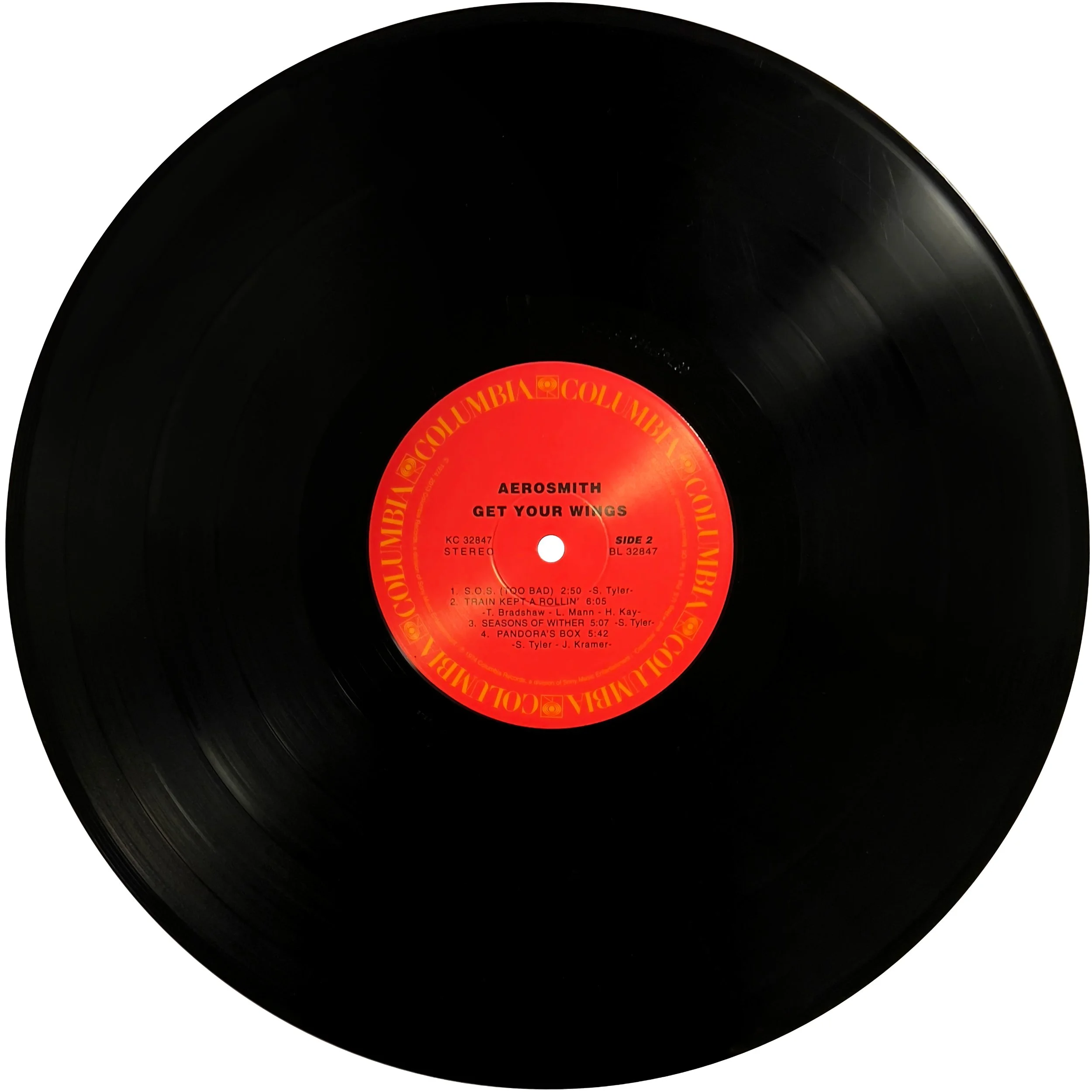
Much like the eponymous debut, Ryan Smith’s 2013 Record Store Day (RSD) vinyl remaster is stunning with a detailed and full-bodied sound that is about as good as you’re going to find on a vinyl reissue of this album. This mastering also wasn’t limited to the RSD release meaning that you can still pick up a copy and experience it for yourself. The only difference is the post-RSD releases aren’t numbered and come with a different hype sticker. 

Switching our focus to streaming, you’ll find the (Hi-Res) Lossless Apple Digital Master, on Apple Music, to be a perfect digital facsimile. Yes, it’s a fair bet that the vinyl reissue was pressed from a digital intermediary, but the process of putting the music on vinyl shifts the sound of the music ever so slightly making it warmer in tonality. That isn’t to suggest that the stream is cold or shrill, anything but, but the vinyl counterpart can be enjoyed without any EQ changes, whereas when listening to the stream, I find myself wanting to reduce the treble and increase the bass slightly. It’s a small difference, granted, but if given the choice I’d gravitate to the vinyl reissue for it has a slight edge over the digital stream. 

The artwork itself, on the vinyl reissue, is a lovely replica. Naturally, there are some differences such as the updated publishing dates, and the numbered imprint, but even the record label is astonishingly close to an original. Hence, if you’ve been looking for a copy, and have not yet found an original in decent shape, you won’t be displeased with this release.

Same Old Song And Dance has a great beat and rhythm with some killer guitar licks from both Joe Perry and Brad Whitford. The brass performance by The Becker Brothers is stunning and was the perfect addition as it makes it more of a standout than it would have otherwise been. However, I've always felt that the drum track is inadequate on Same Old Song And Dance. It’s almost as if the skin tension is loose on the drum heads, or the microphone placement was poorly chosen, for the drum track lacks depth and makes the overall rhythm section sound as if it’s concealed. It could even be a result of a mixing decision but it is not as prevalent on the other songs on Get Your Wings; a shame considering it’s a killer tune. 

Of the live recordings, the edition found on A Little South Of Sanity is excellent. As the song progresses, you get a sense they’ve loosened up and are simply jamming. The Classics Live! II performance is solid, but not exceptional. It has a similar concealed drum tracking, to the studio recording, and I subsequently can’t help but wonder if it is merely a lack of presence in the drum tracking on this particular song. Hence, it’s then plausible to suggest that it was a mixing decision more than any other aspect.

As Lord Of The Thighs begins, the drum track is noticeably cleaner and more authoritative, remaining this way throughout the rest of the album. As a song, Lord Of The Thighs is exceptional with a killer infectious blues rhythm throughout and is foundational as far as Walk This Way is concerned, from Toys In The Attic, as the rhythmic beat is repurposed on that legendary tune to great effect.

Of the live performances, the recording from Live! Bootleg is energetic and full of attitude, while the Classics Live! rendition is similar in length but isn’t nearly as bombastic. The Texas Jam performance from 1978, as heard on Pandora’s Box, is more rhythmic than that on Classics Live! But lacks the attitude and energy of Live! Bootleg.

Spaced commences with low, audible, atmospheric sounds. I don’t know about you, but I thoroughly enjoy it when rock and roll songs start this way and there’s so much complexity to be heard in Spaced that I never tire of the experience it offers. 

Woman Of The World is blues-driven rhythmic rock 101. 

S.O.S. (Too Bad) has nothing to do with saving souls, although that may have seemed appropriate for the band as they were regularly on the precipice of destruction. Instead, it stands for Same Old Shit and that’s one adage I’m sure we can all get behind. S.O.S. (Too Bad) is a fantastic bluesy rock song with a beautiful intermingling of guitar, bass guitar, and a drum rhythm that holds the song together.

Train Kept A-Rollin’ is arguably the most successful song from the album, despite not charting upon release. Aerosmith may not have written or performed it initially, but the boys from Boston certainly mastered it. 

Of the live performances, you really need to check out Classics Live! if for no other reason than the grungier tone that works extraordinarily well with the style of the song. The Live! Bootleg recording is lackadaisical by comparison. Plus, let’s be honest, the tip of the hat to Strangers In The Night, an incredible tune in its own right, somewhat tarnishes the Live! Bootleg performance.

Seasons Of Wither begins with almost a minute of faux audience and wind sounds in an attempt to set the seasonal stage, yet it is the gorgeous guitar work that stands out here. It’s subtle and doesn’t overshadow the song itself, but is notable nonetheless. But, is it a great tune? Yes and no. Without the extensive introduction, it becomes much more appreciable but it’s also true to say that it isn’t one of Aerosmith’s better ballads. It should, however, have been the closing song on Get Your Wings.

I do wish that Pandora’s Box was re-tracked to appear before Seasons Of Wither. It isn’t that it’s a bad song; it just doesn’t flow well after the soothing Seasons Of Wither. Plus, the long-held guitar riff and drum outro on Seasons Of Wither would have made for a far better closer than Pandora’s Box; a solid tune nonetheless.

Overall, Get Your Wings is a must-own for any fan of Aerosmith or 70s rock and roll. It really is quite exceptional and has stood the test of time.

2 Comments

Eagles – The Long Run (Album Review)

Eagles – The Long Run (Album Review)

For decades, The Long Run was considered the final chapter in the Eagles’ story, and in a way it is, for as exceptional as the four new songs from Hell Freezes Over are, and Long Road Out Of Eden is, The Long Run is the culmination of the classic Eagle’s body of work. While it could never compete with the success of Hotel California, it offers a more cohesive overview of their career with rock influences ranging from their self-titled debut to Hotel California’s laid-back fluidity. The Long Run, subsequently, is one of the greatest Eagle’s albums and one of the best records released in 1979.

Released in 1979, The Long Run featured Timothy B. Schmit for the first time in the Eagles’ lineup as he replaced Randy Meisner. Meisner, as a founding member of the Eagles, was synonymous with their sound but Schmit filled the role perfectly and along with the addition of Joe Walsh in 1976 is amongst my favourite lineup changes in all of recorded music history. Schmit's subtle tones brought a new level of musicality to the band and I Can’t Tell You Why is about as close to perfect as any song can get. 

Perfection was something the Eagles were known for, particularly with regards to their production values and while there isn’t a bad way to experience this album, some versions appeal to me more than others. The vinyl record (2014 reissue/cat: RRM1-508) I’m fortunate to own is spacious, detailed, smooth, and silent with a level of bass depth that isn’t overbearing but similarly feels like it isn’t quite there. It’s a small issue, and one that generally doesn’t bother me, but it sounds a little too accurate. A first-world problem, I know, but when I invest in vinyl, both from a cost and time perspective, I want to be wowed and while I thoroughly enjoy this pressing, I often wonder if another edition would better suit my expectations of a warmer reproduction. 

The (Hi-Res) Lossless Apple Music stream, an Apple Digital Master, is fantastic and while it lacks the vinyl sound signature, it’s edgier and fuller with the same benefits heard on the vinyl release; but there’s a little less spaciousness that is particularly noticeable on songs such as The Disco Strangler with regard to the echoing vocal. The bass issue I have with the vinyl release isn’t present here as the bass is less pronounced but smoother and more analog sounding; a dichotomy considering it is most certainly a digital medium. Regardless, if I had to choose one, as much as it pains me to say it, I’d go with the Apple Music stream every time as it simply sounds right. My body moves involuntarily, I want to sing along, and the air guitar makes an appearance throughout; all aspects that are missing when I play the vinyl counterpart. 

The Long Run isn’t the greatest opener, although you immediately know what you’re going to get. Is it Don Henley’s greatest vocal performance? No, but the guitar tuning and licks are what make The Long Run such an enjoyable tune.

I Can’t Tell You Why is nothing short of a masterpiece and is, without doubt, one of the best songs the Eagles ever recorded. Schmit’s vocal is otherworldly but the entire composition of the tune is so perfect that I could listen to it on repeat indefinitely; it’s most certainly a song for inclusion on any desert island playlist. 

The live performance from Hell Freezes Over is, as I’ve suggested before, incredibly smooth with zero distortion, notable as it’s a live recording, thereby resulting in a perfect song that will see you toe-tapping to the infectious rhythm. The performance featured on Eagles Live is a lovely early interpretation from 1980 that is very similar to the studio recording but  the recording from Live From The Forum MMXVIII is different. Like, really, different! It just isn’t the same and while I acknowledge that Schmit has aged and likely cannot hit the near-falsetto vocal like he could in his prime, I find it detracting to the extent that I don’t appreciate this particular performance. 

While there have been a few covers of this classic tune, one of the best that you should check out is Diana Krall’s from Wallflower. It doesn’t match the original, but it jazzes it up. That said, I would have loved to have seen Krall invite Schmit to record the backing vocals with her, or even perform the song as a duet, for I feel it would have been amazing. 

In The City isn’t an Eagles’ original for Joe Walsh initially recorded it for The Warriors soundtrack. That particular version is a little edgier, from a rock perspective, than the Eagles’ interpretation but both are rather similar and I appreciate the Eagles’ version just a little more as it’s more melodic in both vocal harmony and overall musicality. 

The live performance from Hell Freezes Over takes the song one step further and while I would suggest that Walsh’s vocal is too forward in the mix this is arguably the best recording of In The City as it has the rocking rawness Walsh is best known for. Similar to I Can’t Tell You Why, I’d give the Live From The Forum MMXVIII recording a miss. It isn’t great. A shame considering that In The City is a killer tune and one of my all-time favourite Joe Walsh songs. 

The Disco Strangler is a solid tune but the guitar tuning can be a little grinding. Henley’s offbeat vocal works for the song but there’s no doubt in my mind that it isn’t well-suited to the album. That said, if it were on On The Border it would have been perfect. The core redeeming quality, however, is the echoing vocal at the end of the song. I love the mixing choice in that regard. 

King Of Hollywood is pure bliss and the perfect counterbalance to The Disco Strangler. While the guitar work isn’t quite Dire Straits’ level, it’s gorgeous and is one of The Eagles’ greatest tunes. 

Heartache Tonight has a great rhythm but it’s a little too muddy and concealed, especially in the introduction and chorus. Given that the album has always sounded that way I can only assume that it was an intentional creative choice and while it doesn’t destroy the song for me, it does cause minor irritation to an otherwise great song. 

Those Shoes is a killer tune and who doesn’t love the talk-box; a severely underused tool in modern music. It just gives a unique sound that, yes, we all make when we’ve got our air guitar out and we’re playing along. 

Teenage Jail is a solid album track, but it’s unlikely you’ll ever seek it out on its own. That isn’t to suggest that the song’s bad, far from it, but it simply flows better as an album track than as a standalone song. 

The Greeks Don’t Want No Freaks is a quirky song to follow Teenage Jail. It shouldn’t work, yet it does. Sometimes a fun little tune is all that’s needed and The Greeks Don’t Want No Freaks suits that purpose. 

The Sad Cafe is a beautiful closing song. Another classic Eagles’ tune that will encourage you to listen to the album again and stay within the Eagles’ greater catalogue. Due to the slower tempo, it’s also the perfect song to cease listening to the Eagles on as it permits a level of reflection, especially if you’re, as I am, into late-night listening sessions. 

Overall, The Long Run is a superb album and a perfect closing chapter to the Eagles’ 70s output. While it may be less fluid than Hotel California, it does, as previously mentioned, encompass elements from all their previous albums thereby making this a must-own for any fan.

Dire Straits – Communiqué (Album Review)

Dire Straits – Communiqué (Album Review)

While the self-titled Dire Straits debut is a must-own for any music collection, their second album, Communiqué, is less edgy with a smoother all-over presentation that sees the band evolve from their origins; even though Communiqué was released several months post their 1978 debut. Those dismissing Communiqué as a clone of their first album suggest so because it is fashionable. I’d argue that while they are complementary they are entirely different beasts and should be appreciated in that manner.  

Visually, Communiqué is stunning. The album artwork pops due to its simplicity and use of white space while also permitting a sense of curiosity. It’s, in my opinion, the greatest album artwork ever released on any Dire Straits release. 

Sonically, the lossless Apple Music stream remaster of Communiqué is simply stunning. The entire recording was done so well that I dare suggest there isn’t a sonically compromised version available. It’s dynamic with no audible compression and while different masterings and subsequent releases exist, the Apple Music stream is, in my mind at least, perfect! 

Once Upon A Time In The West opens with Mark Knopfler’s magnificent guitar work that sets the tone for the entire album, but it is the depth of the overall mix and Pick Withers’ drum track that lights up Once Upon A Time In The West with a laid back vibe and sonic wonder that will cause you to raise your head in pure admiration. A magnificent opening track. 

News flows perfectly from the opening song, reducing the tempo, but not diluting the magnificence. Aside from Knopfler’s guitar work, David’s (on Rhythm Guitar) as well, John Illsley’s bass tracking provides the perfect emphasis that holds the sum of its parts together. Withers, again, knocks it out of the park with some of the best drumming you’ll ever hear.  

Where Do You Think You’re Going? continues the laid-back style of Communiqué and it is with this delicate nature that you can begin to thoroughly appreciate Dire Straits’ musical prowess for it isn’t always about the boldest presentation but the fluidity and how music makes us feel. In this case, Where Do You Think You’re Going? reminds me of why I love music.

Communiqué has a slight tempo boost with a little more twang. It’s Dire Straits 101, but as much as I enjoy Communiqué in the linear album format, it’s one song from the album that I generally don’t seek out on its own. As the title song, however, it’s perfectly suited, but I think the one aspect that has always bothered me with Communiqué is Knopfler’s vocal is too forward in the mix. Some may like that approach, and it isn’t necessarily a bad thing, but Dire Straits is as much a musical outfit as it is a vocal storytelling one and subsequently I appreciate their output for the musicality far more than I do the literal intent. 

Lady Writer may well have a Sultans Of Swing feel to it, and there’s no doubt in my mind that Sultans Of Swing is superior to Lady Writer, but just as much of AC/DC’s catalogue sounds the same to everything they’ve ever recorded, I consider Lady Writer to share the same similarity; arguably a positive aspect for fans of Sultans Of Swing. Plus, that guitar work throughout the second half of the song is exquisite in its own right.

The music video is naturally dated, but it isn’t bad for a faux live recording as it’s been edited in such a way that you get a sense of the energy the band had at the time. The audio, however, is atrocious. Granted, the existing videotapes probably aren’t in the best condition, but it would be great to see the record label rework the audio before distributing the video. 

Angel Of Mercy is toe-tapping gold and could almost be considered a country tune with the drawl and twang present throughout. There’s also a little Caribbean influence to be heard and while Angel Of Mercy isn’t necessarily a standout, it’s a solid B-side.

Portobello Belle has a Bob Dylan feel to it, as several other songs on the album do, and it is little wonder that Dylan employed the services of Mark Knopfler and Pick Withers for his magnificent 1979 release, Slow Train Coming. That, dear reader, is a much better correlation to make regarding a carbon copy of music than suggesting Communiqué lacks originality when compared to Dire Straits’ debut. 

Single Handed Sailor has some gorgeous guitar licks throughout but that closing solo is undoubtedly the highlight; stunning!  

Follow Me Home has an incredibly immersive soundstage with atmospheric elements that transport you to another location. It’s without a doubt one of the most relaxing tunes that Dire Straits ever recorded and is the perfect way to close this exceptional album as it encourages you to play the record again or sit in quiet contemplation and marvel at the audible wonder that is Communiqué.

While there are many killer tunes to be heard on Communiqué, there is little doubt in my mind that this is Dire Straits’ most cohesive album and therefore I implore you to listen to it linearly; I promise you won’t regret it! Of course, it’s also one of those special releases that will appeal to every occasion and situation but don’t listen to the detractors. It’s better than their debut and I’d even go as far as suggesting that it is their very best album and one of the greatest albums released in 1979.. 

Kansas – Monolith (Album Review)

Kansas – Monolith (Album Review)

A soaring progressive rock masterpiece that is intensely underrated is a good way to describe Kansas’ sixth studio album Monolith. For decades, fans have been divided when it comes to this 1979 release for it heralded a slight shift from Kansas’ prior works; one that some would suggest was a step too far. I, on the other hand, see Monolith as a natural progression and one of the albums that would influence the hair metal, ballad-driven, 80s era. 

Visually, the album artwork is perfectly aligned with Kansas’ preceding and future output and only second to Point Of No Return. It possesses an imaginative quality that allows the listener to gaze upon the artwork and ponder how, or if, it is related to the music while creating their very own fantasy.  

Sonically, the lossless Apple Music stream is sufficient but I’d be lying if I didn’t say that Monolith requires a remaster. The sound is arguably well-balanced, but it’s a little thin for my liking and you, like I, will likely find a need to adjust the EQ or tone controls on your playback equipment to get the most out of the recording. That said, a thinner sound was applicable to rock bands throughout the era, and even into the 80s, so your opinion may differ from my own. The 2020 vinyl reissue on Music On Vinyl may address this issue but that largely depends on the mastering that was used for this particular reissue. At any rate, I have yet to acquire that version so I’m not able to comment further. 

On The Other Side is a masterstroke as it pertains to the opening song of an album. The guitars soar, the bass slides in perfectly, and the drum backbeat is utterly amazing before Steve Walsh’s vocal enters the mix and culminates in an incredible classic rock tune that is up there with the best rock music ever recorded. That said, Robby Steinhardt’s violin and anvil performance stand out here, ensuring that the song itself, and Kansas’ overall sound signature, is progressive in that this isn’t just another generic rock album. 

The music video is an excellent live performance of the song, but I do wish that they had just got straight into the performance itself as the introduction is utterly ridiculous. Similarly, the video ends rather abruptly rather than fading out, and the multi-window editing style disappointingly becomes a recurring aspect that ultimately detracts from the music itself; a common style from the era, but one that has aged badly. 

People Of The South Wind adds incredible energy to the album and while it isn’t the strongest song from Monolith, it’s a solid tune with some killer guitar licks, particularly in the solo, that will likely appeal to many. People Of The South Wind most certainly was radio-friendly, with a pop/disco-vibe, that is true to the times but would likely have been declared a sell-out by their hardcore fan base.

The music video for People Of The South Wind thankfully does away with the finicky edits, allowing the music and the faux live performance to remain undiluted. The result is a much more compelling music video than On The Other Side. Still, it ends abruptly and I hope that it is merely someone not paying due diligence when digitising the original tapes rather than that being the way the videos were ended. 

Angels Have Fallen opens with Steinhardt’s stunning violin, but it is the lyrical delivery from Walsh that truly captivates the senses as the song builds to its ultimate peak before returning to a more mellow tempo. It’s simply magnificent and is without a doubt one of the strongest songs on the album and in Kansas’ entire catalogue, but it should be noted that the mix is the pinnacle element here as every musical aspect is perfectly positioned in the soundstage. Angels Have Fallen is one of those songs that you can immediately connect with upon hearing it. That aspect is no more apparent than during the second half of the song where the vocals, guitar, and other musical elements bring the song to its soaring closing moments that will encourage you to turn the volume to 11. Phil Ehart’s drumming in this particular section is second to none proving that he is one of rock and roll's greatest drummers. 

How My Soul Cries Out For You picks up the tempo but flows perfectly from Angels Have Fallen with its signature progressive elements that do sound a little dated, but not in the detrimental sense of the word. You likely won’t seek it out on its own, but as an album track, I couldn’t imagine Monolith sans this tune. That said, the mid-song lull should have been reconsidered as it breaks with the flow of the music and makes me question if it was really necessary. There’s also an audible drop-off towards the end of the song; likely intentional as it sounds like the master tape was spliced and recompiled in the mixing phase and never corrected or adjusted. An irritating aspect, yes, but one that we can do nothing about. 

A Glimpse Of Home has a corny opening, upon modern-day reflections, but it’s an underrated sonic masterpiece so good that it makes me wonder how A Glimpse Of Home and Monolith, in general, was not better received for it has stood the test of time and is amongst some of the very best music released in 1979.

Away From You is a solid tune but it suffers from another quirky introduction that ages the song. Of course, the trite chorus structure doesn’t help either but it’s one of those moments where you have to accept it for what it is. 

As it pertains to the music video for Away From You, there isn’t much to say as it retains the faux live recording featured on On The Other Side and People Of The South Wind. A solid promotional video, yes, but not music video worthy. 

Stay Out Of Trouble, by comparison, is a killer tune. Perhaps the only questionable aspect is its shifting tempo; a stylistic choice that is suitable but becomes disjointed in the listener’s mind thereby making it difficult to select the best tempo to attach oneself to. Look, it’s progressive rock 101 but it may take a few plays to fully become engrossed in Stay Out Of Trouble. 

Reason To Be is a lovely ballad. Yes, I am one of those music lovers that adore ballads and don’t find them corny; even when they most certainly are. It is just that I often adore the vocal prowess of rock musicians and Reason To Be showcases just how good Walsh is as a vocalist and while some may disagree, I’d put him on par with any of the Eagles. It’s so soothing that it becomes the ultimate closing song as it both encourages me to listen to the album again and reflect on the music that I’ve just heard.

The music video for Reason To Be, however, is woeful and what is it with that wow and flutter in the audio, I can’t help but wonder if that is intentional or not, given that it has a metallic sound signature. Likely, it was simply on the original tape that was digitised by the record label and they never corrected it, but it really throws out the tuning of the songs for those who enjoy watching music videos. 

Overall, Monolith is sensational and the fact that it has been so underrated is a travesty for it is a remarkable piece of audible art. While some would disagree, I consider Monolith to be Kansas’ best album. 

Bee Gees – Spirits Having Flown (Album Review)

Bee Gees – Spirits Having Flown (Album Review)

Many would point to the Bee Gees as the kings of the disco era, subsequently typecasting them to that genre, but their diversity throughout their back catalog showcases that they were more than a bell-bottom-wearing flash-in-the-pan band. Spirits Having Flown was, after all, their fifteenth studio album but what the Bee Gees did better than anyone else during the disco era was to lean so completely into the style that there was no room for doubt as to their intentions and aspirations. The result is some of the very best pop music, with a disco vibe, ever recorded; particularly from 1979.  

Yes, the incredible Saturday Night Fever soundtrack, Children Of The World, and Main Course could also be regarded as some of their greatest works, but there’s something special about Spirits Having Flown that I’ve never quite been able to quantify. Perhaps it’s that it signalled, in retrospect, the end of the era for their 1981 release, Living Eyes was somewhat of a disappointment as the Bee Gees dramatically shifted their focus back to pop-styled music; a style they had not applied continuously since the 1974 release, Mr. Natural.

As it pertains to the sonic qualities of Spirits Having Flown, I’ve yet to be blown away. The music is extraordinarily good, as is the mix, and I never tire of the focus placed on Barry Gibb’s falsetto vocal, but the remastering heard on the lossless Apple Music Stream is merely adequate. Think of it this way, it’s not bad, not by any means, but it could be so much better. A minor contradiction, yes, but the remaster is a little too clean and sterile and thereby loses the emotive element. There is additional hope, however, as in 2020 a vinyl reissue was released to little-to-no fanfare; always a concern especially considering the status of the Bee Gees, but as I’ve yet to hear it, I will reserve any further comment until I actually obtain a copy and update this review. 

The album artwork is iconic, and subsequently picking up a vinyl copy is worthwhile for that very reason, yet I’ve never fully comprehended the red swath at the base of the album cover. What it represents is lost to me but it does strangely make the artwork stand out from the crowd; a key aspect when releasing albums in an era where the visual element was as important as the music itself.

Tragedy is not only a quintessential Bee Gees song, but it was the ideal choice to open the album on. Rhythmically charged, with some killer guitar moments, and arguably only beaten in that regard by Stayin’ Alive, Tragedy is one of their very best recordings and while the Bee Gees catalogue is extensive, traversing several styles and genres, few would argue that this song doesn’t belong in a Top 10 list of the best Bee Gees songs ever recorded. Magnificent!

Too Much Heaven is a majestic ballad with symphonic and intermingling vocal elements that prove just how essential it is to get the mix right. The orchestral musical accompaniment can’t be understated for it forms the overall sound of the song, but it is the combination of all elements, perfectly positioned in the soundstage, that makes Too Much Heaven a timeless masterpiece.

The music video is, for lack of a better term, perfect! Recorded in a studio environment, and also lacking the rhythm that made videos such as Stayin’ Alive so popular, it maintains an interest because it plays to the beloved harmonies of the Bee Gees. When watching the music video it also became apparent to me that they would have had to know, at the time of recording, just how well Too Much Heaven would be received for even the most self-critical person couldn’t deny a masterpiece was in the making. To say I would have liked to have been a fly on the wall is an understatement and I can only imagine how exciting it would have been to have been part of the Bee Gees’ inner circle during the recording process. 

Love You Inside Out is pure magic; it’ll get you on your feet, dancing, even if you, like I, have two left feet. Besides the rhythm, I long to hear Alan Kendall’s lead guitar work for his licks are incredible and while it isn’t the focal point of the music, the distortion, including the slide, in the chorus, is hypnotic. 

If you’re looking for a killer instrumental cover of Love You Inside Out, look no further than Arturo Tappin’s exceptional jazz-styled version from Inside Out

Reaching Out slows the tempo a little but it’s such a beautiful composition that the shift doesn’t detract from the overall flow of the album. While the initial verse structure can be a little slow, once the song reaches the chorus it really takes off and becomes a solid tune in and of itself.

Spirits (Having Flown) gives us a break from Barry’s falsetto vocal, during the verses at least, thereby providing a vocal contrast that strengthens the song overall. It’s a solid title track but, not unlike Reaching Out, it is the chorus that takes this song to another level entirely.

Search, Find is a party starter with some great horns opening things up. The upbeat tempo makes it a great toe-tapper, but it is that bass guitar tracking that gets me every time. Search, Find very well could have been a Motown tune as it has that type of groove but, either way, this is one song that will have you moving towards the dance floor. 

Stop (Think Again), in comparison to Search, Find, is a little sombre but I’d be lying if I didn’t say how much I enjoy this song. For me, it’s the musical elements that make the song. The soundstage is three-dimensional and you feel as if you’re in the middle of an incredible performance that is for you, and you alone. From a production standpoint, it could be argued that Stop (Think Again) is the pinnacle from Spirits Having Flown for as good as the other songs are, they aren't as ethereal.

Living Together picks up the tempo and is most certainly a 70s tune; but who doesn’t like a little nostalgia, especially when it’s this good! 

I’m Satisfied is one corny love song, but it’s a fun little tune that works well within the album structure. I couldn’t imagine Spirits Having Flown without it. 

Until is a lovely vocal ballad but is considerably different from the rest of the songs on Spirits Having Flown and therefore stands out like a sore thumb. That said, Until allows the listener to reflect on the album and the tune itself thereby making it an intriguing closing song. I don’t, however, like the abrupt ending as it seems it would have been better to taper the volume off towards the end of the composition.

While there isn’t a B-side to be heard, one could argue that there is a little too much Barry on vocals throughout. Yes, the harmonies are there, and Robin and Maurice are present, but Spirits Having Flown, like no other Bee Gees album, is most certainly a Barry-first record. Depending on your perspective that could be a blessing for his falsetto vocals certainly deliver an unmistakable signature sound, but as incredible as the entire album is the Bee Gees, in my mind at least, is all about the interweaving harmonies. Regardless, Spirits Having Flown is a masterpiece from the very first note and worthy of inclusion in every music lover’s library.

KISS – Dynasty (Album Review)

KISS – Dynasty (Album Review)

What a thunderous record! 

Okay, so in 1979, KISS had to contend with the monster that was AC/DC’s Highway To Hell but if there is one truth to be said it is that rock certainly wasn’t dead in the late 70s despite the disco boom. KISS certainly played into the disco rhythm with Dynasty, as it’s a little more pop-driven than their preceding output, thereby making it more accessible to a broader audience, but you’ve got to be listening with disco in mind to pick up on it otherwise it comes across as a rhythmic hard rock masterpiece. 

Dynasty has always divided fans and if nothing else it has kept the album at the forefront of the KISS back catalogue because of this divisive nature. Still, KISS were well and truly in their stride when they released Dynasty, their seventh studio album, and while others may disagree, I feel Dynasty is one of their best albums and one of the best records released in 1979

As to the quality of the recording, mix, and mastering; it’s astonishingly good! The soundstage is wide and immersive with a warm tonality and slight boost in the low-end while remaining crystal clear across the entire sound spectrum with just enough distortion to make Dynasty really rock. While this is one album that should be in every KISS fan’s vinyl collection, the lossless Apple Digital Master, on Apple Music, is the very definition of perfect. Don’t get me wrong, I love vinyl, but when a stream sounds this good it’s difficult to look beyond it for you never quite know what you’re going to get with used or new vinyl. A double-edged sword, yes, but it’s a serious consideration that each music collector must ponder as the cost of vinyl continues its upward trajectory. It is with this in mind that streaming, when done right, can be the perfect accompaniment to your physical music collection. The trick is to download albums to your device so that it plays seamlessly and is uninterrupted by the instability of the Internet. Doing so gives you a sense of having the record; a psychological anomaly perhaps, but one that allows me to feel as if the digital collection has more permanence.

I Was Made For Lovin’ You is iconic with Gene Simmons’ bass tracking rhythm, Anton Fig’s driving drum beat, Ace Frehley’s killer guitar licks, and Paul Stanley’s falsetto vocal. It’s a perfect (KISS) song and while some may point to its disco-driving groove, I class it as pure rock and roll. Admittedly, KISS didn’t help issues with the disco-style music video, but as a fan of both genres, I consider this merging to be nothing short of perfection. It was, after all, representative of the era. 

2,000 Man has too much of a Cheap Trick sound, particularly with regard to the vocal echo, for it to be fully KISS. Frehley does an adequate job on vocals, but I’ve never really been a fan of his vocal presentation, except perhaps on Hard Times, subsequently preferring Stanley and Simmons on lead vocals. Yes, KISS’s 2,000 Man is more rock and roll than the original Rolling Stones recording; but it was far from a stellar song from the Stones so it’s a wonder that KISS decided to cover it. 

Sure Know Something is rhythmic gold. While I’d suggest that it isn’t Stanley’s greatest vocal performance, it sure is compelling.  

Dirty Livin’ is the only Peter Criss song on Dynasty and what a killer tune it is. Criss’ vocal melds perfectly into the mix and is understated thereby allowing the music to take prime positions and therefore not allow the listener to be distracted by the lyrical intent. That said, it would be interesting to hear a mix with Criss’ vocal sitting atop the musical bed. Regardless, Dirty Livin’ is a great song that is worthy of inclusion here.

Charisma has a killer rhythm and is, without a doubt, one of my favourite KISS songs. Simmons recorded a masterful dreamy vocal performance and those guitar licks are utterly perfect.

Magic Touch is a solid rock tune but isn’t as strong as many of the other songs from Dynasty. It’s as if it’s missing something and that dip, mid-song, in tempo and drive takes the listener out of the mix somewhat. Magic Touch is akin to a highly polished demo but it just needed a little boost to make it great. It would be interesting to hear it sped up, just a little, to see if that shifts the song to a bolder, more KISS-like approach. 

Hard Times is a far better Frehley performance than that which was heard on 2,000 Man. The gruffness, and distortion, throughout the chorus in both his vocal and the accompanying musical backing make Hard Times a killer tune and one of the best KISS songs of all time.

X-Ray Eyes is a fun tune and is a perfect album track. However, you’re unlikely to seek it out on its own for it isn’t amongst Simmons’ greatest and I’d argue the tempo is a little too slow to be truly great and I would love to see an additional kick drum element placed in the mix. 

Save Your Love closes out Dynasty with a drilling rhythm that compels me to play the album again. Yes, as with a number of the songs on Dynasty, it may never make it to a compilation, but songs like Save Your Love are the backbone of KISS and ensure that the album is notable for more than a couple of killer tunes. 

From start to finish, Dynasty is hard rock at its very best. The firestorm of rhythm, followed by an incredible mix and lyrical styling makes this one of the greatest KISS albums of all time with memorable and engaging tunes. While we can all lament Gene Simmon’s suggestions that rock is dead, I find it hard to argue with his position when listening to classic KISS albums such as Dynasty for no musician makes hard rock music like this anymore. 

Neil Diamond – September Morn (Album Review)

Neil Diamond – September Morn (Album Review)

Released in 1979, Neil Diamond’s thirteenth studio album, September Morn, is somewhat tarnished by the theist perspective of The Good Lord Loves You and the Caribbean/reggae-styled cover of I’m A Believer. Yet, even with these missteps, September Morn is a magnificent release with the title track and The Sun Ain’t Gonna Shine as the draw-cards that hold the album together, thereby permitting it to become one of my favourite albums from the era

Disappointingly, September Morn has remained largely out-of-print for those of us who like owning music physically, although there was a CD reissue by Capitol Records in 2014. While some may argue that September Morn isn’t one of Diamond’s greatest releases, I’d question that assumption for it was successful upon release selling over a million copies and it, therefore, surprised me that its 40th Anniversary came and went without a whimper. 

One would have expected a short-run vinyl reissue at the very least but it simply wasn’t forthcoming. What has been, however, was a remastering of Diamond’s back catalogue in 2016 whereby 36 albums, including this one, were remastered for iTunes (formally Mastered for iTunes [MFiT], now Apple Digital Master) and HRA (High-Resolution Audio).  All albums were thankfully remastered by Diamond’s longtime audio engineer, Bernie Becker, from the original source tapes and they sound simply magnificent with clarity and crispness that isn’t overly shrill for the mid-range and low-end has been finely crafted to ensure that when you listen to September Morn in (Hi-Res) Lossless, via Apple Music, you’ll become fully immersed in the music and likely won’t long for any other edition. In fact, from a sonic perspective, the only thing a vinyl re-issue could add to this remastering would be the analogue warmth that’s common with the format.

September Morn is worthy of being the title track. It’s classic Diamond; a simple vocal and piano-focused composition that builds progressively. Diamond & Gilbert Bécaud certainly penned a masterpiece. While September Morn is somewhat wistful, I choose to look at it from a positive perspective as I don’t feel the intent was to focus on what was but instead to reflect on a glorious moment of life. Nevertheless, for some, it may be too forlorn. 

Mama Don’t Know is a little more upbeat than September Morn, but it flows seamlessly from the title track. It’s a killer tune with some interesting rhythmic instrumental aspects and Diamond’s vocal delivery is perfect; especially with regards to the pitch increase at the end of the word whole. 

That Kind, again, shifts the tempo but it doesn’t disrupt the flow of the album. It’s a beautiful song and while the composition may be sparse, it amplifies Diamond’s exceptional vocal dexterity. 

Jazz Time is, pardon the pun, jazzy! There’s a solid tune to be heard here but it is closer to a musical interlude than a song in and of itself for the lyrical aspects are simply a repetition of the same three words; proving that sometimes less is more. It works, quite well, but isn’t a song that you’ll likely seek out, outside of the album format. 

The Good Lord Loves You is one of those songs that will drive agnostics mad. If you can look past the overly religious undertone of the song, it isn’t as corny as it initially appears. Yes, the chorus most certainly is but the verses are potent in the sense that Diamond is asking the listener, from all walks of life, to contemplate the negativity of society and the divisive nature of people the world over. With that in mind, one can appreciate The Good Lord Loves You on a different level, even though it’s a little preachy. 

Dancing In The Street is intriguing for its faux live recording adds to the style of the song and while it’s perfectly suited to Diamond, I do question if it’s a little too disco-driven. Yes, it was applicable to the era but I can’t help but wonder if Diamond could have turned it into a pop-rock tune, thereby making it even more suitable to his style. Admittedly, this rendition pays homage to the original Martha Reeves & The Vandellas Motown recording, but it does lose the horns which I feel are a trademark of the song. You may also wish to take a listen to Human Nature’s modernised recording; a truly wonderful rendition!

The Shelter Of Your Arms is a magnificent song with an incredible composition to boot. As a cover of the Sammy Davis original, Diamond’s interpretation has a slower tempo, with a bolder musical presentation, which makes it a stronger song than the original. Diamond’s recording is, in my mind, the definitive version of this classic tune. 

I’m A Believer is blasphemous for the original recording, by The Monkees, is a masterpiece. Why Diamond chose to record it, with a reggae-vibe, is a mystery. Yes, it’s his original composition, but this particular interpretation is a second-rate effort at best. It wouldn’t be the only time Diamond re-interpreted this classic, for it was also included on Dreams; a lovely acoustic-styled recording. He also recorded it in the original style to The Monkees and whichever version you prefer there is no doubt in my mind that they’re all superior to the recording featured on September Morn.

The Sun Ain’t Gonna Shine is the bookend to September Morn and I do wish that it had been the closing track for the album as I consider it to be stronger than Stagger Lee. I also consider this interpretation to be the definitive version of Bob Crewe and Bob Gaudio’s classic. Yes, there are other notable renditions but none come close to this exceptional recording. 

Stagger Lee is a solid toe-tapper with a swinging chorus and Diamond does an admirable job on this popular folk tune. While I still contend that it doesn’t close the album out as well as The Sun Ain’t Gonna Shine could have, it is far from the worst closer I’ve ever heard. 

September Morn from start to finish is excellent, even with the missteps noted above. Subsequently, September Morn is one of those albums within my collection that I can’t listen to just once for I find myself putting it on repeat several times before I’m ready to move on; an indication of a truly great album.