Viewing entries in
'90s

Nirvana - MTV Unplugged In New York (Album Review)

Nirvana - MTV Unplugged In New York (Album Review)

Experimenting with styles is a key motivator for most musicians, but who would have ever thought that Nirvana would perform unplugged and in the process deliver a recording that is superior to their studio albums? 

Yes, fellow Nirvana fans, you may be offended by that declaration, and while I’m not suggesting that Nirvana weren’t an exceptional rock band and a highlight of grunge, punk, and alternative rock genres, there’s something magical about their MTV Unplugged In New York performance that can't be overlooked. Such a combination shouldn’t work, on paper, yet in retrospect, it isn’t difficult to suggest that Nirvana were ideally suited to the soft and/or folk-rock styles heard via this performance. This is especially relevant when listening to the dexterity in Cobain’s vocal range. 

Whether you agree, or not, with the above affirmation, there is no doubt that Nirvana’s 1993 live performance, MTV Unplugged In New York (released a year later, several months post-Cobain’s death, in November, 1994), is a no-compromise off-the-charts recording. Showcasing some of Nirvana’s greatest tunes, and incredible covers, while also being one of the best live recordings ever made; this is one release you should not ignore. Of course, you don’t have to take my word for it as Nirvana’s MTV Unplugged In New York impressively sold more than 10 million units and also won them a Grammy Award (their only one) for the performance. 

Interestingly, this concert was less about Nirvana’s well-known chart-topping hits and more about creative expression and the exploration of deeper cuts that most people, had they not heard the albums, would have been unaware of. Similarly, the inclusion of covers made this particular performance even more memorable. From The Vaselines to David Bowie to The Meat Puppets and even a Lead Belly cover, the songs were done so well that Nirvana made them their own. 

Flawless is certainly one way to describe this release, but if there was one criticism to make it would be that I generally dislike the conversation between songs. It isn't excessive, nor is it irrelevant, but the volume level is so low that the context isn't easily discernible. This is less problematic when using headphones, but I feel it should have been omitted from the music-only releases of the performance. 
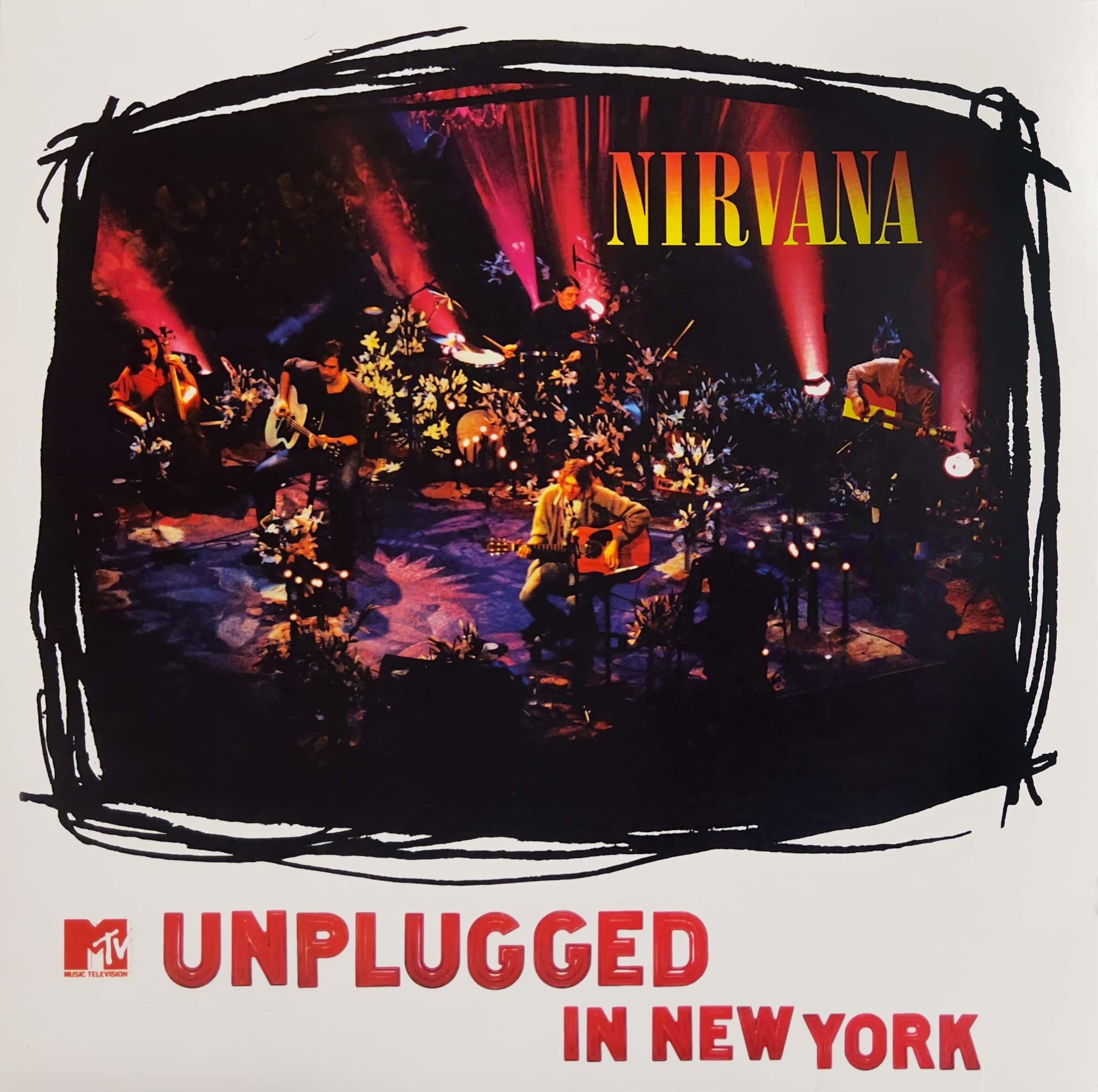
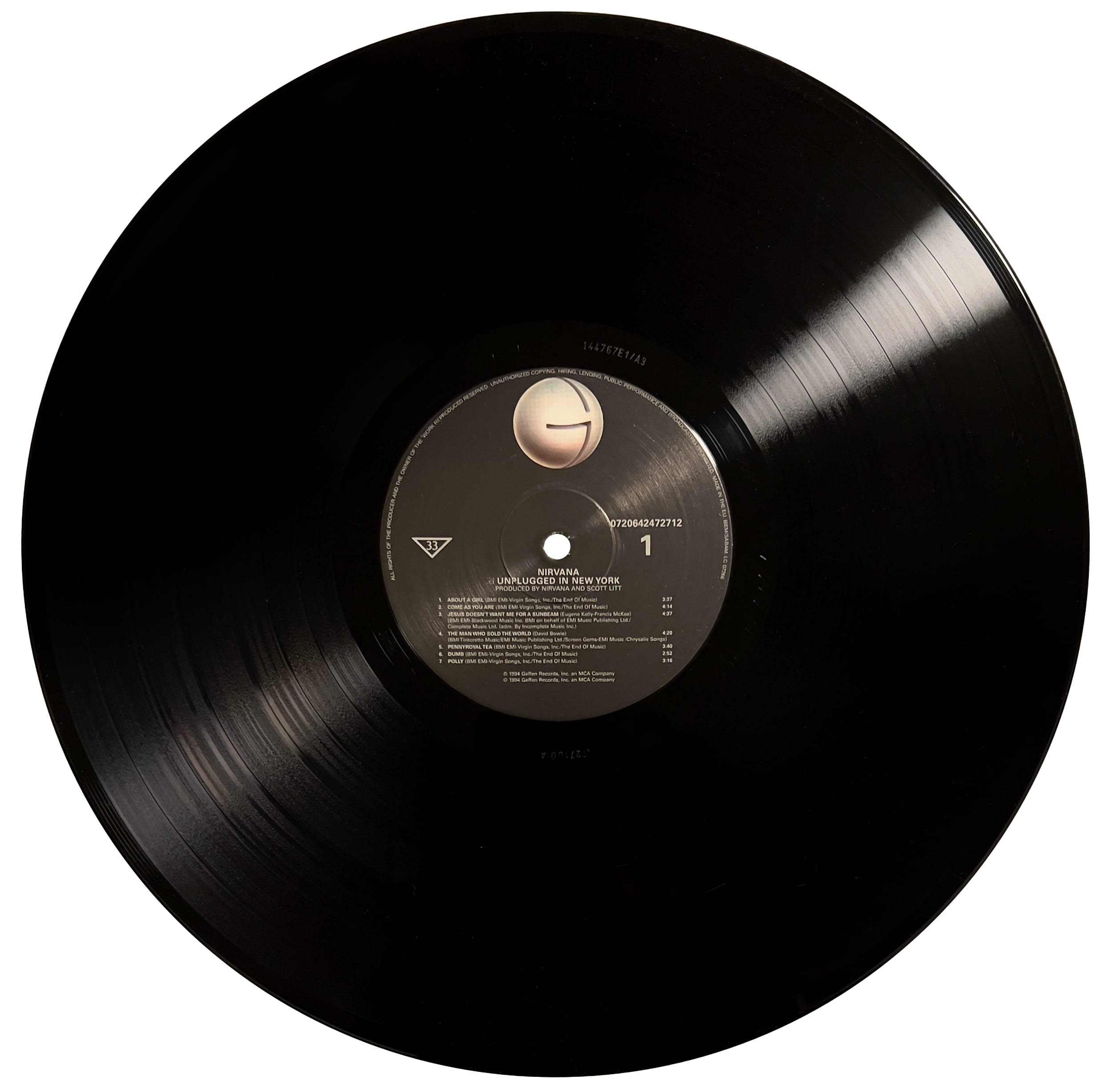
Regarding the sonic qualities of the recording, MTV Unplugged In New York has been reissued numerous times, especially on physical formats. While I’ve been fortunate to own the 2008 vinyl reissue, this particular release isn’t as stunning as the Lossless Apple Music stream. The mastering simply sounds off. While Cobain’s vocal is front and centre, the instrumental backing is somewhat compressed and shriller than on the lossless stream. Additionally, you don’t get the sense that the band is in the room with you when listening to the vinyl counterpart; an aspect that is most certainly present on the Apple Music stream. In essence, if you choose this particular vinyl reissue, you’ll experience this performance via your speakers rather than being enveloped in the performance itself.

While I acknowledge that other vinyl releases, based upon reviews, suggest sonic superiority, it’s a case of once bitten, twice shy. Plus, when the Apple Music stream simply sounds right, with a more solid mid to low end, even I have to acknowledge that sometimes that is more than enough. 

Granted, the artwork is far more impressive on the physical counterpart and while it is a solid reproduction, there are flaws. If you take a closer look, you’ll notice the photos are softer than they ideally should be. Admittedly, the original artwork was compiled during the height of the CD era and we can subsequently assume that this reproduction has been done by merely enlarging the graphical elements. Yes, a vinyl edition was released in 1994, but without having one to compare it to, I can’t say if that original release is better than this reissue. While it isn’t a major problem, it’s one that every music-loving vinyl collector needs to be aware of for the format isn’t only just about that warm analogue sound. 

While there are a couple of different versions of the MTV Unplugged In New York performance, particularly following the 25th Anniversary reissue, this review will focus on the original track listing from 1994; the one that’s present on the aforementioned vinyl reissue and Apple Music stream. 

About A Girl is the only song from MTV Unplugged In New York to be released as a single and it’s no wonder for it’s a killer song when performed acoustically. With a soft alternative pop/rock feel, I can’t help but think of The Beatles, particularly from a barebones instrumental and vocal standpoint. The original, from the 1989 release Bleach, is somewhat similar and as much as I adore that recording, this live rendition surpasses it. It’s a simple case of Cobain's vocal delivery leaving me speechless when performed live. What an incredible talent!

Come As You Are, from Nevermind, is a mellow wonderland and while I adore the original studio recording, this live performance, similar to About A Girl, takes the song to another level.

Jesus Doesn't Want Me For A Sunbeam is a valued addition to their repertoire and is significantly better than The Vaselines’ edition titled Jesus Wants Me for a Sunbeam. No, it isn’t the strongest song in the lineup, but it works well within the structure of the performance. 

The Man Who Sold The World is an incredible David Bowie cover and while Bowie’s version is magnificent, in its own right, Nirvana further refined it and made it just as much their own as a homage to the originator. Due to the guitar styling of the original song, it becomes obvious why Cobain was compelled to use the fuzz box during the recording. While it may have fallen outside the parameters of the acoustic performance, there is no doubt that it is better for its inclusion. The result is an exceptional rendition of The Man Who Sold The World.

Pennyroyal Tea, from In Utero, is a Cobain vocal masterpiece. This is yet another example of where the MTV Unplugged performance surpassed the brilliance of the studio recording. 

Dumb has all the groove and rhythm of the original, as heard on In Utero, yet this performance takes the song to heavenly heights previously unheard on the studio recording.

Polly, from Nevermind, is an incredible song that is perfectly suited to the unplugged ethos of this performance, despite my preference for the studio recording.

On A Plain, from Nevermind, is far greater performed unplugged than it is on the critically acclaimed 1991 release. Yes, the style and intent are slightly different, but On A Plain further validates how well-suited Nirvana’s music was to being performed acoustically. 

Something In The Way, from Nevermind, is one of the most beautiful Nirvana songs ever recorded. While nothing could ever beat the original studio recording, this performance is utterly exceptional and brings a smile to my face every time I hear it.

Plateau, the first of three Meat Puppets covers, is musical perfection! The intermix of the instrumental backing and Cobain’s vocals reminds me fondly of Neil Young's style in the 70s while the original Meat Puppets recording has a Beck feel to it. Either way, it’s a great song and I’m so glad that Nirvana chose to cover it.

Oh Me is one of those tunes that didn’t immediately grab me. Yet, intriguingly, I don’t know why, for the song and the performance are both excellent. The Meat Puppets’ original recording is thoroughly enjoyable and while I don’t have a preference per se, there’s always room for various interpretations. 

Lake Of Fire is one of the greatest songs Nirvana ever recorded. Yes, it’s a cover, but the song suits Cobain’s vocals so well that I dare say this is the only version you need to listen to. 

All Apologies has a killer groove but I’ve always preferred the studio recording as it’s the perfect closer to Nirvana’s final album. On In Utero, the mix and associated wall of sound best this live performance with regard to giving the song a sense of presence that I feel is missing on the MTV Unplugged edition. 

Where Did You Sleep Last Night, is the Leadbelly cover I alluded to earlier and what a way to close out this performance. While the original recording is iconic, as it pertains to the history of recorded music, as far as I’m concerned this is Cobain’s song for no one has done it better and I doubt anyone ever will. 

Nirvana's MTV Unplugged In New York isn't just an exceptional live album, it is the quintessential Nirvana album; one that should be in every fan’s collection. It’s also unique in that it isn’t just a collection of well-known tunes performed live as it offers a different perspective into a band that was creatively greater than their acclaimed three-album run, between 1989 and 1993, would suggest

Aaron Neville – Warm Your Heart (Album Review)

Aaron Neville – Warm Your Heart (Album Review)

Aaron Neville has long been one of my favourite artists ever since I heard his exceptional collaboration with Kenny G on Even If My Heart Would Break from The Bodyguard Soundtrack. Since then, I've always listened out for Neville's uniquely soulful vocals as there really isn’t anyone quite like him. 

Released in 1991, Warm Your Heart is arguably Neville’s greatest musical achievement. Of course, Neville will warm your heart with this incredible release, but finding a definitive edition proved to be challenging. 

Warm Your Heart had, of course, been recorded, mixed, and mastered with kid gloves, but I always found the original CD release to be a little less soulful than I’d like. It was a little shrill in places and a little too clean. The lossless CD-quality Apple Music stream similarly maintains the sonic brilliance of the recording, but the tonal warmth that makes this album so exciting and pleasurable to listen to was largely absent. Yes, that crisper sound signature may appeal to some listeners, but what I really needed was a vinyl copy with the warmth that only an analog format can deliver.

Unfortunately, I missed the 2013 vinyl re-issue by Original Recordings Group and while I had considered the SACD release, I decided that it was time to focus my attention on a singular format; plus streaming. Subsequently, when Analogue Productions reissued Warm Your Heart in 2020, I simply had to pick up a copy as it was one of my holy grail records. 

The attention to detail that Chad Kassem’s Analogue Productions put into this release is beyond my ability to express in words for it has to be held and played to be believed. Yes, this release has a hype sticker that promises this and that but in this case, you can believe every word printed for this is how vinyl should sound. Detailed, smooth, and enveloping with an incredibly low noise floor ensuring that you will be swept away with the music. While it’s audacious to proclaim that this is how the artist intended it, I can say without a doubt that I’ve never heard the album sound better.  

Pressed at Kassem’s Quality Record Pressings pressing plant, Warm Your Heart is delivered across four sides having been pressed at 45rpm. Yes, it could have been a 33.3rpm release, as the original LP had been, but the track structure and overall flow of the album don’t suffer from a sense of repeated flipping. Perhaps it is that the music is so enjoyable, and the quality is beyond reproach, but despite a shorter runtime on each side, this is one 45rpm record that doesn’t make me feel as if I’m getting up and down continuously. 

As with many albums re-issued on audiophile labels, the music isn’t the only thing that is exceptionally well done. The tip-on gatefold jacket by Stoughton Printing is a piece of art in and of itself and while it adds considerable weight to the overall package, this Analogue Productions release is built to last a lifetime as it benefits from additional rigidity. The inner gatefold opens to display the liner notes, sans lyrics, in a highly legible font; an appreciable element for my ageing eyes. 

Naturally, both records are presented in the highest quality anti-static inner sleeves and are so flat, and pitch black, that you’ll find yourself staring at them in awe. By now it should go without saying, but the record labels are perfectly centred and presented beautifully. This is most certainly a quality release and while you’ll pay a premium, if you love Warm Your Heart as much as I do, it is worth the investment for no other reason than I’ve found audio nirvana and no longer need to search for a better version. 

Louisiana 1927 is a perfect introduction to the body of work that is Warm Your Heart. Written by the incomparable Randy Newman, his sonic cues are most certainly present throughout, but it is the historical story of the Great Mississippi Flood of 1927, from the perspective of an unknown individual, that makes this a moving lament. Newman recorded it himself in 1974 and while Neville’s version is similar, Neville took it to new levels. It isn’t that Newman’s version is lacklustre, but Neville made it his own and his alone is the definitive recording of this beautiful song. That said, Russell Watson, Gary Brown, and Marcia Ball have all performed it beautifully within their respective vocal range. 

Everybody Plays The Fool has a fantastic mix of soul and funk and Neville presents a smoother interpretation than The Main Ingredient’s original recording. Of course, I would have loved to have heard Bob Marley record this tune as there’s a definite reggae groove lurking just below the surface but as that never happened, to my knowledge, Neville’s is the best interpretation of this song to date. 

It Feels Like Rain is simply gorgeous. Just listen and you’ll hear incredible musical layering with every element being transparent, ensuring nothing is concealed. This is how music should sound!

Somewhere Somebody has a killer groove that is perfectly recorded. Topically the search for love is highly relatable but at no time does Somewhere Somebody come across as your typical clichéd love song, it’s much more than that. Take a listen for yourself and you’ll understand what I mean.   

Don't Go Please Stay is a beautiful song with a gorgeous classical choral overlay. That said, I don’t like the audible jolt when the song starts following Somewhere Somebody, but that is a minor quibble as all is forgotten as the song moves through the first verse. 

With You In Mind is astonishingly good. Allen Toussaint wrote a masterful song and Neville, as is the case throughout Warm Your Heart, makes the song his own. Although, if you have the time may I suggest you give Toussaint’s original recording a listen; it’s that good and I really can’t decide which version I prefer, not that I really want to make that determination anyway. 

That's The Way She Loves is one of the greatest songs ever written and recorded, by any artist. As with With You In Mind, Allen Toussaint also penned this tune and Neville and co made it a masterpiece. That's The Way She Loves is so compelling, from a musical perspective, that it is one of those songs that I use to audition new gear because I know exactly how I would like it to sound and therefore it assists me to make sure that any investment is an improvement. 

Angola Bound is a little jolting after That's The Way She Loves. Thankfully, due to the 45rpm pressing’s need to flip, the shift between songs is less noticeable but if you’re streaming you’ll definitely notice it. It isn’t that Angola Bound is a bad song, it is just poorly positioned on the record. If I were doing the tracking, I’d likely have placed Angola Bound after Everybody Plays The Fool.

Close Your Eyes is a beautiful duet with Linda Ronstadt. Ronstadt was also the producer of the album and she did a fantastic job in my opinion. While Close Your Eyes doesn’t compare to Don’t Know Much, it’s wonderful that these two master musicians collaborated on more than a single song for they’re so perfectly matched. Of the numerous other renditions of Close Your Eyes, the only one that comes close is that recorded by Earl Lewis and The Channels in 1973. It’s perfect for the era it was recorded in but Close Your Eyes is another example of Neville taking a lovely tune and, with the help of Ronstadt, making it a timeless classic.

La Vie Dansante is a lovely tune, with a Caribbean style, and exceptional backing vocals that complement Neville’s lead vocal perfectly. 

Warm Your Heart is a solid track, but perhaps not one to write home about. It suits the album well, however, but I don’t believe it was strong enough to be the title track.

I Bid You Goodnight is a beautiful vocal-focused ballad that is amplified significantly by the magnificent intermingling backing vocals; a perfect mix.

Ave Maria needs no introduction. Neville pays respect to the song, and its legacy, and despite being covered by some of the very best vocalists the world has ever heard, Neville’s version would undoubtedly be in my Top 10.

Streaming Bonus Track:

House On A Hill is a toe-tapping, head-bopping, song that is slightly jolting following the relaxed nature of Ave Maria, but it is so good that I don't mind the shifting style. However, I am happy to report that it wasn’t included on the vinyl release as I feel Ave Maria is the perfect closer for Warm Your Heart. Similarly, it wasn’t featured on the original CD release but as a streaming-only and CD-reissue addition, I consider it to be a value-added proposition for fans. 

Warm Your Heart is superb from start to finish and should be in every music lover’s collection. If you can, I’d encourage you to pick up the Analogue Productions re-issue, but rest assured that this album is so good that it doesn’t matter which format/method you choose to enjoy it via; it’s a masterpiece! 

Julian Lennon – Photograph Smile (Album Review)

Julian Lennon – Photograph Smile (Album Review)

Julian Lennon’s Photograph Smile, his fifth studio album, is one of the greatest pop/rock albums ever recorded and remains a timeless masterpiece. Yes, some would reflect on Lennon’s musical approach and suggest that it is too similar to his father’s musical style, but I honestly consider Julian Lennon to be completely independent of John Lennon and while there may be correlations I’d argue that Julian’s musical prowess on Photograph Smile is superior to his father’s and that is coming from someone who is in awe of John Lennon and his legacy. 

Day After Day is a fantastic tune, but the abrupt opening has always irritated me, for you’re not necessarily expecting it. Nevertheless, it’s a great start to the album and is a lovely composition that will have you toe-tapping and head-bopping throughout. There’s also a little guitar element, around the 3-minute mark, that reminds me of Lynyrd Skynyrd’s Free Bird

Cold has an incredible soundstage and the level of vocal and instrumental distortion is absolutely perfect. The tempo is well suited to the song and the included acoustic guitar is simply beautiful. Without a doubt, Cold is one of the best songs on the album!

I Should Have Known is one of the many songs on Photograph Smile that I know by heart and never tire of. The chorus compels me to sing along; an activity that I find myself doing throughout the entire album. While it suits the mood of the song, if there was one criticism to be made it would be that the muddiness in the lows can be a little distracting when listening via headphones. 

How Many Times is a great song but if there was one tune that I’d skip when listening to the album, it would likely be this one. It’s arguably longer than it needs to be and doesn’t push the creative envelope far enough to stand out from most of the pop/rock songs from the era. That said, the meaning behind Lennon’s lyrics here is admirable and when listening from that perspective, one can have a different opinion. 

I Don’t Wanna Know is a fun track and sometimes that is all you need. 

Crucified is a little left of the centre when compared to the tracks that preceded it. It’s sonically bold, perhaps a little too bold, but if you can get past the stylistic shift, it isn’t a bad tune. 

Walls is simply beautiful. 

Believe is perfectly suited to closing your eyes and allowing your body to flow back and forth to the rhythm. It’s hypnotic and utterly addictive.

Good To Be Lonely is a lovely song.

Kiss Beyond The Catcher is a cool tune with arguably one of the most interesting song titles I’ve ever come across. 

And She Cries is one of my favourite songs on Photograph Smile; a song that I could listen to on repeat for hours as Lennon’s vocals are absolutely perfect on this recording.

Photograph Smile is hauntingly beautiful as it’s musically stripped-down allowing Lennon’s incredible vocal to sit prominently in front of, and on top of, the music. This is what good music should sound like.

Faithful flows perfectly from Photograph Smile and is another beautiful song with a lovely connotation. Gemma Hayes’ backing/duet vocals here are also magnificent. 

Way To Your Heart is a great closer, compelling me to listen to the album again, but the faux vinyl record surface noise only reminds me that Photograph Smile was never released on vinyl and while I have my fingers crossed for a one-off vinyl pressing, it’s likely wishful thinking on my part.

Photograph Smile may not have been wildly successful when it was released, but if commercial success was the ultimate indicator of quality music, then art as we know it has no future. Photograph Smile is truly a hidden gem and would be a welcome addition to any music lover’s collection as it is Lennon’s greatest musical achievement. Hence, if there’s only one Julian Lennon album that you add to your collection, make it this one. 

Aerosmith – Get A Grip (Album Review On Vinyl, CD & Apple Music)

Aerosmith – Get A Grip (Album Review On Vinyl, CD & Apple Music)

It was 1994, the Grammys were playing on television, and Aerosmith came out on stage and performed Livin’ On The Edge. In my mind, it was a faultless performance and while I know that I can re-experience it on YouTube, I don’t want to. Something as powerful as this first exposure, that would result in a life-long love of Aerosmith’s music, should be left to my interpreted memory and not toyed with.

Memories of this performance, and the album Get A Grip, came flooding back recently when my son decided that he wanted to go through my CD collection and find an album to listen to. I said nothing, didn’t encourage him either way, and he selected Aerosmith’s Get A Grip; it was a proud parenting moment.

As a music-loving father, I try to ensure that my library of music is always accessible. I don’t believe in taboos and while this album isn’t overly explicit, it is Aerosmith. Everything is an innuendo. I also believe in the freedom of artistic expression and subsequently have never purchased a ‘clean’ version of any album. I know many people are opposed to profanity, but I strongly believe music is art, hence a ‘clean’ version is akin to an abridgement of the artist’s original intent. I also feel that it is better to have questionable subjects raised in the home, rather than in the controversial and often erroneous schoolyard. While my son may be naive with regards to many of the innuendos, laughing when Tyler speaks the words ‘come here baby’ on Crazy, I want him to know that through our shared love of music, he can come to me and discuss song meanings as he begins to understand more adult-based themes.

For the moment, however, he is content to play his air guitar when listening to Livin’ On The Edge and laughs contagiously when Eat The Rich concludes and the burp is heard at the very beginning of the following track. I’ve no doubt they programmed the CD to play the burp at the beginning of Get A Grip, rather than at the end of Eat The Rich, to ensure we would all keep hitting the back button. This morning I played it really LOUD on my main system. The house rumbled to, I assume, Steven Tyler’s guttural belch and while I haven’t taught my son to burp the alphabet, this was a priceless father-son moment. Thank you, Aerosmith!

Speaking of the CD, it is glorious to behold for the liner notes are extensive with associated artwork that is slightly more extended than the vinyl counterpart. Yes, the CD artwork, on the disc, is a little risqué but it’s not like Aerosmith has a clean-cut image to uphold. 

Sonically, the CD is flat and brittle, meaning that it is challenging to listen to for long periods as it simply lacks the kind of emotive energy that will captivate you. The clarity, however, is incredible, but I look for fullness of sound. I want to hear fat riffs and feel every drum beat and the CD just sounds a little too thin. Comparing it to the Apple Music Stream, an Apple Digital Master, it is smoother and more dynamic, yet I still wouldn’t say that this edition blows me away. Does it sound better than the CD to my ears, yes, but how does it compare to the 2017 vinyl re-issue that I’m fortunate to own? 

The vinyl reissue is superior in sonics to both the CD and streaming editions, as it has a greater sense of emotive energy that will get your body moving involuntarily. It also has a fuller sound, which is most likely due to the inherent distortion of the format, but it simply sounds right. The brittleness and absence of flatness are no longer present but the overall muffled sound of the recording can be easily heard across all versions. It is as if someone turned on Dolby NR (Noise Reduction) in the recording and mastering process. That’s not necessarily a negative aspect, but if you’re looking for a cleaner, or clearer, reproduction, I’m honestly not sure one exists for these three editions offer a good overview of the different tonalities available across each format. As to which you prefer, that will be to your own subjective preferences. I find that I can comfortably enjoy the Apple Music stream, but my preferred version is the vinyl release. The CD, I’m sure, would sound fantastic on a less revealing system but as it is, it is just a little too clinical for my music tastes. 

As for the vinyl packaging, it’s presented in a slipcover where both records’ inner sleeves are also the associated liner notes. It’s impressive to hold and is one of those albums that I find myself as captivated by the packaging as I do the music itself. Unlike some vinyl releases, the design here is fantastic as the text and overall layout is perfectly sized, meaning that you won’t just put the album aside, but enjoy it for what it is; a piece of art. 

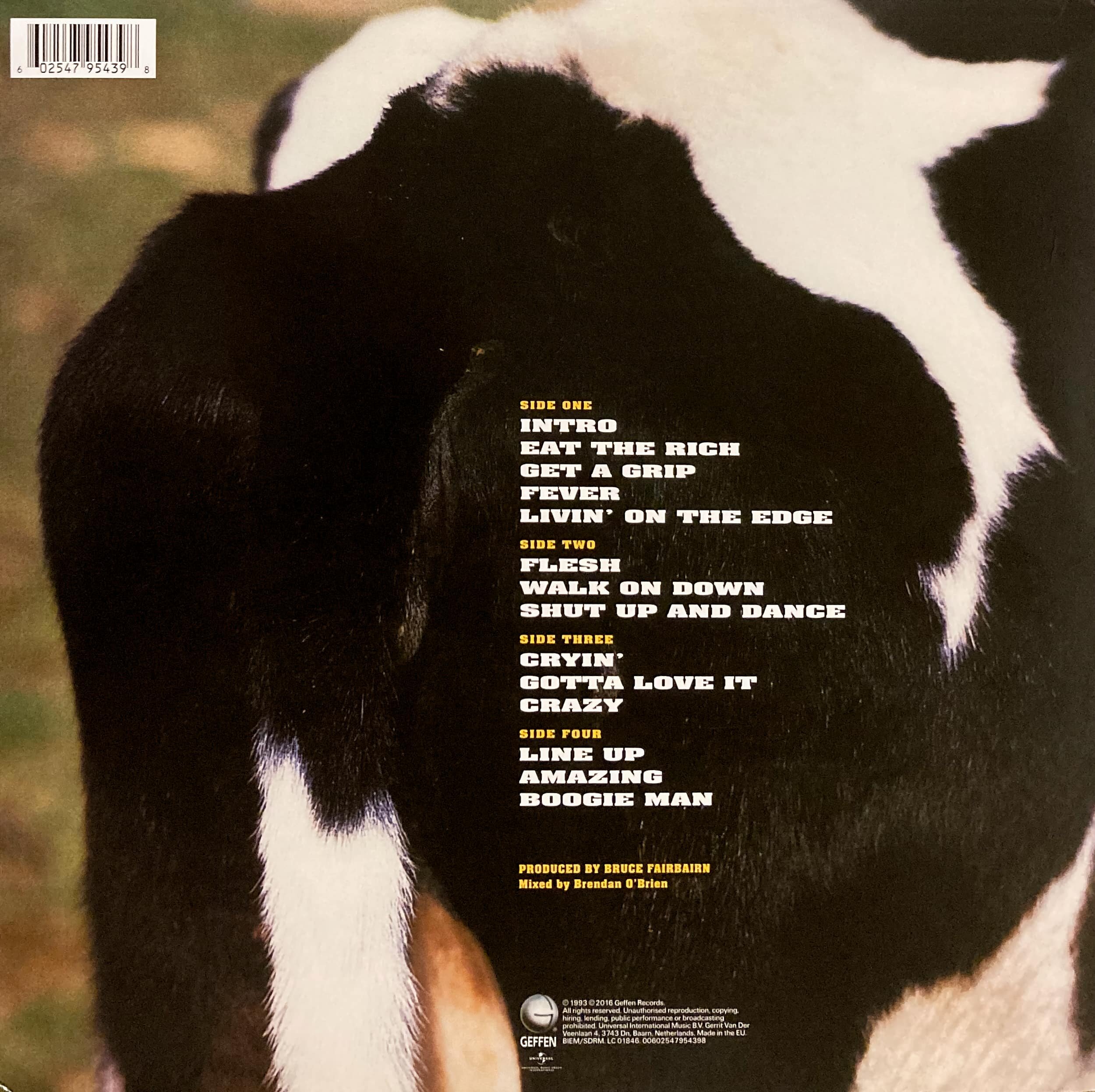
The records are similarly magnificent. They’re flat and the noise floor is incredibly low. You’re really only going to hear the dead wax with headphones, or if you tend to turn the stereo up so loud that you annoy your neighbours. They are, for lack of a better term, flawless. Even the way the records have been cut impresses, for a song like Livin’ On The Edge should, as the final track on Side One, suffer from a little inner groove distortion, but it doesn’t as the record has been pressed well within the threshold, meaning that this killer song isn’t tarnished by the format’s limitations. Side 3, ending on Crazy, is similarly pressed and while it may be a little thing, these elements are important to music-lovers who choose vinyl as their format of choice. Nothing is more disappointing than putting on a record that sounds superior to other formats, only to be disappointed towards the end of each side when inner groove distortion can rare its ugly head. 

SIDE ONE

INTRO is self-explanatory, but I’ve heard worse album openings. That said, it wouldn’t be far-fetched to suggest that the Intro could have been merged into Eat The Rich. 

EAT THE RICH is witty with a great sense of rhythm that will likely see you singing along throughout the chorus. Plus, who doesn’t love that guttural burp at the end?

GET A GRIP is a killer rock tune, but I’d love to hear Tom Hamilton’s bass guitar be a little more prominent in the mix as it's the driving force behind the rhythm of the song. 

FEVER lacks cohesion for Get A Grip, yet it would have been perfect on Permanent Vacation. Despite that, it’s a solid tune. 

LIVIN’ ON THE EDGE is one of Aerosmith’s greatest and one of my favourites.

SIDE TWO

FLESH is utterly brilliant; that is until the chorus kicks in. Flesh is one of those songs where the verse structure is perfect but the chorus is a letdown. A shame, for I want to love Flesh, but find it is just too distracting. That said, the smoother nature of the vinyl edition means that it is a little less jarring on the senses and subsequently can be enjoyed when listening to the album via this format. 

WALK ON DOWN is classic Joe Perry as it reminds me of much of what I love about The Joe Perry Project. As an Aerosmith song, it works perfectly with the other songs on Get A Grip and is one tune that I feel should have got more attention than it did.

SHUT UP AND DANCE is lyrically brilliant as the double entendres will put a smile on your face. Musically, it features some of Brad Whitford and Joe Perry’s best guitar tracking on the album; fantastic!

SIDE THREE

CRYIN’ is one of Aerosmith’s best power ballads and one of the greatest blues-rock tunes they ever recorded. 

GOTTA LOVE IT says everything that needs to be said in the title. You gotta love it for it just works. While you’ll never find Gotta Love It on a career perspective release, or an Essentials Playlist, I’d add it to a playlist of the very best Aerosmith songs that you’ve never heard before. It has a little bit of everything and is what I’d consider to be quintessential Aerosmith.

CRAZY as a power ballad works extremely well. The chorus is catchy, you’ll likely sing along, and it is just corny enough to be considered a classic power ballad. 

SIDE FOUR

LINE UP has an addictive energy that will see you head-bopping and toe-tapping from the first note.

AMAZING is a ballad masterpiece. It’s amongst Aerosmith’s greatest recordings and helps to close out Get A Grip perfectly. 

BOOGIE MAN as the final track on Get A Grip is interesting, for it is arguably not needed, yet as I have heard this album countless times, over the years, I wouldn’t want Get A Grip to end without hearing Boogie Man; a great tune in its own right, even if its inclusion is questionable. 

Overall, Get A Grip is a fun album to listen to and has a groove that is reminiscent of the classic 70s Aerosmith style while also being uniquely modern to their 90s sound. It’s a rock masterpiece that has stood the test of time and is just as compelling today, as it was when released in 1993.

AC/DC – Ballbreaker (Album Review On Vinyl, CD, and Apple Music)

AC/DC – Ballbreaker (Album Review On Vinyl, CD, and Apple Music)

AC/DC first appeared on my radar when the band released The Razors Edge in 1990. At the time, a friend of mine was a walking encyclopedia on everything AC/DC and he quickly convinced me that they were the band! It is a proud parenting moment to acknowledge that this admiration and influence has now been bestowed on my son and he tells all who will listen about the greatest rock and roll band in the world: Acca Dacca.

While it would be close to a decade before I owned a copy of The Razors Edge, I did pick up the second single, Hail Caesar, from their 1995 release Ballbreaker. The Hail Caesar CD single also featured Ballbreaker’s B-side Whiskey On The Rocks and a live performance of Whole Lotta Rosie from their European tour in 1991. Both songs were excellent additions to the single. The version of Whole Lotta Rosie was labelled as a previously unreleased recording, hence not part of the 1992 Live album. Thus, collectors would be advised to grab a copy of the single to secure this recording.

However, it is fair to say that the AC/DC fan base didn’t lose their collective minds when Ballbreaker was released. While nothing could topple the success of Back In Black and The Razors Edge, Ballbreaker had modest sales success and is often viewed in the same category as Flick Of The Switch and Fly On The Wall; valued and essential interim albums, but not their most adored. Subjectively, I have found that I am often drawn to the less successful albums in their catalogue. 

Alongside the Hail Caesar CD single, I picked up this masterpiece on cassette. At the time, my Sony Cassette Walkman (WM-FX507) was a constant companion and while I could have created a mixtape, I preferred to collect the retail releases of cassette albums as the liner notes were often redesigned and unique when compared to the LP or CD counterpart. Thankfully, the Ballbreaker cassette was not a disappointment as the comic-based graphic design, was reimagined throughout the foldout liner notes and was simply gorgeous. This is one aspect that I truly miss in the modern era and while the vinyl revival has brought album artwork back to the forefront of the music listening experience, the unique presentation of the compact cassette, when done properly, is sorely missed. Now, if we can only get liner notes on all streaming services and digital stores I would be happy. 

While I am aware that the Apple Digital Master edition of Ballbreaker contains an iTunes LP, the iTunes LP feature is still restricted to playback on a Mac or PC and is no longer being supported, for new releases, by Apple. A shame considering the concept bridges the gap between the tactile physical release and the digital equivalent thereby allowing everyone to have a similar experience. I honestly have never understood how Apple could not have implemented iTunes LP in devices such as the iPhone, iPad, or Apple TV thereby creating a seamless experience as they do with films. In my opinion, it is a missed opportunity and would have set iTunes and Apple Music apart from the competition. Regardless, at least you can still purchase the AC/DC releases in iTunes LP but be wary as one must question just how long these releases will continue to be supported on the Mac and PC. 

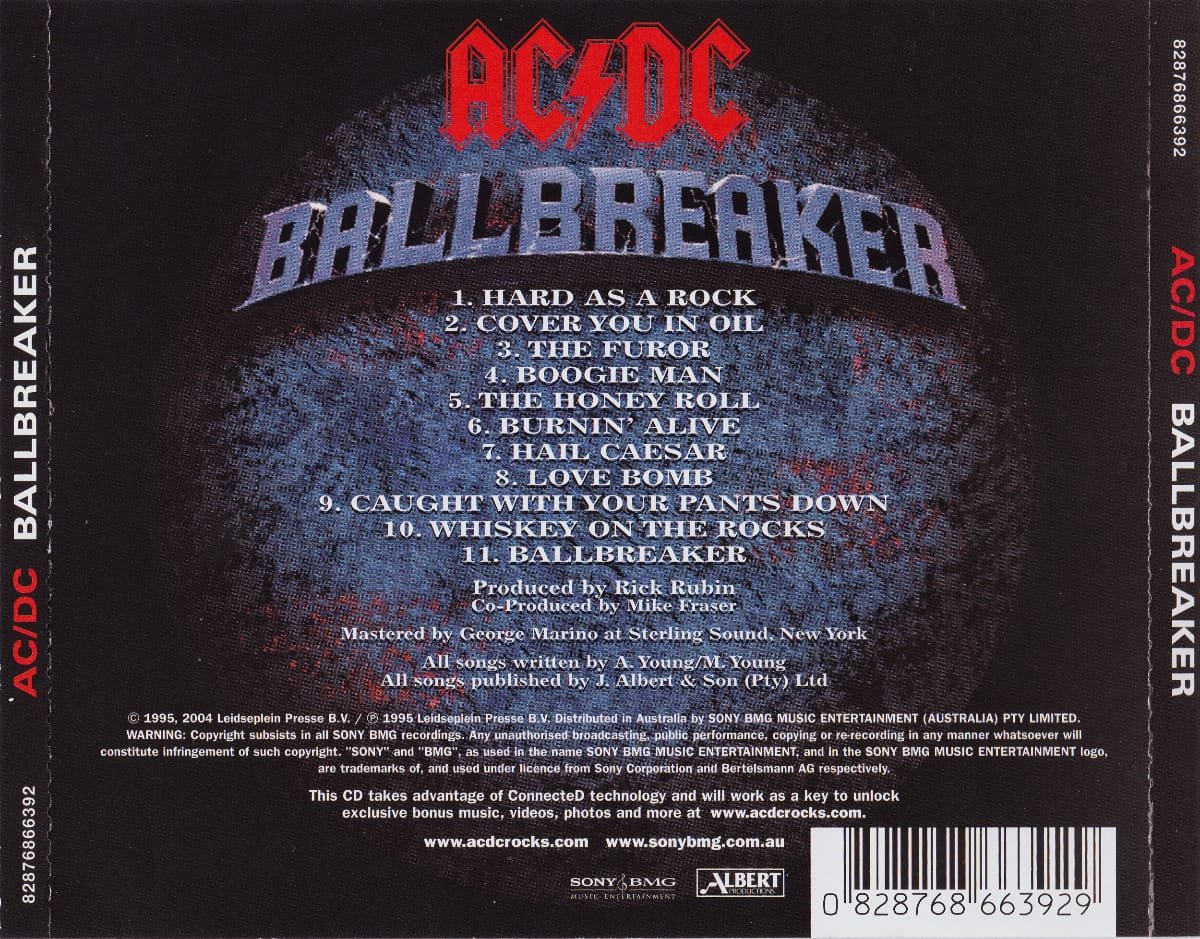
Speaking of LP-sized artwork, the 2014 vinyl re-issue of Ballbreaker is spectacular to hold, although the lyrics that were present with the original Vinyl, CD, and Cassette release are missing from both the LP liner notes and the 2004 CD reissue. One could argue that the write-up and reflection are better suited in retrospect, but I know many who would lament the absence of lyrics. I do, however, enjoy the newer liner notes and the series of live photographs and graphic illustrations from the original release but it would have been great if the liner notes in these reissues had been further expanded to include the lyrics.

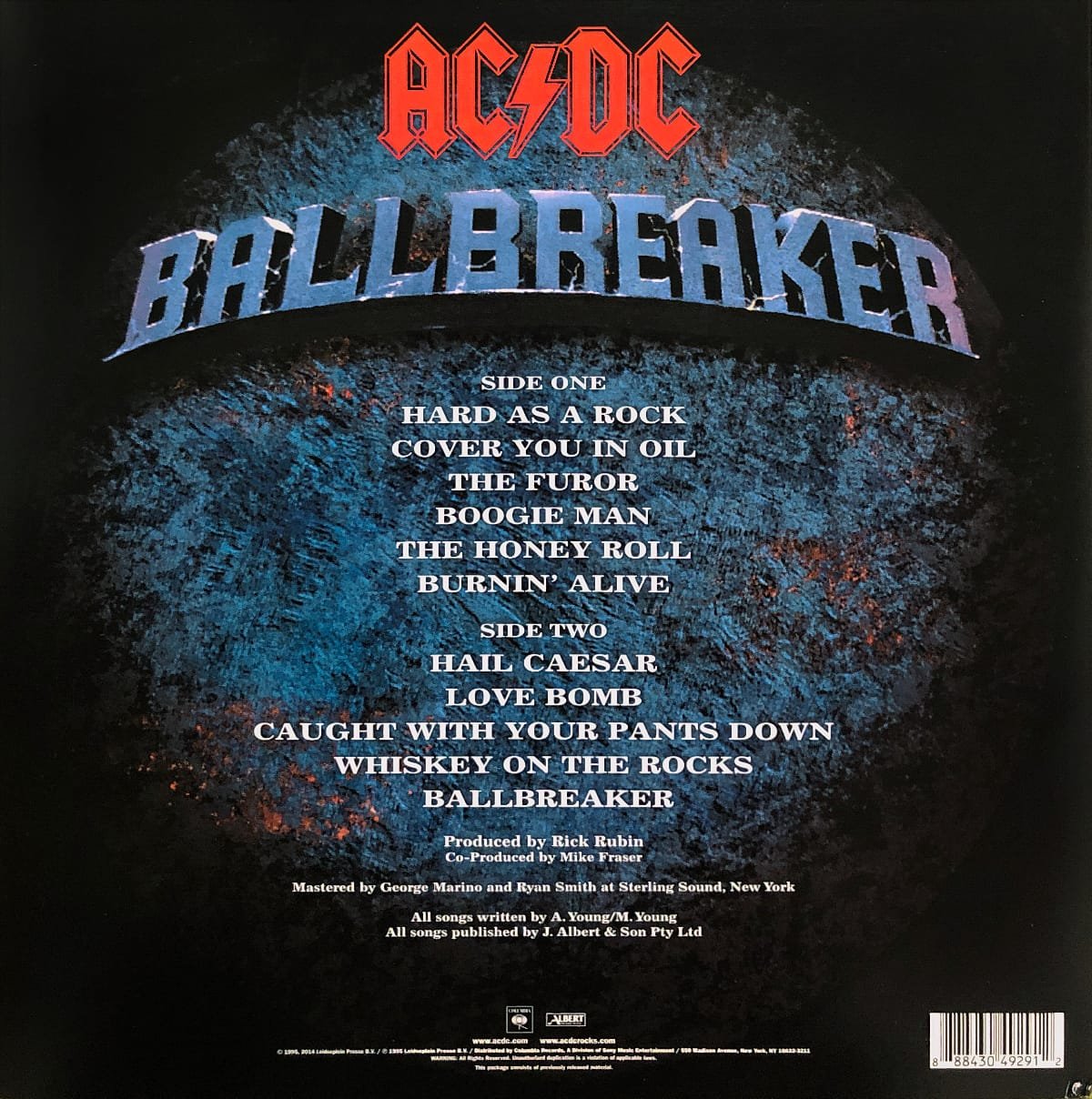
What has remained the same, however, is the Ballbreaker cover; one of AC/DC’s best and most striking. That said, Stiff Upper Lip is my all-time favourite. While the rear cover is bland, it serves a purpose and does not include anything that doesn’t need to be there. Plus, my ageing eyesight is grateful for the larger typeface as so many releases choose the smallest possible fonts for seemingly no good reason, other than design aspects, when it comes to the track listing and liner notes in general. 

While I have never owned the original vinyl releases of AC/DC’s catalogue, the remastered reissues, mastered at Sterling Sound by George Marino and Ryan Smith are a true gift to AC/DC fans. The pressing is silent and is one of the better rock and roll re-issues with deep bass lines, clear vocals, and a guitar track so pure that you would swear the band was in the room with you. Yes, dear reader, that experience also translates to the CD and Apple Music counterparts. Other than the analogue warmth, you’re getting exactly the same sonic presentation across all formats. Yes, the vinyl edition increases the dynamic range but let’s be honest, this is AC/DC and as long as you can rock out and turn the volume to 11 then the dynamic range is of little importance. In my experience, the digital editions that are technically in the red sound as good, if not better, than the more dynamic vinyl reproduction. That may seem to be a counterintuitive argument as brickwalling can kill a good record, but this isn’t brickwalling in the traditional sense as you’re not missing out on any sonic elements. The hi-hats shimmer, the bass is where it needs to be, and Brian Johnson’s vocal is clearer and cleaner than ever. 

Long time readers would note my love of vinyl, but if you get a chance, don’t ignore the CD counterpart for it is really something special. For those of you that prefer to stream their music, the good news is you’ll thoroughly enjoy a near-transparent to the CD reproduction via the Apple Music stream as this is an Apple Digital Master done right. 

Hard As A Rock is, without a doubt, one of the best tracks to start any rock and roll album on. It sets the tone immediately with AC/DC’s renowned sound signature and innuendo-filled lyrics. The rhythmic blues-infused rock and roll sound is addictive and while many naysayers will complain that AC/DC plagiarises their own work, at least you know what you’re going to get.

Cover You In Oil has an incredible slower tempo that I adore and feel it is a precursor to the styling on Stiff Upper Lip; one of AC/DC’s best albums in my opinion. 

The Furor has a killer guitar intro that builds into an epic song. However, I feel Brian’s lyrical delivery is strained and his magic is subsequently missing on this song. It could also be the mix, but it just doesn’t sound right to me.

Boogie Man is groovy!  

The Honey Roll offers the perfect mix of rock and roll and blues. Every element, from the rhythm section to the lead guitar and vocals is textbook perfect. It doesn’t get much better than this.

Burnin’ Alive simply doesn’t resonate with me in its current position on the album. While I won’t stop the record prematurely, or skip the song, it is distracting. It isn’t fundamentally bad, just poorly tracked. 

Hail Caesar is, arguably, the reason I’m an AC/DC fan. The song subsequently holds a very special place in my heart. It’s also one of their hardest hitting songs on the album and one that could make a stadium audience sing in unison. Angus’ guitar solo is off the charts and Brian’s vocals are also perfect insofar as I can understand the words he’s singing, outside of the chorus. While he doesn’t slur his words, I have found that his vocal clarity can get lost in the music as a result of his natural growl. 

Love Bomb reminds me of the 80s hair metal scene. The song is great, but the association is a little disconcerting.

Caught With Your Pants Down is classic AC/DC.  

Whiskey On The Rocks is a favourite of mine, most likely due to the excessive number of times it was played on the Hail Caesar single. Isn’t it amazing how songs can grow on you if you listen to them enough? That said, listening to a song too often can make you hate a perfectly good song as well. In retrospect, perhaps that is why I have formed a love/hate relationship with Whole Lotta Rosie, yet in a cruel dichotomy, I never tire of Thunderstruck.  

Ballbreaker closes out the album with a song that has ‘stadium anthem’ written all over it. As all closing tracks should, it encourages me to listen to the album again and stay within AC/DC’s extensive catalogue.

While Rick Rubin is likely responsible for the raw sound found throughout Ballbreaker, it’s fantastic to have an AC/DC album that truly highlights the building blocks of rock and roll music; the blues. While AC/DC explored this sound further, without Rubin, on the Stiff Upper Lip album, it is a style that I subjectively appreciate and one that highlights the musical influences and origins of one of the greatest rock and roll bands the world has ever seen.

My only disappointment with Ballbreaker is that Big Gun (also Rubin produced) wasn’t included on the album as it was only recorded and released the year before. It is one of my all-time favourite AC/DC songs, and while I acknowledge that it was written and recorded for the Last Action Hero soundtrack, it would have made a perfect addition to Ballbreaker. Big Gun is another stadium-filling song that deserves to be turned up to 11.

While Ballbreaker may not be the first album fans go to when they think of AC/DC, it is an exceptional addition to their catalogue and one that should never be overlooked. As controversial as this may be, I’d take Ballbreaker over Back In Black any day of the week. 

Barbra Streisand – Higher Ground (Album Review)

Barbra Streisand – Higher Ground (Album Review)

Released in 1997, Higher Ground was Barbra Streisand’s twenty-seventh studio album and despite selling over 5 million copies, I completely overlooked this release at the time. Thankfully, due to the flexibility of streaming, I’ve been able to enjoy this masterpiece in recent years and consider it amongst Streisand’s greatest recordings as each song is worthy of inclusion. 

Listening via Apple Music, Higher Ground is presented as an Apple Digital Master; a mastering process that aims to deliver studio-quality sound. Even if I wanted to listen to the album via the CD-quality offered by TIDAL Hi-Fi, Higher Ground is sadly absent from that platform but as the Apple Digital Master often trumps the CD-quality stream, such an omission is only disappointing because it deprives music-lovers of experiencing all there is to offer from an artist’s collection. Nevertheless, the Apple Music stream delivers a soundstage that is enveloping, ensuring the album can be thoroughly appreciated as you get a sense of Streisand being in the room with you as the speakers disappear and you’re at one with the music.

I Believe/You’ll Never Walk Alone is a lovely melody-based opener that immediately captivates the soul from the very first note and highlights Streisand’s gorgeous vocal. That said, as much as I enjoy the melody aspect, both songs in their own right are exceptional, I wonder if the transition could have been a little more seamless as it almost sounds as if they are two separate tracks, just  without the 2-second pregap. 

Higher Ground is a stunning title track that is unassuming and thoroughly relaxing.

At The Same Time is a song I love, although I must admit that I would have left the children’s vocal choir out of the mix as it detracts from the musicality. Yes, I acknowledge the connection to the lyrical element, I just feel the mix wasn’t right. Perhaps it could have been corrected in the studio, but the choir’s inclusion simply sounds detached. 

Tell Him (Duet With Celine Dion) is an absolute masterpiece!

On Holy Ground is a beautiful song, but it could be argued that any song would have suffered following Tell Him. It is a case of incorrect sequencing, in my opinion, but I’m the type of person that would suggest a song like Tell Him would be best served as being the final song on the album as to not detract from any other song. 

If I Could is a lovely tune. 

Circle is simply magnificent and while I don’t normally appreciate music for its lyrical interpretation, instead considering the vocal as an instrument, lyrics are difficult to ignore in Streisand’s works as she pronounces every word so perfectly and the meaning behind the song is touching and remains even more relevant today than it arguably did when it was originally recorded. 

The Water Is Wide/Deep River is the second melody on Higher Ground and it doesn’t disappoint. 

Leading With Your Heart is another beautiful, unassuming, song and, if anything, Higher Ground represents a series of songs that are hidden gems and shouldn’t be overlooked. 

Lessons To Be Learned is one of Streisand’s greatest vocal performances. Yes, that could be said about so many of the songs she’s recorded over the years, but Lessons To Be Learned is a sonic joy, with a perfect mix, meaning that I often play Lessons To Be Learned as loud as comfortably possible as well as playing it on repeat. A stunning performance!

Everything Must Change is a lovely song, but there’s a little distortion in the right channel, especially noticeable when listening via headphones, that is distracting to this otherwise exceptional recording. I can’t say for certain where the distortion entered the mix as I question if it would have been overlooked in the original recording process, but the distortive element that occurs around 2:44 and again at 2:50 is also present on the Spotify stream. 

Avinu Malkeinu is a gorgeous Jewish prayer to close the album with, and while I have suggested that Tell Him would have been perfectly repositioned as the final song on Higher Ground, Avinu Malkeinu is worthy of its position and is arguably the perfect closer to one of Streisand’s greatest albums. 

Higher Ground is simply exceptional, without a B-side to be found. Having only become aware of this masterpiece in recent years, it has fast become one of my most treasured albums, for it really is that good. If you too missed checking out Higher Ground, remember that it is never too late to appreciate timeless classics such as this. 

DMX – …And Then There Was X (Album Review)

DMX – …And Then There Was X (Album Review)

Timeless is one word to describe DMX’s …And Then There Was X. Having sold over 5 million copies since its release in 1999, few Hip Hop fans would disagree as there isn’t a bad song to be heard on this Grammy-nominated album; well, the skits do alter the flow of the album and while some are hilariously done, I’ve always felt they detract more than they enhance a body of work.

Listening to …And Then There Was X via Apple Music and TIDAL Hi-Fi, the latter is preferred, but only slightly, as you get a greater sense of presence from the CD-quality stream. I don’t want to overstate it as it is a minor difference and those of you using Apple Music will enjoy that edition, but as I intend to find the very best editions of the albums I love, in this case, the TIDAL Hi-Fi stream reigns supreme. While I don’t have a physical copy of this landmark release, a vinyl reissue was released in 2016 that, at the very least, would be interesting to pick up as I’ve always adored Hip Hop via vinyl as the styling is perfectly suited to getting the most out of the format; provided it is mastered correctly of course. 

The Kennel (Skit) isn’t the worst opening to an album I’ve ever heard but thankfully it flows well into One More Road To Cross. 

One More Road To Cross is where …And Then There Was X really begins for me. It has a killer rhythm and the lyrical component is perfectly paced. Yes, dear reader, I don’t generally appreciate music for its literal interpretation and therefore I class the vocal as an instrument rather than a storytelling device. I know that may be counterintuitive when listening to Hip Hop as it is a genre that is very story-driven, but that just isn’t how I enjoy music.

The Professional shifts the tempo a little, but The Professional is magnificently smooth. It’s toe-tapping and head-bopping gold!

Fame is a great tune, worthy of pumping the volume for.  

A Lot To Learn (Skit) isn’t a bad skit but as I mentioned earlier, I feel they interrupt the flow of the album even if they do blend well into the corresponding track.

Here We Go Again is interesting. I have a love/hate opinion of Here We Go Again and it changes depending on my mood. Sometimes I get into the groove and thoroughly enjoy the song, yet at other times I feel the hook is a little disjointed and campy. 

Party Up is a killer tune. However, while it is likely the most well-known song from …And Then There Was X, I feel it has started to sound a little dated and I, therefore, wouldn’t class it as one of the best songs on the album but as a single it’s gold.

Make A Move has an incredible musical element that is simply hypnotic. I love it!

What These Bitches Want is Hip Hop 101. A killer rhythm, an addictive hook, and an explicit lyrical delivery; sometimes that is all you need! 

What’s My Name works well within the album context, but this isn’t a song you’d seek out on its own or add to a playlist. 

More 2 A Song has an off-beat presentation that shouldn’t work, but it does. 

Don’t You Ever is a great tune. Repetitive, yes, but thoroughly entertaining! 

The Shakedown (Skit) is the worst skit on the album. Thankfully I don’t class skits as songs and therefore my aforementioned statement that there isn’t a bad song to be heard on …And Then There Was X remains true. 

D-X-L (Hard White) is a great tune with an almost Rocky-inspired backing sample.  

Comin’ For Ya is brilliant!

Prayer III needs no commentary for all you need to do is listen. 

Angel (Featuring Regina Bell) is the best song on the album. Regina Bell has a divine voice and this is one song that I could listen to on repeat indefinitely as I never tire of it. 

Good Girls, Bad Guys is a solid closer but I may have concluded the album with Angel instead.

…And Then There Was X is a true masterpiece and one that I find so compelling that when I choose to listen to it, you can guarantee it will be playing on repeat for the rest of the day.