Viewing entries in
Australian Music

Missy Higgins – Total Control (EP Review)

Missy Higgins – Total Control (EP Review)

While fans will undoubtedly be longing for a follow-up to Missy Higgins’ fifth studio album, Solastalgia, the Total Control EP has the potential to tide them over as she returns in fine form with an incredible rendition of The Motels’ Total Control amongst other songs. 

For those not familiar with the songstress, Missy Higgins is one of Australia’s greatest singer/songwriters and has been pivotal to the Australian music scene since her 2003 debut The Missy Higgins EP; an impressive first showing! Higgins’ unique vocal style is instantly recognisable, in much the same way as Paul Kelly’s is, but it is her ability to tell stories that ensured she’s achieved three No. 1 albums in Australia. Not bad considering she’s only, thus far, released five studio albums. 

Total Control is somewhat different, however, as the storytelling has been inspired by the TV Series “Total Control”; an Australian political drama. Plus, ironically, it isn’t Higgins’ narrative that is the most notable aspect of this release but her cover of the title song. Originally written by Martha Davis & Jeff Jourard, Higgins’ version will blow your mind and ensures that Total Control makes its way into the list of the best album releases (in this case a mini-album) of 2022.

Watch Out is sensational. The introduction alone, with the fundamental instrumentation, sets the tone of the song as Higgins’ poetic vocal soars above the musical bed. It reminds me of the style that Sophia Pfister applied to her music but most importantly Watch Out will stay as an earworm in your mind. While some may detest that fact, and sometimes I do too, Watch Out is so good that I thoroughly enjoy the repetition as it reminds me to play this mini-album again.

The Collector similarly will capture your soul and not let go with its catchy hook. It’s a toe-tapper with a southern rhythm and blues influence that is infectious.  

Edge Of Something (from the TV Series “Total Control”) offers listeners a beautiful soundscape and highlights Higgins’ glorious vocal; she’s magnificent, isn’t she? Edge Of Something is one of those songs that can be appreciated at both low and room-filling volumes and I suggest you consider the latter for it truly soars. Another magnificent performance but you’ve yet to hear Total Control so hold on to your hat. 

The music video, for the Edge of Something, is stunning. It’s simple, yet elegant, as Higgins performs from a side profile as scenes from the associated TV Series are interspersed throughout.

Total Control is magnificent! I hope you haven’t turned the volume down for Higgins is in the room with you and the soundstage is extraordinary and well worth appreciating at higher volumes. Yes, the original recording from The Models is excellent, especially the saxophone solo, but Higgins has made it her own and this rendition is nothing short of perfection.

Big Kids has a killer harmonic vocal introduction but the shift to Higgins’ vocal is a little clunky. Yet, as the song progresses, this stylistic choice makes sense and flows far better than initially expected. A solid song by any measurement but I can’t help but wonder if it couldn’t have been more impactful for I feel Higgins is a little too restrained in her vocal delivery on this tune. 

I Take It Back is a lovely closer that will leave you in a reflective mood. As with the rest of the songs on this mini-album, I Take It Back represents one of the best songs Higgins has ever recorded. It’s simply magnificent and the choral backing towards the end of the song will leave you speechless. 

While some may lament the mini-album runtime of this release, Missy Higgins once again proves that less is more by ensuring she has total control of your attention for the entire duration. While a full-length album would have been nice, it is by no means necessary especially considering there isn’t any filler to be heard on Total Control; an aspect I can’t say is present on all of her studio albums. Total Control is highly polished, well-considered, and purposeful, thereby making it an essential release that should be in everyone’s music library.

Midnight Oil – RESIST (Album Review)

Midnight Oil – RESIST (Album Review)

New albums by beloved artists can be a challenging dichotomy for few reach, or surpass, their creative peak; arguably 1982-1990 in the case of Midnight Oil. Yet, with RESIST The Oils have returned to form by releasing an album that rivals their greatest releases. While nothing will ever compare to the groundbreaking Diesel And Dust, RESIST comes awfully close. The political style remains determinant in intent and the rock tuning and melodic rhythm are in perfect unison with Midnight Oil’s renowned sound signature. More than that, however, the biggest development in their music can be heard in the mix and mastering whereby the sonic experimentation that, while previously present throughout their career, is amplified to an extent previously unheard of by Midnight Oil. 

As it pertains to the overall recording, the lossless Apple Music stream is stunning. When an Apple Digital Master is this good, I question the benefits of picking up an album on vinyl. Yes, the ownership and tactile arguments are justified, but vinyl is mastered differently and that difference can be enough to change the overall tone of the record meaning that there is a chance it could sound inferior to the stream that I already adore. It’s just something to consider, especially as the price of new vinyl releases is at an all-time high. While I do not doubt that those of you who choose to go the vinyl route will be thoroughly pleased, streamers can rejoice in the knowledge that RESIST sounds perfect with no excessive compression throughout, only really showing up on Nobody’s Child. 

For those who can’t get past the political direction of the band, I implore you to put aside your own opinions and give RESIST a listen for it will take you on a musical journey that isn’t easily forgotten. Of course, their message is clear, if you care to hear it, for it is one of solemn reflection with numerous calls to action but RESIST is one of the best rock albums you’ll likely hear in 2022; it’s classic Midnight Oil.

Rising Seas opens the album magnificently with a solemn Peter Garrett on vocal in an acoustic-styled manner, but that quickly dissipates into the rhythmically-charged Midnight Oil sound we all know and love. There’s no interpretation of lyrical intent required here, for Rising Seas is, arguably, the most direct, and to the point, song The Oils have ever recorded. Rising Seas is also a wonderful acknowledgement that we’ve failed the coming generations as it pertains to critical environmental matters. It’s reflective and that is ultimately its superpower for it makes you think, perhaps reconsider, and ultimately want to act.

The associated music video is the best five and a half minutes of footage you’ll likely see this year. They generally don’t make music videos like this anymore. It’s powerful and influential, but most importantly it delivers a very real concern in a manner that touches the soul differently than other forms of media. I strongly believe that music as a messaging platform can be extremely powerful and when you add visuals that match the lyrics the way Midnight Oil has, you’ve got a compelling storytelling device that everyone should see, regardless of their beliefs. 

The Barca-Darling River is Midnight Oil 101. That driving rhythm has Garret’s obscure dance moves written all over it and The Barca-Darling River, while not necessarily forging new ground, is an expansion of their previous works. The musical lull in the middle may detract some who were more interested in a continuous rock tune, but as far as I’m concerned it’s masterfully placed and the transition isn’t awkward. 

Tarkine reminds me, musically, of some of the songs from Paul McCartney’s Egypt Station but Tarkine isn’t a standout. The chorus and musical aspects of the song are compelling, as an album track, but you’re unlikely to seek out Tarkine on its own. 

At The Time Of Writing has a killer hook and is arguably the best song on the album. While the mix is complex, with numerous sonic cues, the soundstage remains solid and you’ll want to turn the volume up on a song that I dare say will become a classic. Sensational!

Nobody’s Child is a bluesy number and is the first time that compression is heard on the album and is particularly noticeable via cymbal crunching. It isn’t nearly as bad as many other modern recordings, but for those of you who detest compressed sound elements, you may wish to skip this song. Regardless, Nobody’s Child is arguably a little different than one may expect from Midnight Oil, but it’s a solid tune nonetheless. 

To The Ends Of The Earth is a masterful composition. It may be an album track, rather than being single-worthy, but I’ll be damned if I don’t acknowledge just how good To The Ends Of The Earth is. Garret sings it perfectly and the band is subtly present but equally dominant throughout. It takes great skill and restraint to have such synergy; a position that could easily apply to the entire album. 

Reef harks back to the classic Midnight Oil sound we all know and love; hence, it’s a killer tune and is another with pure honesty declaring that coral reefs don’t belong to governments or mining corporations but to people; a simple but easy concept for anyone to understand. It's a shame when something that should be common sense is neglected by many and subsequently needs to be expressed in this manner.   

We Resist is perfectly placed in the album structure and while the song is a call to action, I feel that it isn’t directional enough and therefore is too open to interpretation that may not have been intended by Jim Moginie when he wrote it.

The music video offers more context but isn’t nearly as compelling as the Rising Seas video. Again, it comes down to a feeling that it lacks direction and while that shouldn’t undermine its intent, it does mean that the topics being discussed have the potential to be overlooked. 

Lost At Sea is a song that puts me into bass rhythmic heaven for Bones Hillman's bass track is utterly perfect. It’s another song that will remind you of Midnight Oil’s classic era and while that isn’t necessarily a bad thing it’s a little too predictable; if you’re looking for an evolution of the band of course. Predictability, however, is perfectly acceptable when lyrical meaning is strong enough to rise above the music itself. 

Undercover sees Peter Garret deliver the vocals with an exceptional cadence. Yes, he’s been singing in this style for his entire career, but the effect is amplified here and can subsequently be thoroughly appreciated. Undercover is a great song and the more I listen to it, the more it unpacks itself. While it likely won’t be the first song you seek out, it’s one that I feel will become a fan favourite; after a few plays, of course. 

We Are Not Afraid is musical bliss. That introduction is magnificent and it’s fair to declare We Are Not Afraid as one of The Oils' greatest recordings; it’s certainly their greatest slower-tempo song. It’s one that I’d love to see Midnight Oil perform live with a Symphony Orchestra for as amazing as it is, there’s a more ostentatious song to be heard in We Are Not Afraid. The lyrical interpretations that can be devised from We Are Not Afraid are broad and diverse, but the underlying principle meaning is one that anyone can get behind and apply to their own circumstances.  

Last Frontier starts promisingly, even if the radio chatter and overall sonic interlude are a little distracting. I would have preferred that Last Frontier started at around the 1:30 mark, but alas that isn’t the case. As for being the closing song, I would have preferred if We Are Not Afraid closed out the album for the hook of Last Frontier is great, but the song itself is a little too disjointed, from a musical perspective, to close the album on a high note. Nevertheless, the lyrical questioning leaves the listener contemplating, and most likely Midnight Oil chose this song to act as a call to action for it is their motif. 

While RESIST will support the Oils’ final tour, and more new music is always appreciated, if RESIST were to close out the Midnight Oil story, I couldn’t think of a more appropriate swansong. RESIST is also the final series of recordings from Midnight Oil that featured their longtime bassist, Bones Hillman, who passed away in November 2020. His bass chords are ever-present on RESIST and are some of his finest ever recorded. That too could be said for the contribution of the entire band but perhaps what is most remarkable is that Midnight Oil doesn’t sound as though they’ve aged, or taken a hiatus. RESIST, ultimately, is a worthy addition to their extensive back catalogue and one that will undoubtedly appeal to fans and newcomers alike. 

Barry Gibb – In The Now (Album Review)

Comment

Barry Gibb – In The Now (Album Review)

While many individuals who reach their seventh decade are content with tending their gardens, musicians such as Barry Gibb are proving that age is not a limiting factor in the creation of their art. While some commentators may be critical of musicians continuing past their prime, I welcome it with open arms. Yes, there are some exceptions and there will always be a selection of artists who should have stayed in retirement, but Barry Gibb is not one of them.

In The Now is the second solo album by Barry Gibb, although written and recorded with his sons Stephen and Ashley, I had honestly thought he had released more albums, under his own name, but his last album and solo debut was released in 1984. That album was Now Voyager.

I can’t help but wonder if my confusion, relating to his solo releases, was due to the incredible Bee Gees compilation Mythology that highlights the most notable works of each Gibb brother. With 81 songs, and a playtime exceeding 5 hours, it is one of the most extensive compilations ever released. While In The Now is uniquely independent, I also find it eerily reminiscent of the Bee Gees but I had no idea that Gibb was writing and recording again. Yet, upon a visit to my local record store in 2016, I saw the album quickly rising in the charts. As a life-long fan of the Bee Gees I, of course, had to check it out. 

While the vinyl aficionado within desired picking up that release, it was three times the cost of the CD counterpart. This price variance is further exacerbated when you consider that the Deluxe Edition CD includes three extra tracks; a value-added proposition for this fan. 

The Deluxe Edition CD comes in a standard jewel case and includes a full-featured liner notes booklet. However, the lyrics for the bonus tracks are omitted; a disappointing omission for those of you interested in perusing the lyrics while listening to the music. Interestingly, the liner note credits for these additional tracks are included behind the CD storage shell, rather than in the master booklet. This has most likely been done as a cost-saving measure and while it isn’t a major issue, I would like to see more effort put into releases that are considered to be Deluxe. With that in mind, a redesigned booklet, and digipak presentation, would have made this collector very happy.

Another interesting omission, in the liner notes booklet, is the lack of photographs with Gibb and his sons Stephen and Ashley. Both his sons were instrumental in the writing of the album and it seems to be a missed opportunity to celebrate their contribution. Of course, perhaps this exclusion was to avoid obvious comparisons between this work and that of the legendary Bee Gees trio. 

That all said, if we consider the recording, mix, and mastering quality, In The Now is nothing short of exceptional. When comparing the CD to the lossless 24-bit/44.1 kHz ALAC Apple Music edition, both are tonally and dynamically identical to my ears. However, it is important to note that the three bonus tracks are not available to stream, thereby ensuring that the CD release is essential for any Gibb fan. 

In The Now immediately shows that Gibb still has, arguably, the most identifiable vocal in the world. The composition is pop-driven and predictable, but in a good way as it allows Gibb to be at the forefront of the music. It’s a stellar song to commence the album on. I love it!

Grand Illusion is a little edgier with a rock rhythm that’s addictive. I absolutely love the beat and guitar riff in this song and while it may remind me of the Bee Gees, particularly with regards to the interweaving backing vocals, it’s fresh and compelling.

Star Crossed Lovers slows the album down a little with a ballad style but I’m not convinced that this song was a good selection for Gibb as I much prefer his faster tempo tunes. Of course, my subjective point of view doesn’t change the fact that Star Crossed Lovers is a lovely song and many people will thoroughly enjoy it.

Blowin’ A Fuse picks up the pace with an erratic intro that continues throughout the entire song. Despite the unpredictable tempo, it will get you toe-tapping and head-bopping. Although, I would have preferred to have had this song positioned before Star Crossed Lovers as it would have helped with flow. Additionally, the electric guitar solo, about two-thirds of the way through the song, is excellent and a welcome surprise after the song pretends to end prematurely as it makes you sit up and listen.

Home Truth Song is a modern country-pop styled song that works extremely well with Gibb’s vocal style. It will remind you a little of Bruce Springsteen, although, I can’t imagine anyone else singing this song.

Meaning Of The Word is beautifully mellow. Gibb’s vocals are so delicate in this song and I love the tailing off of notes as his vocal almost breaks up, but remains in key. It is simply amazing to hear such a delicate vocal delivery.

Cross To Bear is a lovely composition. I love the acoustic guitar elements, the choral delivery, and the overall twang of the song.

Shadows has a tonality that reminds me fondly of the style used throughout much of Julian Lennon’s Photograph Smile. Simply beautiful!

Amy In Colour is a song that I adore. The verse is so reserved in comparison to the increased tempo, that builds with the chorus, that it creates an interesting dichotomy.  

The Long Goodbye highlights Gibb’s unique vocal style and prowess. I’m continually amazed at how he can maintain such a varied singing voice, especially when you factor in his low-pitched speaking voice. A master vocalist if there ever was one. 

Diamonds is incredibly dynamic with a soundstage that is so immersive that you’ll swear you were in the studio when it was recorded. Incredible!

I do wish that the album had been re-tracked, rather than simply adding the bonus tracks to the end of the album because I believe that End Of The Rainbow is the perfect song to close this album on. End Of The Rainbow is also dedicated to Robin, Maurice, and Andy thereby making it even more symbolic. That shouldn’t take anything away from the additional tracks, as they are exceptional, but it does change the feeling of the album, especially when the first additional track, Grey Ghost, is quite a musical shift from End Of The Rainbow. Grey Ghost has an oriental influence that is lovely in its own right, although it isn’t the strongest song in Gibb’s collection and it causes the album flow to become disjointed.

Daddy’s Little Girl, by comparison, is simply gorgeous and should have been included on the standard release of the album. It features some exquisite guitar work and Gibb’s vocal will touch your soul.

Soldier’s Son is epic! The beat, the tonality of the vocal, the instrumentation, the guitar work, simply everything just fits into place perfectly. While Soldier’s Son becomes a fitting end to the Deluxe Edition, I would have, nevertheless, still preferred End Of The Rainbow to be the closing song.

Overall, it doesn’t matter which edition of In The Now you decide to listen to. Yes, the bonus tracks are worthy of inclusion but the core album is a piece of musical art that will appeal to fans of Gibb and the Bee Gees alike. While reminiscent of the Bee Gees it’s also uniquely a Barry Gibb album and should be listened to with reflection rather than comparison. 

Comment

AC/DC – Ballbreaker (Album Review On Vinyl, CD, and Apple Music)

Comment

AC/DC – Ballbreaker (Album Review On Vinyl, CD, and Apple Music)

AC/DC first appeared on my radar when the band released The Razors Edge in 1990. At the time, a friend of mine was a walking encyclopedia on everything AC/DC and he quickly convinced me that they were the band! It is a proud parenting moment to acknowledge that this admiration and influence has now been bestowed on my son and he tells all who will listen about the greatest rock and roll band in the world: Acca Dacca.

While it would be close to a decade before I owned a copy of The Razors Edge, I did pick up the second single, Hail Caesar, from their 1995 release Ballbreaker. The Hail Caesar CD single also featured Ballbreaker’s B-side Whiskey On The Rocks and a live performance of Whole Lotta Rosie from their European tour in 1991. Both songs were excellent additions to the single. The version of Whole Lotta Rosie was labelled as a previously unreleased recording, hence not part of the 1992 Live album. Thus, collectors would be advised to grab a copy of the single to secure this recording.

However, it is fair to say that the AC/DC fan base didn’t lose their collective minds when Ballbreaker was released. While nothing could topple the success of Back In Black and The Razors Edge, Ballbreaker had modest sales success and is often viewed in the same category as Flick Of The Switch and Fly On The Wall; valued and essential interim albums, but not their most adored. Subjectively, I have found that I am often drawn to the less successful albums in their catalogue. 

Alongside the Hail Caesar CD single, I picked up this masterpiece on cassette. At the time, my Sony Cassette Walkman (WM-FX507) was a constant companion and while I could have created a mixtape, I preferred to collect the retail releases of cassette albums as the liner notes were often redesigned and unique when compared to the LP or CD counterpart. Thankfully, the Ballbreaker cassette was not a disappointment as the comic-based graphic design, was reimagined throughout the foldout liner notes and was simply gorgeous. This is one aspect that I truly miss in the modern era and while the vinyl revival has brought album artwork back to the forefront of the music listening experience, the unique presentation of the compact cassette, when done properly, is sorely missed. Now, if we can only get liner notes on all streaming services and digital stores I would be happy. 

While I am aware that the Apple Digital Master edition of Ballbreaker contains an iTunes LP, the iTunes LP feature is still restricted to playback on a Mac or PC and is no longer being supported, for new releases, by Apple. A shame considering the concept bridges the gap between the tactile physical release and the digital equivalent thereby allowing everyone to have a similar experience. I honestly have never understood how Apple could not have implemented iTunes LP in devices such as the iPhone, iPad, or Apple TV thereby creating a seamless experience as they do with films. In my opinion, it is a missed opportunity and would have set iTunes and Apple Music apart from the competition. Regardless, at least you can still purchase the AC/DC releases in iTunes LP but be wary as one must question just how long these releases will continue to be supported on the Mac and PC. 

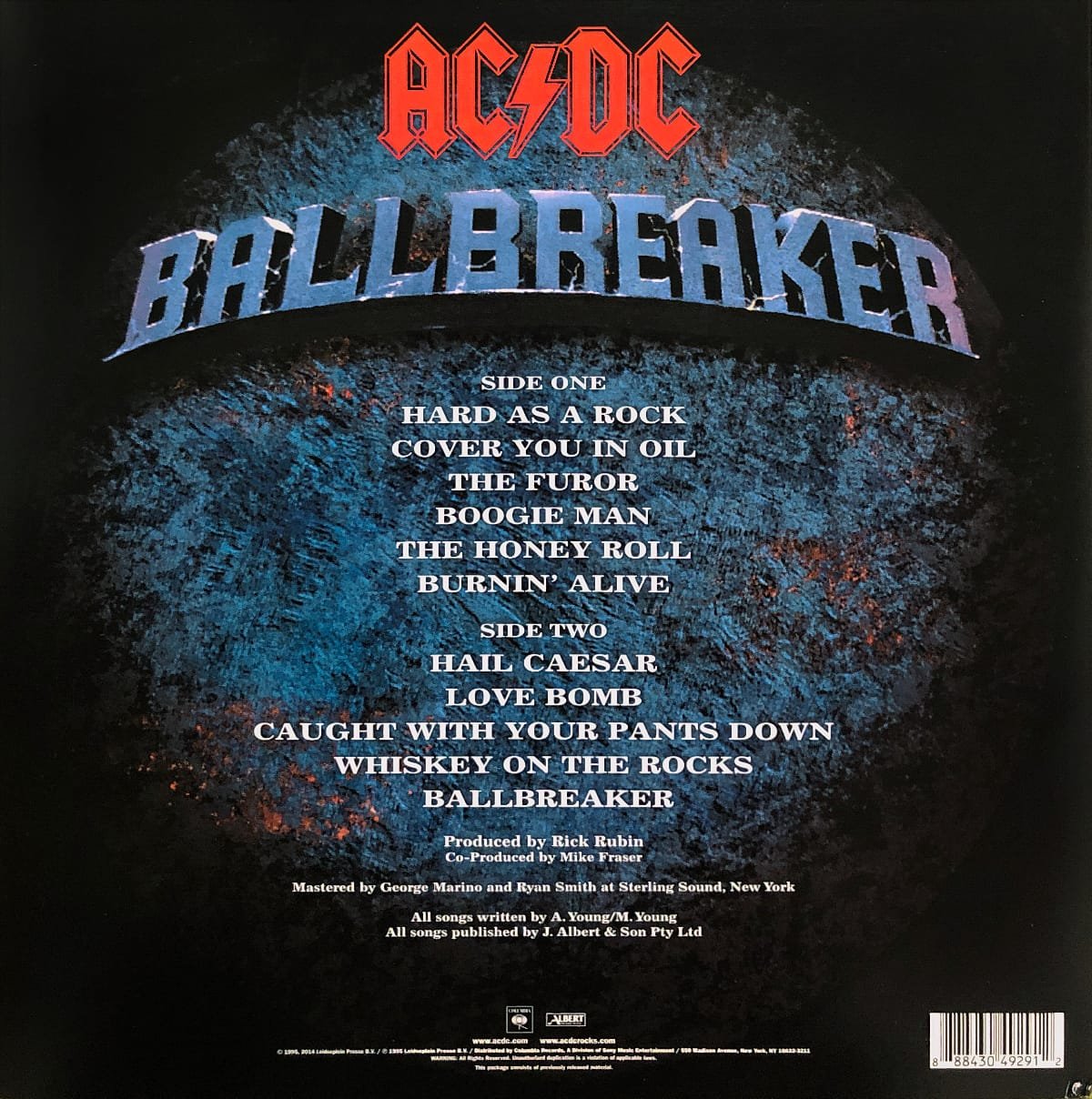
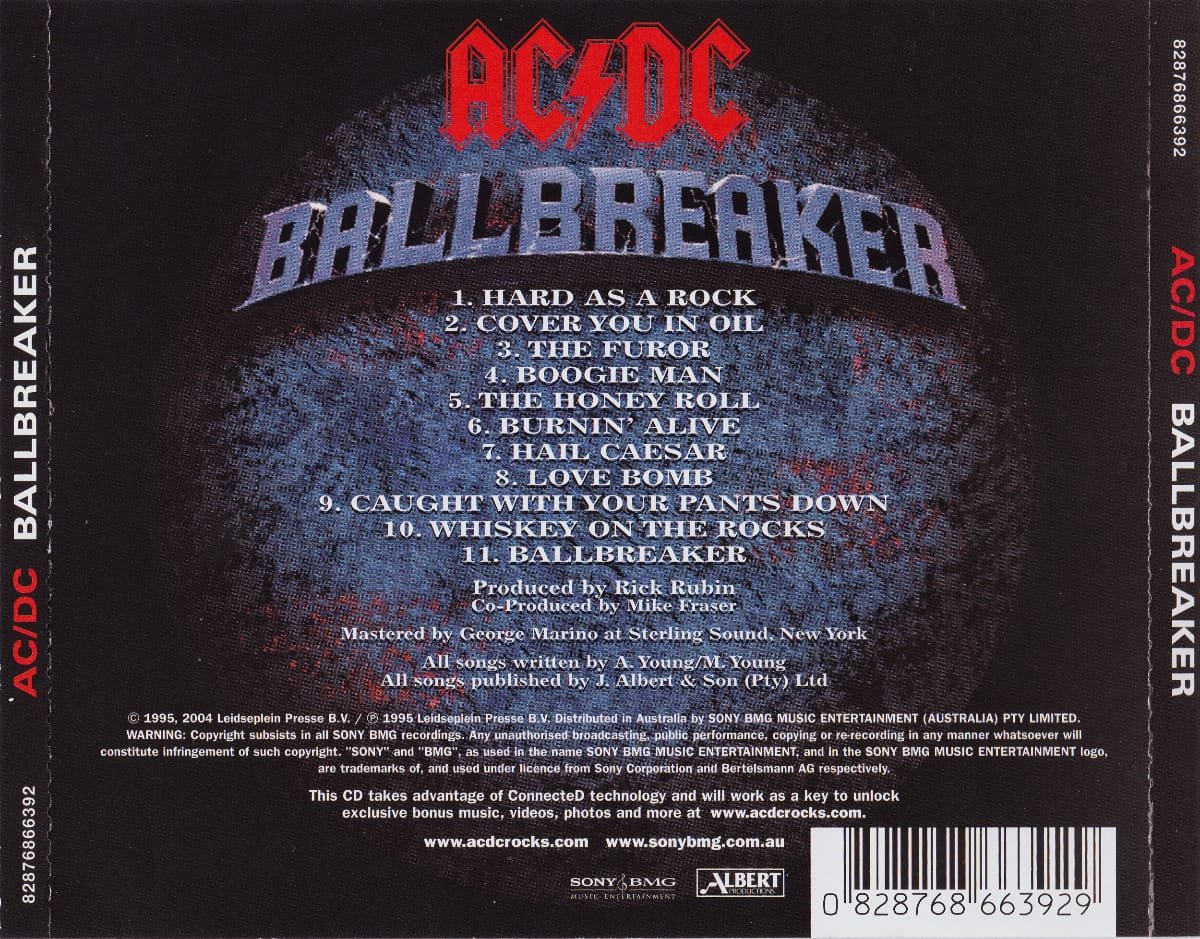
Speaking of LP-sized artwork, the 2014 vinyl re-issue of Ballbreaker is spectacular to hold, although the lyrics that were present with the original Vinyl, CD, and Cassette release are missing from both the LP liner notes and the 2004 CD reissue. One could argue that the write-up and reflection are better suited in retrospect, but I know many who would lament the absence of lyrics. I do, however, enjoy the newer liner notes and the series of live photographs and graphic illustrations from the original release but it would have been great if the liner notes in these reissues had been further expanded to include the lyrics.

What has remained the same, however, is the Ballbreaker cover; one of AC/DC’s best and most striking. That said, Stiff Upper Lip is my all-time favourite. While the rear cover is bland, it serves a purpose and does not include anything that doesn’t need to be there. Plus, my ageing eyesight is grateful for the larger typeface as so many releases choose the smallest possible fonts for seemingly no good reason, other than design aspects, when it comes to the track listing and liner notes in general. 

While I have never owned the original vinyl releases of AC/DC’s catalogue, the remastered reissues, mastered at Sterling Sound by George Marino and Ryan Smith are a true gift to AC/DC fans. The pressing is silent and is one of the better rock and roll re-issues with deep bass lines, clear vocals, and a guitar track so pure that you would swear the band was in the room with you. Yes, dear reader, that experience also translates to the CD and Apple Music counterparts. Other than the analogue warmth, you’re getting exactly the same sonic presentation across all formats. Yes, the vinyl edition increases the dynamic range but let’s be honest, this is AC/DC and as long as you can rock out and turn the volume to 11 then the dynamic range is of little importance. In my experience, the digital editions that are technically in the red sound as good, if not better, than the more dynamic vinyl reproduction. That may seem to be a counterintuitive argument as brickwalling can kill a good record, but this isn’t brickwalling in the traditional sense as you’re not missing out on any sonic elements. The hi-hats shimmer, the bass is where it needs to be, and Brian Johnson’s vocal is clearer and cleaner than ever. 

Long time readers would note my love of vinyl, but if you get a chance, don’t ignore the CD counterpart for it is really something special. For those of you that prefer to stream their music, the good news is you’ll thoroughly enjoy a near-transparent to the CD reproduction via the Apple Music stream as this is an Apple Digital Master done right. 

Hard As A Rock is, without a doubt, one of the best tracks to start any rock and roll album on. It sets the tone immediately with AC/DC’s renowned sound signature and innuendo-filled lyrics. The rhythmic blues-infused rock and roll sound is addictive and while many naysayers will complain that AC/DC plagiarises their own work, at least you know what you’re going to get.

Cover You In Oil has an incredible slower tempo that I adore and feel it is a precursor to the styling on Stiff Upper Lip; one of AC/DC’s best albums in my opinion. 

The Furor has a killer guitar intro that builds into an epic song. However, I feel Brian’s lyrical delivery is strained and his magic is subsequently missing on this song. It could also be the mix, but it just doesn’t sound right to me.

Boogie Man is groovy!  

The Honey Roll offers the perfect mix of rock and roll and blues. Every element, from the rhythm section to the lead guitar and vocals is textbook perfect. It doesn’t get much better than this.

Burnin’ Alive simply doesn’t resonate with me in its current position on the album. While I won’t stop the record prematurely, or skip the song, it is distracting. It isn’t fundamentally bad, just poorly tracked. 

Hail Caesar is, arguably, the reason I’m an AC/DC fan. The song subsequently holds a very special place in my heart. It’s also one of their hardest hitting songs on the album and one that could make a stadium audience sing in unison. Angus’ guitar solo is off the charts and Brian’s vocals are also perfect insofar as I can understand the words he’s singing, outside of the chorus. While he doesn’t slur his words, I have found that his vocal clarity can get lost in the music as a result of his natural growl. 

Love Bomb reminds me of the 80s hair metal scene. The song is great, but the association is a little disconcerting.

Caught With Your Pants Down is classic AC/DC.  

Whiskey On The Rocks is a favourite of mine, most likely due to the excessive number of times it was played on the Hail Caesar single. Isn’t it amazing how songs can grow on you if you listen to them enough? That said, listening to a song too often can make you hate a perfectly good song as well. In retrospect, perhaps that is why I have formed a love/hate relationship with Whole Lotta Rosie, yet in a cruel dichotomy, I never tire of Thunderstruck.  

Ballbreaker closes out the album with a song that has ‘stadium anthem’ written all over it. As all closing tracks should, it encourages me to listen to the album again and stay within AC/DC’s extensive catalogue.

While Rick Rubin is likely responsible for the raw sound found throughout Ballbreaker, it’s fantastic to have an AC/DC album that truly highlights the building blocks of rock and roll music; the blues. While AC/DC explored this sound further, without Rubin, on the Stiff Upper Lip album, it is a style that I subjectively appreciate and one that highlights the musical influences and origins of one of the greatest rock and roll bands the world has ever seen.

My only disappointment with Ballbreaker is that Big Gun (also Rubin produced) wasn’t included on the album as it was only recorded and released the year before. It is one of my all-time favourite AC/DC songs, and while I acknowledge that it was written and recorded for the Last Action Hero soundtrack, it would have made a perfect addition to Ballbreaker. Big Gun is another stadium-filling song that deserves to be turned up to 11.

While Ballbreaker may not be the first album fans go to when they think of AC/DC, it is an exceptional addition to their catalogue and one that should never be overlooked. As controversial as this may be, I’d take Ballbreaker over Back In Black any day of the week. 

Comment

AC/DC – '74 Jailbreak (EP Review On Vinyl, Apple Music, and TIDAL Hi-Fi)

Comment

AC/DC – '74 Jailbreak (EP Review On Vinyl, Apple Music, and TIDAL Hi-Fi)

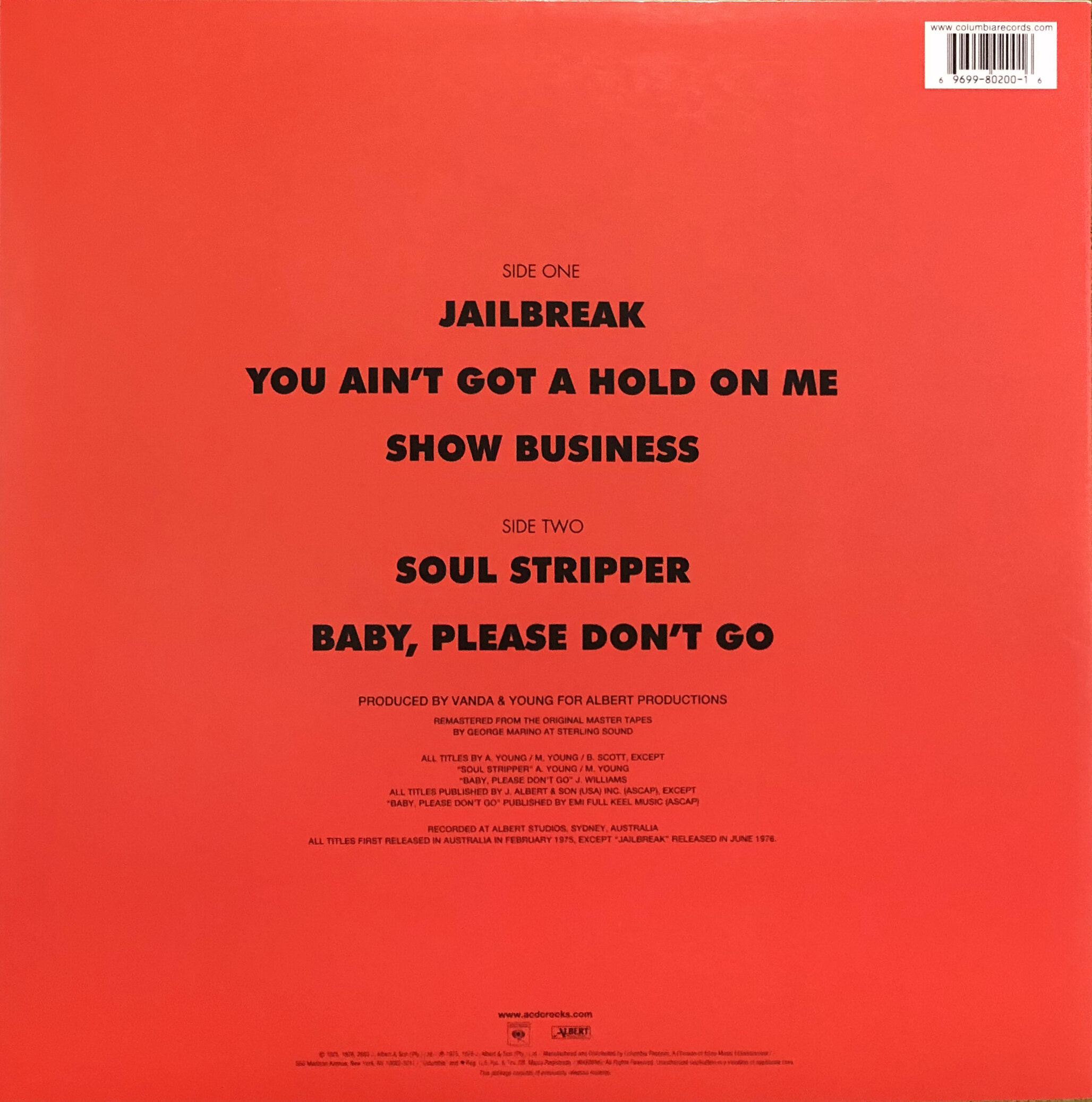
Few EP releases are as strong as AC/DC's '74 Jailbreak. In many respects, one could call this release a mini-greatest hits had it not been for the fact that the included songs were largely unavailable to music lovers outside of Australia. Released in 1984, US audiences were able, for the first time, to conveniently hear five exceptional tracks that were never released in their region during the 70s. While it is difficult to comprehend a fan's joy upon first hearing this release, one only has to spin the record and turn the volume up to hear just how polished AC/DC was in those early years. It is an experience that must be heard to be believed. 

Without a B-side to be found, '74 Jailbreak is one of the greatest AC/DC releases and should be in every fan's collection. Yes, the EP is short but that isn't necessarily a bad thing, especially if you opt to listen via CD or streaming services. From my experience, the Apple Digital Master, available via Apple Music, is the gold standard when it comes to streaming and while TIDAL Hi-Fi delivers the CD-quality counterpart, from the same mastering sessions, the TIDAL Hi-Fi version isn’t any better than the edition presented on Apple Music and subsequently, in this case, I prefer the Apple Music edition as it takes up less storage when using offline play as well as being more accomodating for those of us with restrictive cellular data allowances. That said, you can rest assured that regardless of how you choose to stream ’74 Jailbreak, you’ll be hearing the very best sound that streaming has to offer.

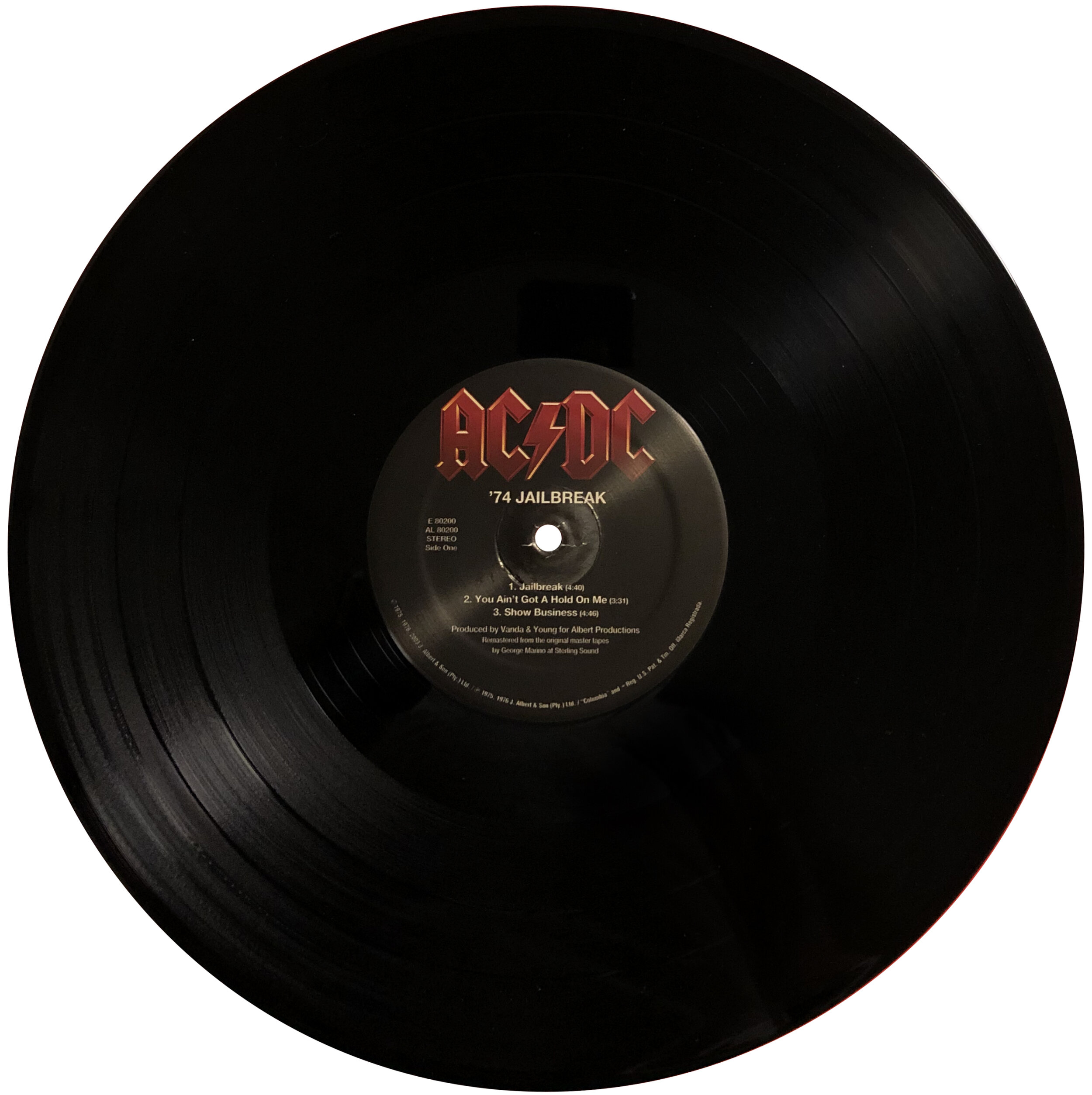
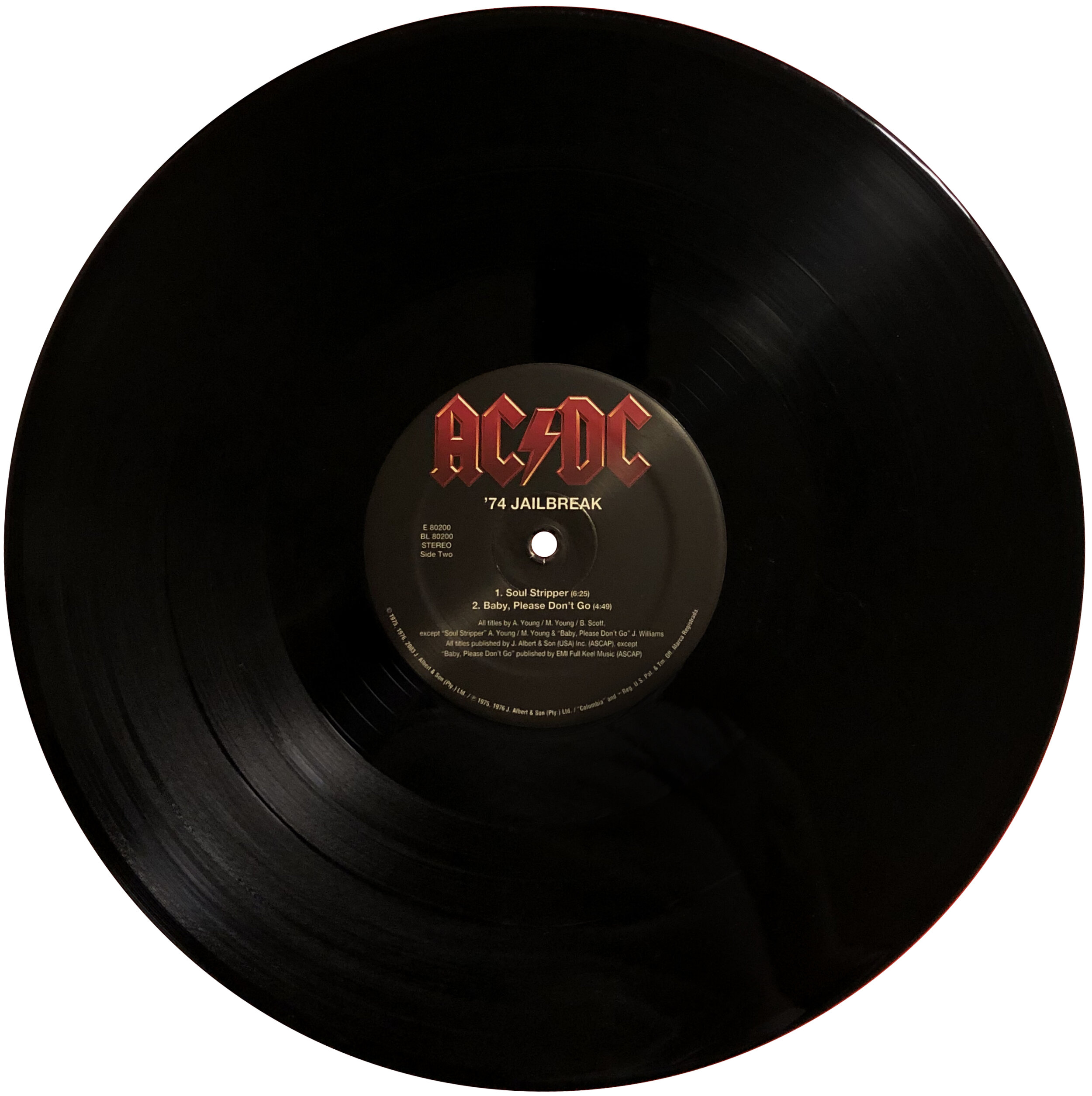
When at home, however, I’m fortunate enough to own the 2003 vinyl reissue and to say it’s spectacular is an understatement. Vinyl rarely sounds better than this, although I don't feel that way about all the AC/DC reissues from 2003 as the inner-groove distortion on the Back In Black reissue is infuriating. Nevertheless, '74 Jailbreak has an incredible soundstage with a perfect mix that ensures the bass and drum beats remain prominent, but never overpowering. Similarly, Bon Scott's vocals have never sounded better and each percussive element is crystal clear. If you’re a vinyl fan, this is one record you should add to your wish list, and your collection, as I know you won’t be disappointed. 

Side One 

Jailbreak may not be the first song fans gravitate towards but it’s an exceptional song that has been featured in AC/DC’s live performances for decades; even if it does appear a little self-indulgent when performed live. This studio recording, however, is the perfect opener for ’74 Jailbreak as it sets the tone for what is to come and never disappoints. 

You Ain't Got A Hold On Me has an incredible rhythm, although, I’ve always thought that Scott's vocal sounds a little too thin and forward in the mix. Interestingly, you may notice when listening to Brian Johnson-era recordings, by comparison, his vocals were always mixed in a more central position in relation to the music, whereas Scott's tend to stand out in the mix. It is a minor difference, but a noticeable anomaly.

Show Business is blues-rock 101. I love it!

Side Two

Soul Stripper is a layered and complex wonderland that presents listeners with a massive soundstage. The entrance, albeit lengthy, never gets dull and Scott's vocal entry and presence in the song is nothing short of perfection.

Baby, Please Don't Go is an incredible cover that I’ve always enjoyed. Is it the best version, however? Well, that is, of course, subjective but I can only reiterate that the Aerosmith rendition is just as good and that if you want the purist recording of this song, you should check out Big Joe Williams' 1935 recording. Nevertheless, Baby, Please Don’t Go is the perfect way to close the EP, extraordinary!

From start to finish, '74 Jailbreak is an exceptional collection of blues-based rock and roll songs that are timeless and will remain part of the social consciousness for generations to come.

Comment

1927 – ...ish (Album Review On Vinyl)

1927 – ...ish (Album Review On Vinyl)

Sometimes a debut album can become a smashing success that simply can’t be replicated. Selling in excess of 400,000 copies and winning the 1988 Australian Recording Industry Association (ARIA) Awards for best debut single (That's When I Think of You) and album, 1927 effectively became a household name in Australia overnight. While international success eluded them, that shouldn’t reflect on the wonderful musical experience that is ...ish. Ian McFarlane, in his opus The Encyclopedia Of Australian Rock And Pop, put it perfectly when he wrote ...ish is brimful of stirring, stately pop rock anthems. Yes, dear reader, it is that good!

SIDE A

To Love Me is a great opener that is truly representative of the Australian music scene during the 80s. It is recorded, mixed, and mastered beautifully, as is the entire album.

That’s When I Think Of You has a beat, vocal presentation, and guitar solo that are off the charts. There is no pretentious playing here, it is simply beautiful! This is what good music sounds like, you literally won't be able to stop your body moving to the rhythm. So good!

If I Could is rock ballad heaven. Listen to the song once and you’ll be singing it for the rest of the day. If I Could is simply stunning!

You'll Never Know picks up the tempo, but doesn't feel out of place in the tracking of the album. By this stage, if you haven't already turned the volume up, I suggest you do so. Get that air guitar out and warm up those vocal cords, you're going to need them.

Compulsory Hero is one of the greatest songs ever recorded, by anyone, anywhere in the world. It is an unofficial Australian anthem and not only does it bring me to tears, but it makes me proud to be an Australian. It’s a sonic masterpiece!

SIDE B

All The People is a great pop/rock tune, but it was always going to be difficult for any song to follow Compulsory Hero. Thankfully, in the minute or so it takes to flip the record, the senses have a chance to reset. Regardless, All The People is a worthy addition to the album.

Nothing In The Universe is a lovely song. While not on par with some of the earlier songs, it is certainly no B-side.

Propaganda Machine has an interesting punk/pop feel to it. I love it!

Give The Kid A Break has a sensational beat and series of guitar riffs. I hope you didn't turn that volume knob down as this song deserves to be heard at ear-bleeding levels. While a B-side, no one ever said a B-side couldn't be thoroughly enjoyable.

The Mess, unfortunately, doesn't follow the quality B-side that is Give The Kid A Break. The mess is, for lack of a better term, a mess and sounds like pure filler. That, however, doesn’t deter me from flipping back to Side A and enjoying this sensational album once more.

...ish is not only one of the greatest albums ever recorded by an Australian band, but it is also sonically and musically on par with all the greatest bands of the era. In fact, the production quality is world-class and it truly shows on the 2018 vinyl re-issue. Pressed at the world-renowned Pallas plant in Germany, I’ve never heard this album sound so good…ever! The record is pressed on audiophile quality eco-grade vinyl and is so silent you’ll hear the blood rushing through your veins before you hear any unwanted surface noise. The soundstage is immersive, with incredible depth that proves just how good vinyl can sound if diligence is taken in the mastering and pressing process. Yes, the edition on Apple Music is excellent, but it pales in comparison to the vinyl release.

I could honestly keep talking about how exceptional this album is, but I suggest you just track down a copy and experience it for yourself.

AC/DC – Blow Up Your Video (Album Review)

Comment

AC/DC – Blow Up Your Video (Album Review)

Released in 1988, Blow Up Your Video was the perfect bookend to Back In Black as AC/DC’s other 80s releases were less than stellar, even though there are many hidden gems to be enjoyed. Nevertheless, Blow Up Your Video is often unfairly overlooked. The blues-based rock that is exhibited here is on par with the ultra-bluesy Stiff Upper Lip; an album I adore and consider to be their greatest release. 

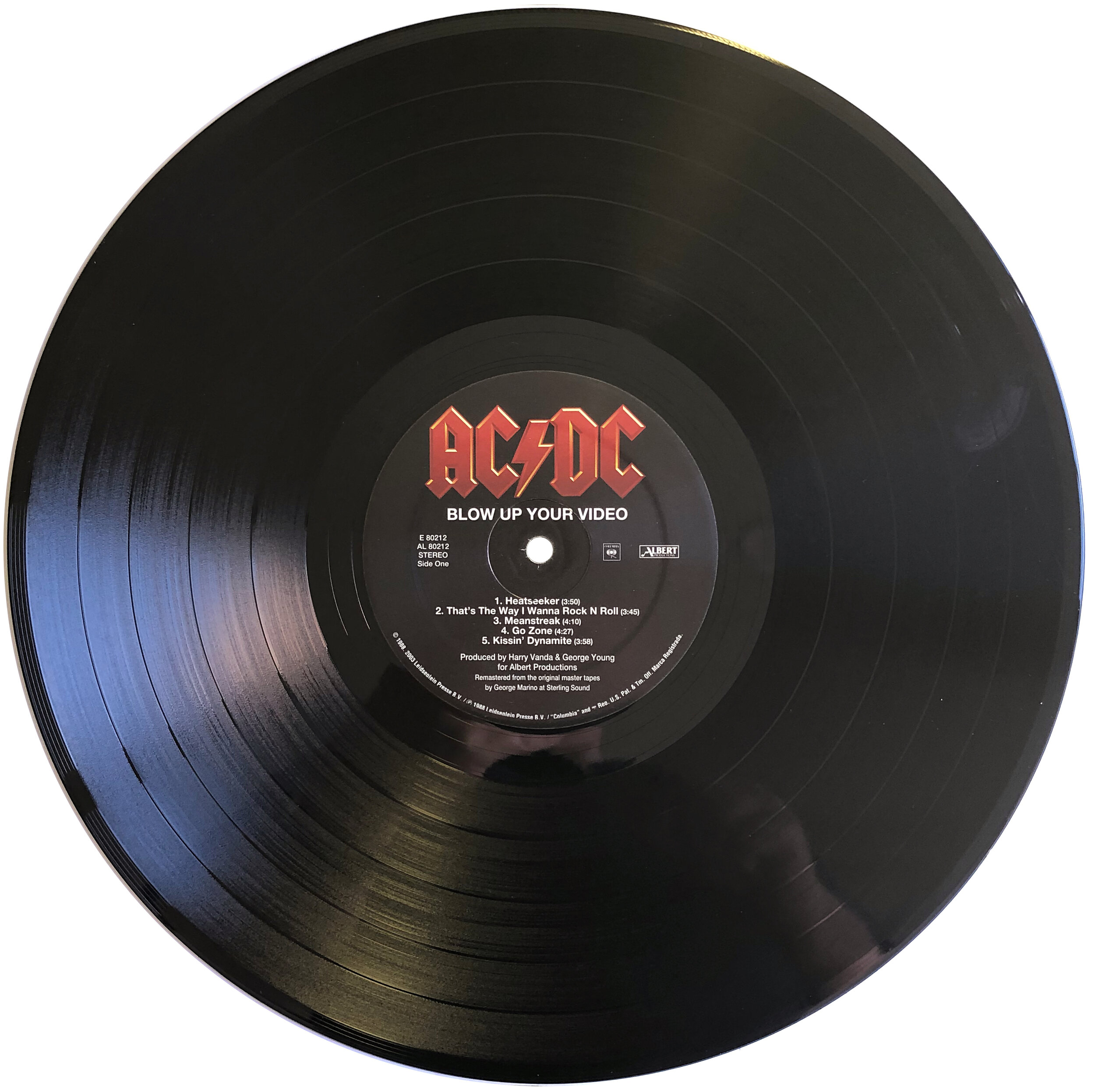
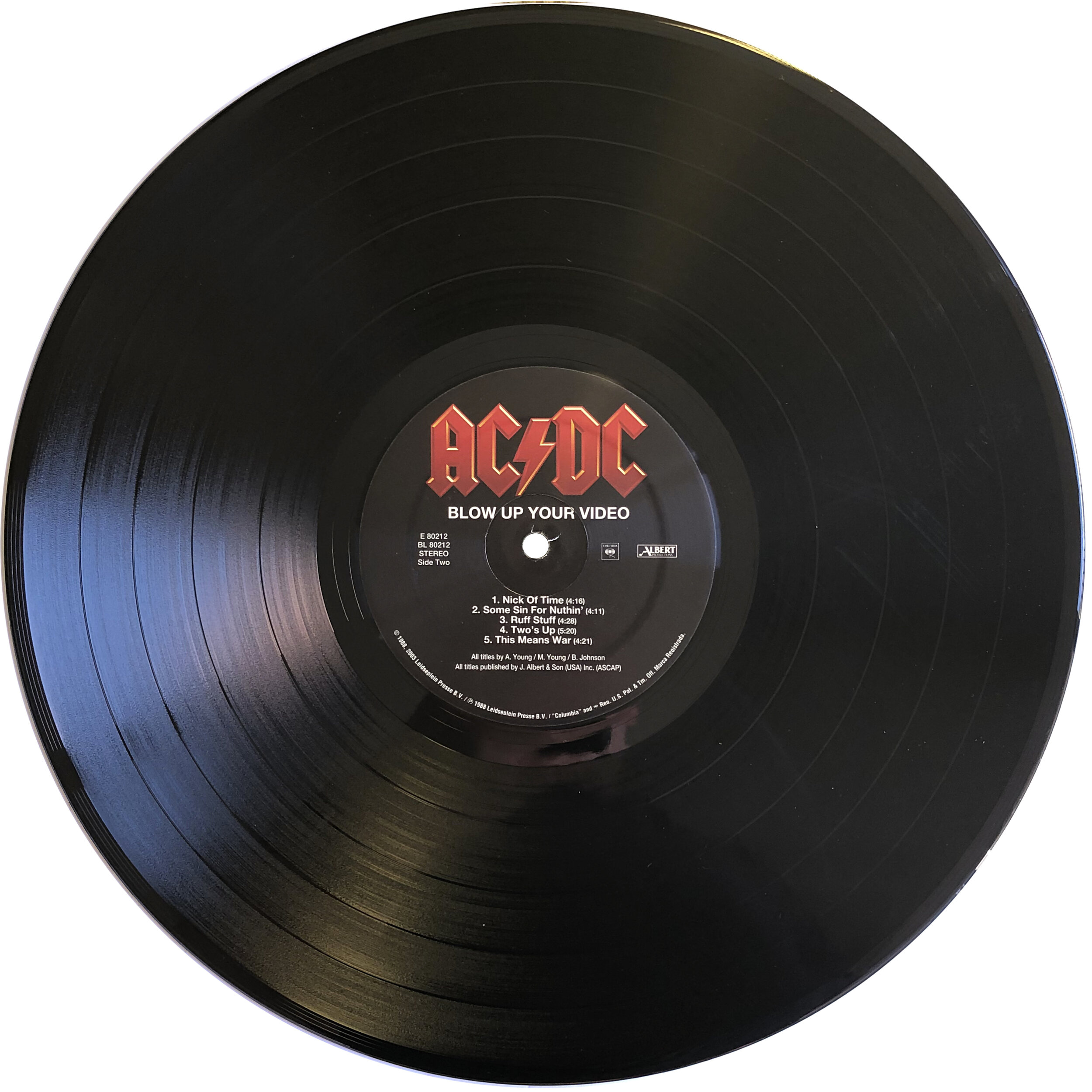
For a number of years now, I’ve been fortunate enough to own the 2003 vinyl re-issue of Blow Up Your Video; this particular mastering is the one that is still in production and George Marino and his team at Sterling Sound did a wonderful job on not only this remaster but the entire AC/DC catalogue. The pressing has little to no surface noise to speak of and is presented in a high quality outer and inner sleeve. The inner sleeve, in particular, is a cornucopia of information, penned by Alan Di Perna – a legend in his own right, relating to the period and recording of the album, a value-added addition that will likely be of interest to any fan. 

From a sonic perspective, these 2003 vinyl reissues are perfect and given vinyl was well in recession at the time, it is remarkable that these were even considered, let alone produced as beautifully as they are. While AC/DC is most certainly suited to playing on loudspeakers, trust me when I suggest that you listen to these records via headphones as the music locked within the grooves really comes to life and gives you an even greater appreciation of AC/DC and their production quality.

If you prefer streaming, the Apple Digital Master, as available below via Apple Music, sounds exquisite and I believe is taken from the same mastering sessions as the 2003 vinyl re-issues. Certainly, from my point-of-view, there is no difference to note other than the natural analogue warmth that is a byproduct of vinyl reproduction. That isn’t to suggest that the Apple Music edition is shrill or digital sounding, but there is a difference between the formats and you may prefer one over the other.

Side One

Heatseeker is AC/DC 101 and is a great opener. I particularly enjoy the studio background noise introduction and it has a rawness to it that ultimately complements the song and makes you feel, as the listener, that you’re in the studio with the band. Heatseeker also, as so many AC/DC songs do, has a killer rhythm. 

The music video is brilliant but the heat seeker scenes are hilarious as is Angus’ entrance. It has equally stood the test of time and yet has aged in those aforementioned ‘special effect’ scenes. Regardless, it is fun and you should check it out if you get a chance. 

That’s The Way I Wanna Rock N Roll has a fantastic drum recording. Simon Wright gets ignored far too much in AC/DC’s history, in my opinion, but as far as I’m concerned he locked in and mastered this performance. 

The music video applied the same mix of live vs storytelling as seen in Heatseeker and truth-be-told the live performance was strong enough and would have been adequate. Of course, if we look at the late 80s, via a lens of nostalgia, the music video at the time would have been very well received even if the additional storytelling components now seem to be a little superfluous. 

Meanstreak has a killer riff. One of their best? Hell yeah! Its also got plenty of the blues influence that I love and without a doubt is one of their greatest recordings that doesn’t get the respect it deserves.  

Go Zone has a really solid and controlled bass element that I appreciate. Go Zone is a great song with an albeit short, but pleasurable guitar solo. Yes, it may be a meat and potatoes rock and roll track, but it’s some of the best meat and potatoes rock that you’ll ever enjoy. 

Kissin’ Dynamite is pure gold. How is Kissin’ Dynamite not more prominent in AC/DC’s back catalogue? It is one of their best recordings and I don’t know about you dear reader, but I get tired of ‘how good Back In Black is’. Yeah, it’s good but if that’s all you listen to, you’ve stymied your musical growth. Seriously, turn Kissin’ Dynamite up, blow your eardrums out and piss the neighbours off, you can thank me later.

Side Two

Nick Of Time is a hard-hitting rock tune and is the perfect opener for the second side of the album.

Some Sin For Nuthin’ slows things down a little with a rhythmically charged song that isn’t anything to write home about, but would be sorely missed if it wasn’t included on Blow Up Your Video.

Ruff Stuff is creamy blues-based rock and roll goodness. Absolutely, brilliant! 

Two’s Up is one of the greatest songs on the album. That rhythm is off-the-charts and Two’s Up really doesn’t get the recognition it deserves. 

This Means War has intermingling rhythms that make for an interesting listen. It doesn’t sound disjointed, as it was recorded, mixed, and mastered perfectly, but you really need to pick a groove to get the most out of This Means War. It’s a fantastic way to close out Blow Up Your Video and ensures I’ll be spinning the album again. 

Overall, Blow Up Your Video is severely underrated when it comes to the post Back In Black 80s records, but it shouldn’t be for The Razor’s Edge was just around the corner and Blow Up Your Video is the logical precursor to that masterpiece. My suggestion for what it’s worth is to put away the common albums and songs and expand into the lesser know masterpieces that will fill you with the joy and excitement that you had when you first discovered AC/DC. I’m sure you won’t regret it!

Comment