Viewing entries in
Australian Music

AC/DC – Fly On The Wall (Album Review)

AC/DC – Fly On The Wall (Album Review)

Released in 1985, AC/DC’s Fly On The Wall marked a significant moment in the band’s career as it was the third album to follow their mammoth release, Back In Black (1980), and was released during a period of downturn in interest from fans the world over. Comparisons aside, Fly On The Wall was successful in its own right with sales exceeding one million units. While it’s an album that isn’t always heralded by fans as one of their best, Fly On The Wall is somewhat of a hidden gem that features their landmark hard-rocking sound via this electrifying and gritty release that is amongst the greatest hard rock albums from the 80s.

Part of the hidden appeal, considering there isn’t necessarily a standout tune on the record, is the continued high-production values for this was an era when music, especially rock music, began to shift to a more shrill tonal quality that would plague many of the era’s greatest rock and roll albums. Yet, amongst this industry shift, AC/DC never changed their styling and the result is an album that rocks as hard as any other they released. Additionally, Angus and Malcolm Young did a masterful job in the Producer’s chair, ensuring that their vision for the album came through loud and clear. It also helps that the album artwork is visually appealing with its comical design that looks as fresh today as it would have been upon release.

Sonically, as is the case with the majority of AC/DC releases, it’s a powerhouse and the Hi-Res Lossless Apple Music stream, an Apple Digital Master, is no exception for the bombastic nature remains while every aspect is clearly presented within the chosen mix and overall mastering of the album. Brian Johnson’s vocals are raw and exceptionally detailed within the soundstage; a sonic presentation that will envelop you from the very first note to the last. One of the best examples of this can be heard on Danger; where every musical element can be heard clearly but it isn’t shrill and is so sonically pleasing that you’ll be looking to turn up the volume despite being able to enjoy the record at lower volumes.

While some will always lament the fact that AC/DC has basically played the same song over and over, decade after decade, music lovers and fans alike can be confident that AC/DC never changed their style and adopted the “new” recording styles for if they had, an album such as Fly On The Wall would have been a shrill nightmare that would have seen everyone needing to turn down the treble and boost the bass. Thankfully, that isn’t an issue here, so turn up the volume, sit back, and let’s take a look at the songs that make up this, often, overlooked, masterpiece.

Fly On The Wall kicks the album off, perfectly, with an energetic opener featuring sharp guitar riffs, bold percussive elements, and Johnson’s unmistakable growl.

Shake Your Foundations would also make it to Who Made Who, the soundtrack accompanying Stephen King’s film Maximum Overdrive. That version, however, differs slightly from this one as it was remixed and cut down slightly in runtime. As to which I feel is the stronger version, that would be this original album release for despite the remix presenting Johnson’s vocals more prominently, it pales in comparison to the original as the musical bed is somewhat recessed and the song, subsequently, doesn’t rock as hard as the Fly On The Wall original does. Propelled by a driving beat, bluesy rhythm, and sing-along chorus, it’s a wonder that Shake Your Foundations hasn’t remained more prominent within AC/DC’s back catalogue as it’s an exceptional tune.

First Blood is a mid-tempo blues rocker with duelling guitars that weave together seamlessly. It’s quintessentially AC/DC and sometimes you don’t need to forge a new path to stand out, for I’d take songs like First Blood over a shifting style any day of the week.

Danger has a brooding tempo that shows a different side of AC/DC; one that could offer a more blues-focused appeal than the hard rock styling most commonly associated with the band. However, one can understand why it wasn’t a hit amongst fans, at the time, but I have a feeling that modern audiences would be much more receptive to this mood-driven eerie number.

Sink The Pink is, arguably, the song that would appeal to most of AC/DC’s legacy fans for it combines their renowned playful attitude with an infectious groove and some hard rocking licks.

Playing With Girls is a fast-paced rocker that leans heavily into AC/DC's cheeky, tongue-in-cheek persona. While the core riff is straightforward it, combined with the song’s energy, keeps the momentum going and is a standout on this release.

Stand Up is a magnificent tune and is one of Simon Wright’s greatest drum performances with the band, having taken over that role upon Phil Rudd’s departure. In truth, Wright performed magnificently throughout the album and while his style is slightly different to Rudd’s, his appointment didn’t detract from the music at all. I’d even go as far as saying that his inclusion was an enhancement. Nevertheless, Stand Up is a raw, back-to-basics, tune that will have you coming back for more.

Hell Or High Water is a hard-hitting anthem with a relentless rhythm. AC/DC doesn’t get much better than this as Hell Or High Water will appeal to all fans of the band.

Back In Business is a killer mid-tempo rocker with a powerful riff and a driving rhythm section. Its anthemic quality adds to the album, as well as AC/DC’s incredible back catalogue, in such a way that you’ll experience an earworm as that catchy chorus will remain front and centre in your mind well after the album has concluded.

Send For The Man is an ideal closer with its heavy, blues-infused, sound, featuring a grinding riff and thunderous rhythm that ensures the record ends on a high note; one which will compel you to listen to the album again for Fly On The Wall can seldom be listened to once.

Fly On The Wall may be a polarising release within AC/DC’s discography, but it shouldn’t be as the band’s signature hard rock energy is present throughout as it accompanies the infectious riffs and anthemic choruses they’re best known for. Hence, if you’ve overlooked this release, and have never given it a proper listen, I implore you to give it another shot for you may just fall in love with the album’s raw, unfiltered, and rebellious spirit; I know I have!

Skyhooks – Living In The 70’s (Album Review)

Skyhooks – Living In The 70’s (Album Review)

A debut like no other; an Australian masterpiece!

That is, perhaps, the best way to describe Skyhooks’ Living In The 70’s, for they may not have known it at the time, but Living In The 70’s would go on to become one of the greatest albums ever recorded.

Beloved in Australia, Skyhooks never really made inroads into the international music scene. Subsequently, many international readers may be unaware of their music and the influence they’d have over generations of Australian rock bands to come. Thankfully, streaming allows you, dear reader, to listen to Living In The 70’s, wherever you are and there is no time like the present to check out one of the most controversial, yet praised, debut releases ever by an Australian band.

Living In The 70’s was controversial in that the Federation of Australian Commercial Broadcasters decided to ban six of the songs from the album, from national airplay, citing sex and drug references. Of course, the counter-culture teenage population, at the time, wasn’t going to be told what they could and couldn’t listen to and Living In The 70’s quickly rose to #1 on the charts, selling 226,000 copies in its first year; a feat never before seen within the Australian music industry.

Not only was their sardonic view of the zeitgeist in Australia in the 70s a pivotal element for Skyhooks, but they had a hook and they caught us hook, line and sinker, with their catchy blues-based groove rock and combined glam rock style. To say Skyhooks was multifaceted would be a borderline understatement, for their musical style defies adequate explanation. Living In The 70’s is, subsequently, an album that needs to be heard in order to be fully understood and appreciated. Exceptionally written, recorded, mixed, and mastered, you’ll be in pure musical bliss for the entire duration.

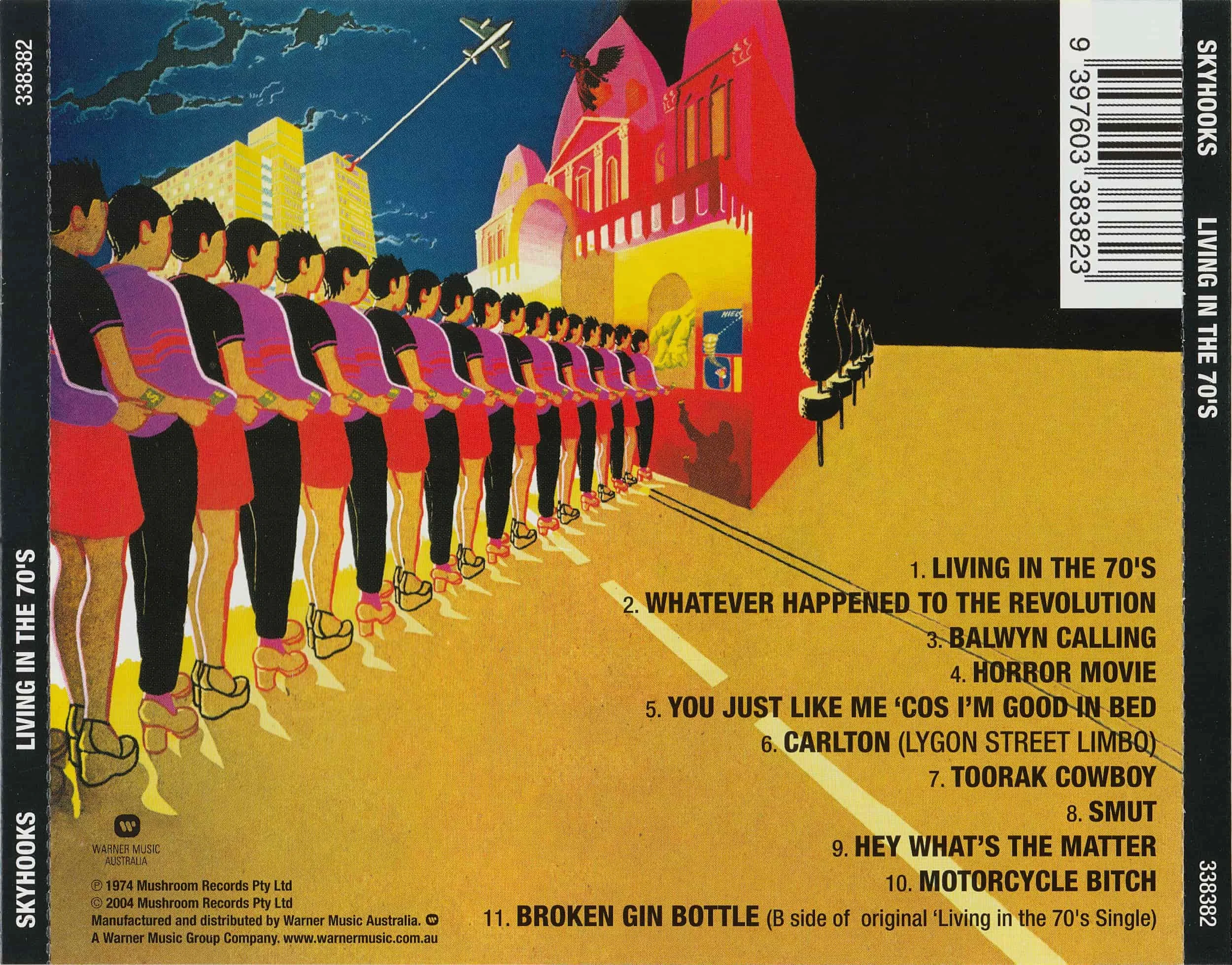
The edition of Living In The 70’s that I’m fortunate to own is the remastered CD from 2004 with the additional B-side, Broken Gin Bottle; a perfect addition to an already flawless album. The CD, however, isn’t quite as perfect as I’d like it to be as the booklet has a printing error whereby several pages of the liner notes are missing, replaced by liner notes from a Linda Ronstadt compilation. Now, I have nothing against Ronstadt; a phenomenal musician in her own right, but this is a Skyhooks album and I’m missing all the lyrics except for the title track and Broken Gin Bottle. It’s a frustration, to say the least, but the sound quality is so good that I haven’t bothered with a replacement.

Yes, Living In The 70’s is a remaster and while I’ve been critical of remasters over the years, this one is done nicely, with respect for the source material. It sounds right, unlike the remaster of Cold Chisel’s Circus Animals. The soundstage is wide and enveloping and every instrument can be heard with incredible clarity. The Lossless Apple Music stream, by comparison, is a solid CD facsimile but isn’t quite as live-sounding as the remastered CD. As usual, if you don’t compare the editions, you’re unlikely to notice anything is lacking, but the CD offers a more enjoyable listening experience as the music has a fluidity that is missing from the streaming counterpart despite being derived from the same mastering sessions.

Additionally, a vinyl reissue is on its way, scheduled for an early 2025 release, along with a CD edition that celebrates the 50th Anniversary of the album. One problematic aspect, however, is that it’s said to be a new 2024 remaster. Let’s just hope that it has been handled with respect for the source material for I still declare the 2009 remaster to be perfectly fine. Nevertheless, it seems somewhat fitting that one of the greatest Australian albums of the 70s finds its way back to the format that it was originally presented on; if for no other reason than to display that incredible album artwork.

Living In The 70’s is a killer, rhythmically charged, opener that will have you singing along as you grooving to the music. It has some exceptional guitar and percussion work that showcases the polish and musical skill Skyhooks had right out of the gate, but it’s the song’s references, and sharp critique, to counterculture and societal expectations, that strike a perfect balance between humour and reflection. The result is that Living In The 70’s is one of the greatest debut album openers of all time.

Whatever Happened To The Revolution continues with the upbeat tempo and in many respects, Skyhooks has a similar style to The B-52’s, in that it becomes a fun listen that’s unique when compared to much of the music of the era. Even by modern standards, Whatever Happened To The Revolution sounds fresh with its crunchy guitar riffs and high-energy rhythm.

Balwyn Calling is packed with vivid imagery, a funky bassline, and melodic guitar hooks that give this song its playful edge and ensure that it’s one of the most memorable tunes from the album.

Horror Movie is, without a doubt, my all-time favourite song from Skyhooks. It’s also, arguably, Skyhook’s most iconic tune for its an unforgettable anthem and Graham “Shirley” Strachan’s powerful vocals bring Greg Macainsh’s satirical lyrics to life. However, it’s the overall vibe that takes this song to another level for it is most certainly positioned in the 70s style but has remained timeless and still resonates with rockers the world over.

You Just Like Me ‘Cos I’m Good In Bed says it all, doesn’t it? It’s a fun tune that will bring a smile to anyone's face. While I can understand why the Federation of Australian Commercial Broadcasters banned this tune and five others, I’d call it overkill as we really can take ourselves a little too seriously at times. Nevertheless, it’s a great song; one that flows beautifully within the album’s linear structure and, again, showcases just how proficient Skyhooks were from the get-go.

Carlton (Lygon Street Limbo) incorporates the energy and musicality of Australian music in the 70s, despite the mid-tempo styling. While it isn’t a standout, it’s a quintessential album-only tune that ensures the album is structurally sound and the sum of its parts, rather than being appealing because of one or two songs. 

Toorak Cowboy is a toe-tapping, head-bopping, good time with a country meets glam rock style that is highly appealing.

Smut, true to its name, pushes the lyrical boundaries with its tongue-in-cheek wordplay atop a compelling musical backdrop. It’s a fun song that showcases the band’s irreverence as they challenged societal norms with their bold take on taboo topics.

Hey What’s The Matter is groovy; try sitting still through this one. As with much of the album, it’s impossible to not groove along to the music. The result is that Living In The 70’s can very easily become the ideal soundtrack to an energetic life.

Motorcycle Bitch is gritty riff-driven heaven and Strachan’s vocals on Motorcycle Bitch, in particular, are magnificent. There’s little doubt in my mind that he was one of the greatest vocalists to ever record a tune. Bon Scott is usually held up as the poster child for Australian rock and roll vocals and while this doesn’t take anything away from his vocal prowess, Strachan was on par, if not slightly more capable as a vocalist, particularly concerning pronunciation. I mention this as I don’t feel Strachan has ever received the recognition he deserved.

Broken Gin Bottle was not part of the original tracking of Living In The 70’s, having been released as the B-side to the Living In The 70’s single. However, I couldn’t imagine the album without it as it fits the overall styling so well. Again, and I know that I’m repeating myself, the gritty blues-infused guitar work is extraordinary and will compel you to listen to the album again.

Living in the 70's is a bold, unapologetic, and groundbreaking album. Skyhooks' ability to combine biting social commentary with infectious melodies and a uniquely Australian identity made it a cultural touchstone but this debut isn’t just an album, it’s a cornerstone of Australian music history and one of the greatest albums ever recorded.

Bee Gees – Mr. Natural (Album Review)

Bee Gees – Mr. Natural (Album Review)

When you think of the Bee Gees, Mr. Natural is likely not an album that instantly comes to mind. Still, the more you listen to this classic release, the more you realise that it’s one of the greatest hidden gems in not only the Bee Gees’ illustrious career but in all of recorded music history.

Released in 1974, Mr. Natural marks a transitional period in the group’s evolution, as they began exploring a more contemporary soulful sound that incorporated elements of rhythm and blues, funk, and rock. Interestingly, it’s not entirely representative of their earlier works nor the disco-driven vibe that would catapult them to superstardom and define an era. Mr. Natural sits precariously in between their old and new styles, yet there is connective tissue to be heard throughout and it’s thoroughly enjoyable and perfectly suited to the trio.

While Mr Natural didn’t achieve commercial success, it remains a pivotal album in the Bee Gees’ discography and demonstrates their willingness to experiment with new directions; an essential aspect should the world of music long to hear sensational disco-driven releases such as Main Course and Spirits Having Flown.   

As we’ll come to see, as we peruse the songs that make up this hidden gem, the music is but one part of the album experience for the album artwork, much like the music, grows on you the more you look at it. Initially, it appears a little drab and uninspiring, but it melds perfectly with the chosen selection of songs and adds to the overall album experience.

Of course, the greatest album artwork would be for nil if the music contained within was lacklustre and while it is anything but, the lossless CD-quality Apple Music stream also sounds exquisite. There are no glaring omissions to concern ourselves with and you’ll find a soundstage that is wide and enveloping, with enough space between each musical element, allowing every aspect of the recording to shine. While mastering is essential, and in this case, it is ideal, when music is recorded and mixed this well, then the only thing left to do is to grab a coffee, sit back, and enjoy.

Charade isn’t an ideal opener, despite being a lovely ballad. The problem is it lacks a hook, one that will draw you into the music and the album itself. It isn’t, however, until you play the album multiple times that you start to appreciate Charade for its gentle yet melancholic melody that evokes some of the Bee Gees’ earlier 60s-styled recordings.

Throw A Penny introduces a more contemporary, soft rock-influenced sound, building momentum with its smooth groove and layered production. I can’t help but wonder if Throw A Penny would not have been a better opening. Nevertheless, it’s an exceptional song and the shift between the slower delicate verses, and the slightly more upbeat chorus that blends elements of R&B and Soul, is simply exquisite.

Down The Road flows seamlessly from Throw A Penny yet smoothly transitions the mood to that consisting of a bluesy, rock-and-roll vibe. Add to that the carefree swaggering groove, with a lively beat, and you’ve got yet another exceptional hidden gem from the Bee Gees.

Voices shifts the tone with its eerie slow-burning arrangement that makes me immediately think of songs such as Massachussetts and New York Mining Disaster 1941. To say that Voices is a masterpiece would be a just statement for it’s a magical song.

Give A Hand Take A Hand is an uplifting soulful ballad and while the Bee Gees’ vocal prowess is not a point of contention, the vocal skill heard here is second-to-none as Barry Gibb has rarely sounded better. Subsequently, this vocal-driven number is a standout from Mr. Natural and another of those hidden gems that really need to be appreciated for the hits are one thing, but Give A Hand Take A Hand is musical gold.

Dogs will captivate you with its fluid melody, particularly throughout the verses and chorus. Additionally, that mid-tempo shift in the bridge is pure genius. Not to sound like a broken record, but given Mr. Natural was all but ignored when released, it’s songs such as Dogs that need to be shared with fellow music lovers for casual fans of the Bee Gees have no idea of the exceptional music they’re missing out on.

Mr. Natural was an interesting choice as the title track as it’s a solid song with an infectious groove and funky bassline, but it’s most certainly an album-only tune, despite being released as the album’s first single. It just doesn’t hold one’s attention as much as many of the other songs on the album do.

Lost In Your Love slows the tempo down again with this delicate ballad, offering a tender moment. The arrangement is sparse, allowing Barry’s magnificent vocals to take the spotlight, thereby ensuring that Lost In Your Love is another memorable experience.

I Can't Let You Go has a killer riff, as the song brings an upbeat rock-oriented style to the record; one that melds perfectly with the Bee Gees’ overall style and harkens back to their origins.

Heavy Breathing continues the upbeat nature with this jazzy groove-focused tune that is perfectly suited to the era. If you’re not toe-tapping and head-bopping to this number, you’re listening wrong for its rhythmic gold with some exceptional musicality, particularly from the brass section to the ripper guitar licks. The bottom line is that Heavy Breathing is one Bee Gees song that should not be overlooked.

Had A Lot Of Love Last Night is, arguably, the greatest closer, from any album, in the history of recorded music. Not only is it uplifting, but it’s reflective, as well as encouraging the listener to play the album again. It also happens to be the most beautiful song that the Bee Gees has ever recorded that almost no one has ever heard. Had A Lot Of Love Last Night is so beautiful that I’d even argue that it’s the best song the band ever recorded; it’s that impressive!

In conclusion, Mr. Natural was a crucial, though often overlooked, album in the Bee Gees’ discography. It marked a period of experimentation and transition, as the group adapted their sound in preparation for their later success in the disco era. The album’s blend of soulful ballads, rock, and subtle R&B influences helped set the stage for what was to come, and it remains a thoroughly pleasing listen for those curious about the Bee Gees’ musical journey, beyond their chart-topping hits.

INXS – The Swing (Album Review)

INXS – The Swing (Album Review)

Released in 1984, The Swing, INXS’s fourth studio album, was a pivotal release that propelled the Australian band into the international spotlight. Whilst similar, yet somewhat removed from their earlier releases, The Swing would ultimately shift INXS’s sound from their post-punk influences to a more polished, radio-friendly, groove-oriented rock; a sonic styling that would later culminate in their masterpiece, Kick. Encompassing a mix of infectious grooves, catchy melodies, and innovative production techniques, The Swing became not only a commercial success but a landmark release with such enduring appeal that it can still be appreciated to this day.

As already alluded to, the production quality of The Swing is superb. Every aspect, from the recording, to the mix, and the mastering of the album has been handled with care, for when you play the record, particularly via Apple Music, you won’t be disappointed with the sonic presentation. It’s so good that you’d be hard-pressed to find a better facsimile of the album than the Lossless Apple Digital Master. It’s bold, detailed, and thoroughly enjoyable to listen to. While I was fortunate to have owned the 2011 CD reissue, it just wasn’t as pleasing to the senses as the streaming counterpart is.

Technically, both editions should sound the same, as they’re derived from the same remaster series, but the Apple Digital Master is delivered as a 24-bit 44.1kHz ALAC file compared to the 16-bit 44.1kHz version found on the CD counterpart. It’s important to note that higher numbers don’t automatically correlate to greater quality, but to truncate the 24-bit 44.1kHz to the CD’s 16-bit 44.1kHz requirements, dithering is added to reduce distortion but that process also adds noise. It’s a minor detail, but the Apple Digital Master process manages to preserve all the dynamic range of the source file while eliminating the need to add dither. Granted, most music lovers won’t care about this aspect, but I mention it to only highlight that, in this case, the stream offers a much more pleasing sonic presentation than the equivalent CD release. So, with that in mind, let’s take a look at the songs that make up this landmark release.

Original Sin is a quintessential album opener. It not only sets the tone for the music that’s to come but has such a compelling and catchy rhythm that you’ll find yourself bopping along to this upbeat number. Produced by Nile Rodgers (co-founder of Chic), Original Sin has a funky bassline, dynamic horns, and layered vocals that create a powerful anthemic sound. Daryl Hall’s harmonic vocal inclusion with Michael Hutchence, in the chorus, is idealistic and further amplifies this timeless, and iconic, tune.

Melting In The Sun shifts the style slightly, with a more laid-back, rock-oriented vibe. There’s no doubt that Melting In The Sun is an 80s tune for it has all the signature cues, but for those of us who lived through the era, it’s highly nostalgic and the jangly elements are a feature rather than a deterrent.

I Send A Message picks the tempo up again and is the natural successor to Original Sin with its infectious funk-driven melody. While not as tight as the opening tune, I dare you to sit still as I Send A Message is playing. I know I can’t do it for the song’s blend of synthetic elements, the overall musical bed, and Kirk Pengilly’s saxophone reach into the soul and don’t let go until the very final note has been played.

Dancing On The Jetty is an interesting track as the introduction is considerably different to the styling of the songs that preceded it. The darker, more atmospheric, sonic signature with the brooding bassline and haunting synths create a sense of tension, while Hutchence’s vocals add a layer of emotional intensity. As it pertains to the chorus, however, I can’t help but hear a slight Midnight Oil influence. Nevertheless, the track's moody ambience and experimental production make it a fascinating listen, showcasing the band's willingness to push the boundaries of their sound.

The Swing may be the title track, but this album-only number is solid but not exceptional. It is doubtful that this song alone will compel you to listen to the album, but as connective tissue, holding the record together, it works perfectly well.

Johnson's Aeroplane is a sonic masterpiece that blends rock and new wave elements with a symphonic-influenced musical backing. The song's somewhat unusual structure, with its shifting tempos and varying dynamics, adds to its intrigue, but it’s songs such as this that offer a prime example of INXS’s ability to craft musically compelling songs.

Love Is (What I Say) returns the album to an upbeat, danceable sound, with this mid-tempo number. It’s catchy with a funky bassline and lively percussion and while it may not be the most innovative track from the record, its role as an album-only tune ensures that The Swing, as an album, is essential for fans of the band and the music that the era had to offer.

Face The Change has a great mid-tempo groove. The atmospheric production, combined with layered guitars and synth elements, creates a captivating and unconventional soundscape. While it was never going to be a chart-topping hit, even if it had been released as a single, there’s something extremely satisfying about Face The Change that I can’t quite put my finger on. What I do know is that each time I play the album, I unpack the musical elements of this song and appreciate it differently each time, meaning that even after all these years, Face The Change remains fresh.

Burn For You flows seamlessly from Face The Change and quickly becomes one of the album’s standout tracks; one that blends pop perfectly with a rock edge. The song's catchy melody, combined with its driving beat and lush production, makes it an irresistible listen. The 80s cues, throughout, don’t sound dated but are one reason why it performed so well on the singles charts, reaching #3 in Australia. Regardless, Burn For You is one of INXS’s greatest songs.

All The Voices is a compelling closing tune, but not in the way that you’d normally expect. Yes, I feel compelled to play the album again, as I listen to this track, but the overarching style is considerably different to the previous songs. Nevertheless, as with Face The Change, I find myself dissecting the song upon each listen and can appreciate it, thoroughly, for its layered production encapsulates all elements of the band.

The Swing is not only INXS’s most pivotal release, but it’s a masterpiece as it pertains to the recording, mix, mastering, songwriting, and overall performances. Yes, Kick will forever be their magnum opus, but The Swing is the origin of that release and all other INXS tunes that would be released post-1984. The album's blend of rock, new wave, and dance elements not only made it a commercial success but offered a unique musical presentation that ensures The Swing is a must-listen for fans of not only the 80s but of INXS.

Bee Gees – Main Course (Album Review)

Bee Gees – Main Course (Album Review)

Released in 1975, Main Course marks a significant turning point in The Bee Gees' career; one that would also contribute to major shifts within the music industry during the following years. Departing somewhat from their signature harmonious ballads and melodic pop, Main Course ventures into the realm of disco, a genre that would soon catapult the brothers Gibb to even greater international stardom than they had already experienced. Funk, rhythm and blues elements are also present throughout, but it was the Bee Gees’ musical skill that permitted a merging of the genres into a coherent sound that was not only startling at the time, but long-lasting and thoroughly appreciated by music lovers to this very day. 

There’s no doubt that the shift in style would have had its detractors but part of an artist’s journey should be an evolution, for few are successful in recording the same type of music over and over again. The stylistic shift would also revitalise their career, following a few less-than-stellar releases in the prior years. Whether or not you embrace the disco-infused sounds of the Bee Gees, one thing is for certain, they embraced the new sound that was not only fresh but also timely, aligning with the disco fever that was sweeping the globe during the mid-70s.

Naturally, Main Course boasts several iconic hits that were perfectly aligned with the zeitgeist upon release, but songs such as Jive Talkin’, Nights On Broadway, and Fanny (Be Tender with My Love) remain as fresh today as when they were released. While there may never be another band, or artist, quite like the Bee Gees, their music lives on for generations of music lovers to enjoy as they make their way to the dance floor. 

While a focus is most certainly on the disco vibe, to say that Main Course is solely a disco album would be disingenuous for the melodies and harmonies still exist with a touch of funk, soul, and pop. Main Course is, really, quite a diverse record. 

Aside from the music itself, part of the album’s appeal is due to its slick and polished production values. Working with the legendary producer, Arif Mardin (who also produced their 1974 release, Mr. Natural), the Bee Gees were helped in elevating their music to new heights and that included a greater focus on Barry Gibb’s falsetto vocal. Of course, with such a producer behind the scenes, and the Bee Gees already well-established by this time, the result is a sonic wonderland that is best heard firsthand as words are insufficient to describe the musicality that will be emitted from your speakers. 

The high production qualities thankfully make their presence felt on the CD-quality stream and while Main Course isn’t presented as an Apple Digital Master, the record is delivered nicely with an enveloping sound stage, clarity between elements, and a boogie rhythm that will get you moving. Is it perfect? Well, that aspect is truly subjective, but I wouldn’t reject a respectfully remastered edition with a little boost to the low and mid-range aspects of the sonic spectrum. Of course, adjusting one’s EQ settings can bring it into line with expectations but what I can say is that if this is the only master available to music lovers, then we’re incredibly fortunate for it's quite lovely. 

Nights On Broadway opens with a funky bassline and pulsating rhythm that’s a masterful accompaniment for Barry’s falsetto and Maurice and Robin’s vocal harmonies. It’s a magnificent tune that is not only an ideal opener but harks back to the mid-70s and the emerging musical styles of the era.

Jive Talkin’ is, arguably, the most iconic track from the album as this disco anthem showcased the Bee Gees' transition into the genre. With its infectious groove and catchy guitar riff, there’s little doubt as to why Jive Talkin’ became an instant hit.

Wind Of Change is best described as lush. The musicality, the vocals, and every aspect have a succulent appeal that immediately grabs your attention. While Wind Of Change was never released as a single, the catchiness of the song had the potential to be a minor hit had it been released. It, subsequently, is a hidden gem and is deserving of more recognition than it has received. 

Songbird is a departure from the disco sound that dominates the album. Instead, we’re met with an absolutely beautiful tender ballad that is saturated with raw emotion and sincerity. It really is one of the greatest vocal-focused performances the Bee Gees ever recorded and is another song that is severely underrated. 

Fanny (Be Tender With My Love) returns the album to its more upbeat groove and while it has all the hallmarks of a disco tune, it’s the melding of rhythm and blues, with a touch of soul, that ensures this song remains memorable with it’s catchy melody and infectious rhythm. 

All This Making Love would traditionally have opened side two of the vinyl release and while it makes perfect sense in that format, as there’s a longer pause between songs when flipping sides, it can present a slight jolt to the senses in the modern era. On its own it’s magnificent but in the flow of a digital album, be it streaming or CD, the funky, upbeat tempo rhythm that exudes energy and swagger is too much of a sonic shift to ignore and the subsequent brilliance of this song can be lost as a result.

Country Lanes offers listeners a sonic respite filled with a folk-inspired melody and evocative lyrics that make for an ideal reflective ballad. The song's gentle instrumentation and lush harmonies create a sense of intimacy and nostalgia, transporting listeners to a simpler time and place.

Come On Over continues the ballad-inspired style with a touch of country influence. It’s the quintessential album-only tune and while not filler, it’s unlikely that you’ll seek it out on its own.

Edge Of The Universe is a fantastic atmospheric number that works masterfully with the song's hypnotic rhythm and swirling synthesisers. It’s a hidden gem, certainly, and if it doesn’t connect with you immediately, may I suggest you listen to the song a couple of times as unpacking this multi-layered recording will allow you to fully explore the magnificence of the song.  

Baby As You Turn Away closes the album on a high note with a ballad style that has a haunting melody accompanying the emotive lyrics. It’s masterful and is the perfect album closer; one that permits reflection whilst simultaneously encouraging you to play the record again.  

No matter which way you look at it, Main Course is a landmark release that showcased the Bee Gees during one of their most creative periods. With its irresistible grooves, magnificent vocals, and captivating lyrics, Main Course remains a classic album and is a testament to the enduring legacy of one of the world's most iconic groups.

AC/DC – Flick Of The Switch (Album Review)

AC/DC – Flick Of The Switch (Album Review)

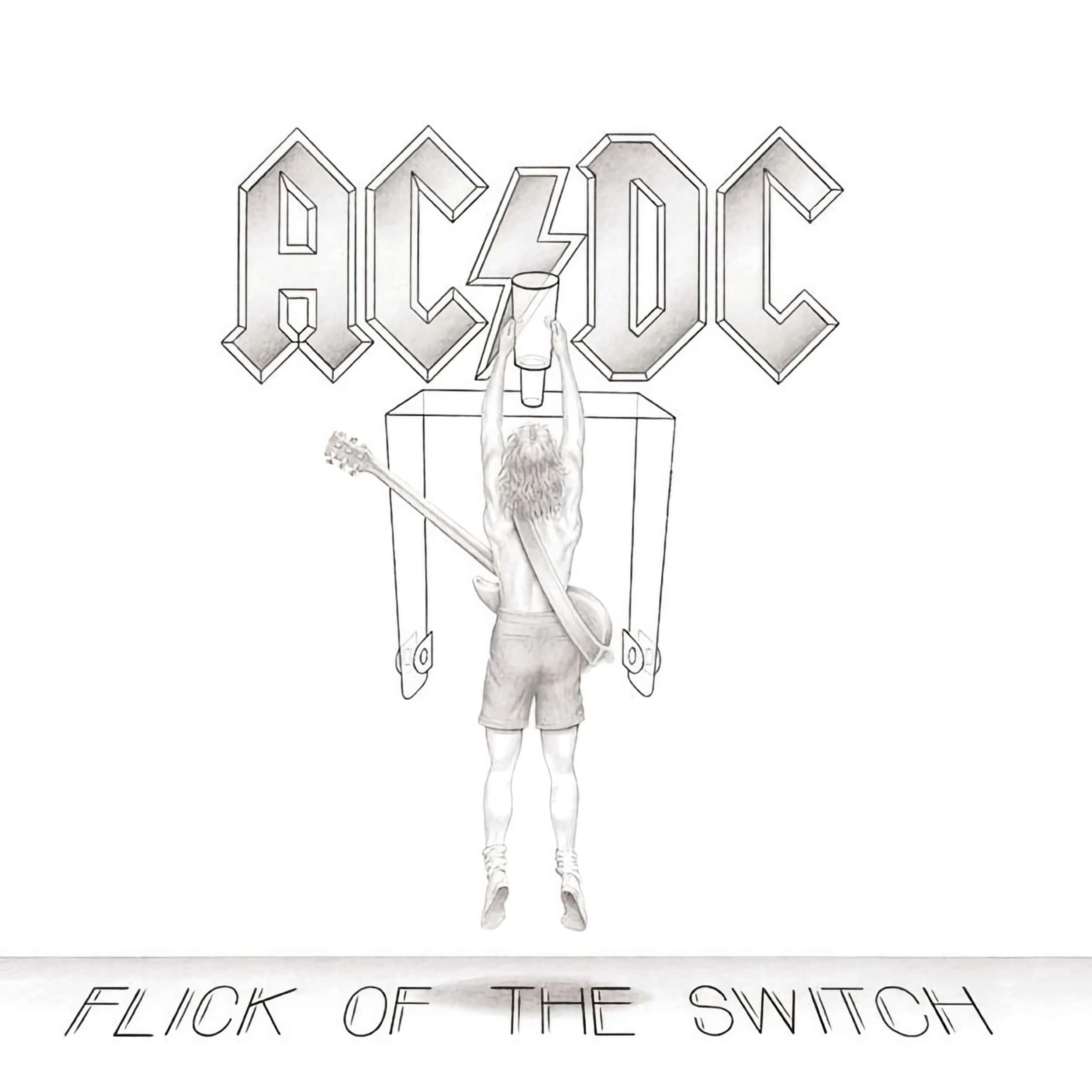
Flick Of The Switch is an interesting release for it was most certainly overshadowed by the mammoth success of Back In Black and to a lesser extent, For Those About To Rock (We Salute You) but despite leaning into the band’s signature blend of hard-hitting riffs, catchy melodies, and tongue-in-cheek lyrics, what we have is a thoroughly enjoyable selection of songs but not a perfect album experience. 

In some respects, Flick Of The Switch could almost be seen as a collection of songs that were cut from the aforementioned releases. It isn’t, after all, uncommon for a band to write more than they require for a given release, only to work on those songs at a later date and release them on a future album. That is, after all, how Rock Or Bust and POWER UP were conceived. To my knowledge, however, that wasn’t the case here. What is acknowledgeable is the stylistic shift towards rawer production values, similar to those heard on the Bon Scott era AC/DC albums. 

It well could be the more straightforward, no-frills sound that limits the overall flow of the album experience; particularly if listening to their discography in chronological order. That said, Flick Of The Switch features numerous killer tunes and while I have ranked it as 12th in AC/DC’s discography, it remains one of the best releases from 1983 and is only ranked so low because AC/DC’s greater discography is impressive, to say the least. I do, however, stand by my statement, in the ranked list, that the album doesn’t have a memorable quality. If you were to quiz me on specific songs, from this release, I’m not sure I’d be able to answer correctly, despite thoroughly enjoying the songs when I play the album. I don’t want to suggest that this record is best listened to in the background, but there’s nothing offensive regarding the song selection, there just isn’t a chart-topping hit to speak of.

Rather than working again with Robert John “Mutt” Lange, AC/DC decided to self-produce this release and that significantly contributed to the overall style of the record for Lange’s production focus was bold and dynamic with a focus on chart-topping stadium-filling hits. While we can ponder what Flick Of The Switch may have been with Lange in the production chair, it wasn’t to be and if we’re to endorse artistic intent, then fans have to be content to acknowledge that while Flick Of The Switch may lack focus, and the bold production values of Lange-produced albums, it is ultimately what the Young brothers were aiming to achieve. 

None of that, however, limits us from rocking out to this release, although the Hi-Res Lossless Apple Music stream, an Apple Digital Master, is a little underwhelming in places. Perhaps it’s the way the album was recorded and mixed, but there’s a sense of the music being concealed slightly as well as some annoying cymbal crunching. As the album was remastered in 2003, and the stream is the direct counterpart, it very well could have been a result of the 2003 remastering process that significantly reduced the dynamic range of the recording. 

Other than that, the stream sounds good and you’ll find it easy to appreciate Angus Young's blistering guitar solos and Malcolm Young's rhythm guitar providing the backbone of the album, driving each song with relentless intensity. Brian Johnson's raspy vocals soar above the instrumentation, delivering gritty and impassioned performances throughout, while Cliff Williams' solid bass lines and Phil Rudd's powerhouse drumming anchor the rhythm section, adding depth and groove to the entire album.

Rising Power kicks the album off with a magnificent guitar riff that, when combined with the rhythm, creates an energetic track with some thunderous drumming from Phil Rudd and driving basslines from Cliff Williams. Brian Johnson's gritty vocals complement the lively instrumentation, but the bridge and chorus, with the backing vocals, are a distractive element in an otherwise perfect tune. 

This House Is On Fire maintains the album's high energy with a relentless rhythm and infectious guitar hooks. The lyrics convey a sense of urgency that matches the intensity of the music and in many respects, This House Is On Fire is so close to an anthemic sing-along tune that it, with a little more spit and polish, could have been a standout track. 

Flick Of The Switch is a fierce and unapologetic anthem that captures the essence of AC/DC's raw, no-frills sound. It’s, subsequently, the perfect title track. Again, it is only let down by the rawer production. 

Nervous Shakedown introduces a mid-tempo groove with a killer guitar riff that would have been perfectly suited to Stiff Upper Lip. Johnson's vocals take on a smoother more melodic tone, adding a dynamic contrast to the album, but it’s the catchy chorus and addictively good hooks that make Nervous Breakdown, arguably, one of the best songs from the record.

Landslide opens with some lovely noodling on the guitar that builds momentum with its driving rhythm, and Johnson’s raw vocal delivery. Landslide is a solid album-only tune, but it is unlikely to be anyone’s favourite song and is largely unforgettable. That said, every time it comes on when I play the album, I thoroughly enjoy it. 

Guns For Hire, much like Nervous Shakedown, is one of the standout tracks on the album. It's a high-octane rocker with a relentless groove that, when coupled with Angus Young's electrifying guitar solos and Johnson’s soaring vocal performance, creates an impressive listening experience.

Deep In The Hole is another of AC/DC’s incredible bluesy numbers that showcase not only their versatility but penchant for songs with a swaggering vibe.

Bedlam In Belgium with its upbeat tempo and catchy rhythm is an engaging listen but it’s unlikely that you’ll seek this song out, outside of the album’s linear structure as it simply isn’t a standout. 

Badlands maintains the album's momentum with a driving beat, catchy guitar riffs, and a dose of the blues. The track's straightforward structure and memorable hooks contribute to its overall appeal but Johnson’s vocals sound a little strained. Nevertheless, Badlands is a killer tune that reminds me fondly of ZZ Top as it would have been perfectly suited to the trio. 

Brain Shake is grossly underproduced and the cymbal crunching drives me insane each time I hear it. It’s a shame because it’s an adequate closing track otherwise. Yes, I believe Badlands would have been a stronger closer, one that would ultimately encourage the spinning of the album again, but that wasn’t to be.

Flick Of The Switch may not have achieved the same commercial success as its predecessors, but it remains a solid entry in AC/DC's discography. Its raw sound, and infectious energy, capture the essence of the band, even if the production on this release is a let-down. Nevertheless, Flick Of The Switch continues to resonate with audiences decades after its release and is one of the best albums released in 1983 and would likely have ranked higher within AC/DC’s discography had they not had so many other exceptional albums both prior and after this album’s release. 

AC/DC – High Voltage (Album Review)

Comment

AC/DC – High Voltage (Album Review)

Released in 1976, High Voltage would become AC/DC’s pseudo debut as the song selection was taken from their 1975 Australian-only releases of T.N.T. and High Voltage. While the Australian-only releases are highly sought-after by collectors, the songs that were omitted have since been released on the incredible ’74 Jailbreak and the rather extensive Backtracks compilation and are worthwhile checking out. That said, I consider the international 1976 version of High Voltage to be the true debut of the band as this edition is non-relenting in its rhythmic drive, ensuring there isn’t a dull moment from start to finish.  

The excitement is naturally driven by the album artwork. While it may not be the greatest in AC/DC’s illustrious career, it suits the band and the album perfectly ensuring that the visual element is a perfect counterpart to the music contained within. One can only imagine being a record buyer in 1976 and seeing the cover art for the first time; I know it would have compelled me to pick up the album based on the artwork alone. 

Moving forward into the modern era, music lovers can increasingly get access to the record via streaming services and while I’m still a proponent of physical media, the Apple Digital Master, available via Apple Music, sounds exquisite and I believe is derived from the core 2003 remastering sessions of AC/DC’s entire back catalogue that were the basis for the well-regarded vinyl and CD reissues. While some may lament the remastering of albums, it’s comforting to know that regardless of which delivery method you choose to listen to this classic album via, they’re all based on the same master. Plus, and some may disagree, but I feel the 2003 AC/DC remasters are fantastic.

It’s A Long Way To The Top (If You Wanna Rock ’n’ Roll) is one of the greatest songs ever written and recorded. The inclusion of the bagpipes was a masterful move and showed Bon Scott as more than just a vocalist. The version heard here is, however, shorter than the original Australian-only release, so if you’re a purist you would be well-advised to check it out on Backtracks. It’s A Long Way To The Top (If You Wanna Rock ’n’ Roll) has also been covered extensively with two of the best renditions being recorded by John Farnham and Lemmy Kilmister & Jake E. Lee.

Rock ’N’ Roll Singer isn’t a bad song, but it isn’t one of AC/DC’s strongest. However, via the charismatic nature of Bon Scott, Rock ’N’ Roll Singer takes on a life of its own and we’d be worse off as fans if this tune had been omitted from the album. 

The Jack is brilliant. The blues-based rhythm is compelling and it’s yet another example of AC/DC at their cheeky best.  

Live Wire is a killer rock and roll tune and that intro is one of the best in AC/DC’s entire catalogue; perhaps only rivalled by the build-up of Thunderstruck. Regardless, Live Wire is an all-time favourite of mine and is a highlight from High Voltage.

T.N.T. is one of AC/DC’s best and is one of the greatest rock and roll anthems that has ever been written and recorded.

Can I Sit Next To You Girl is a great song, but it is Mark Evans’ bass tracking that takes this song from a run-of-the-mill bluesy rock and roll tune to a killer rock song worthy of the AC/DC name. Interestingly, Can I Sit Next To You Girl was AC/DC’s first single, released in 1974 and at the time titled Can I Sit Next to You, Girl with Dave Evans on vocals, Colin Burgess on drums and George Young on bass guitar. While the earlier version is out of print, and is different, it hasn’t been officially reissued since its initial release, but if you look on YouTube, you’ll come across uploads of the original. 

Little Lover is pure sonic bliss. It may be a slow track, but there is nothing pedestrian about Little Lover. It is a shame, however, that it hasn’t been more prominent throughout the years, but perhaps that is a good thing considering I generally prefer Brian Johnson’s vocal delivery, but I couldn’t imagine anyone else singing Little Lover better than Bon Scott; he mastered it!  

She’s Got Balls has a great rhythm and is a solid tune but it isn’t a standout. That said, the album wouldn’t be the same without it.

High Voltage is a fantastic song, a perfect title track, and an ideal closer. However, perhaps it’s just me, but having heard it so many times over the years, I can’t help but feel it’s a little overrated.

High Voltage is a classic album that captures the essence of AC/DC’s early years. It serves as a testament to their ability to create timeless, no-nonsense rock and roll; a constant element throughout their career. A core strength of High Voltage lies in the simplicity and authenticity of AC/DC's sound as the album doesn't rely on complex arrangements or intricate production; instead, it thrives on the sheer power of its raw, stripped-down rock and roll. The result is that High Voltage is amongst the greatest hard rock albums ever released and is a must-listen for anyone seeking a genuine hard rock experience. 

Comment