England Dan & John Ford Coley – Some Things Don't Come Easy (Album Review)

England Dan & John Ford Coley – Some Things Don't Come Easy (Album Review)

When you think of classic albums, England Dan & John Ford Coley’s Some Things Don't Come Easy probably doesn’t spring to mind, but this 1978 release, their sixth studio album, is a musical masterpiece that showcases the duo's extraordinary musical skills. With a mix of soft rock, pop, and country, the 11 tunes featured present a delightful listening experience that captures the essence of the music scene in the 70s.

Speaking of capturing the soul of a recording, Some Things Don't Come Easy was recorded, mixed, and mastered with kid gloves. While the album has never been remastered, to my knowledge, the lossless Apple Music stream is simply magnificent. It’s flawless and thoroughly enjoyable and I wouldn’t want a single aspect to be changed; well perhaps a slight recess in the brass elements on songs such as Calling For You Again. Nevertheless, your thoughts may differ, but the stream is one of those examples whereby there is plenty of latitude that allows for the tweaking to one’s tastes via EQ settings.  

Some Things Don’t Come Easy is an exceptional opening ballad that showcases the duo's vocal range and emotional depth. It sets the tone for the entire album and is worthy of the title track. The song's lyrics express the difficulty and pain of love, one we can all relate to, thereby, creating a poignant and touching listening experience.

If The World Ran Out Of Love is a sensational followup to Some Things Don’t Come Easy as the slow ballad, easy listening, style is acoustically marvellous. It’s one of those songs that you’ll likely find yourself pausing, in awe, for the soundstage that emanates is intoxicating. There is little doubt in my mind that If The World Ran Out Of Love is one of the greatest hidden gems of the 70s. 

You Can’t Dance is an upbeat number that shifts the tempo of the album. With its catchy pop-rock melody that is accentuated by the duo's trademark harmonies, and backing vocals, there’ll be fans of You Can’t Dance. I’m not one of them as I feel it is too far removed from the other songs on the album, but Some Things Don't Come Easy wouldn’t be the same without this tune. 

Who’s Lonely Now features a beautiful and melancholic melody, perfectly complemented by the duo's soulful harmonies. It’s a standout track that reminds me somewhat of the overarching style on Crosby, Stills & Nash’s CSN, but that is a compliment as I adore that album. If nothing else, Who’s Lonely Now will resonate with anyone who has experienced the pain of a broken heart; that’s all of us, right?

Hold Me features a beautiful and soulful melody that makes it one of the best songs on the album and one of the greatest that England Dan & John Ford Coley ever recorded; magnificent!

We’ll Never Have To Say Goodbye Again is a trademark tune and for good reason, as it appeals to those of us who appreciate touching and sentimental ballads. The ability for one to connect with the music they love is incredibly powerful and while some will lament the cliché aspect of love songs, there is no denying that they’re timeless.

Lovin’ Somebody On A Rainy Night has an Eagles’ feel to it that perfectly suits Dan and Coley’s style. I wouldn’t, however, consider it the strongest song on the album as it’s more filler than standout and you’re subsequently unlikely to seek it out, outside of the album format. 

Beyond The Tears returns us to a gentle and melancholic melody that I feel is better suited to the duo as it permits them to do what they do best; convey deep emotions and vulnerability through their music. 

Calling For You Again is a shock to the senses following the laidback style of Beyond The Tears. Nevertheless, once the addition of the brass component has settled down in my mind, Calling For You Again is a solid energetic tune. The only quibble I have is that I feel the saxophone element could have been dialled back a little as I find it to be too forward in the mix.

Wanting You Desperately is a heartfelt and emotional tune with soulful harmonies and lush instrumentation that creates a powerful and emotional atmosphere.  

Just The Two Of Us is one of the most beautiful and romantic ballads you’re ever likely to come across. It’s also the perfect closer as it encourages contemplation and the thought of playing the album again. Its simple yet effective arrangement, along with the duo's tender harmonies, creates a warm and intimate atmosphere that further showcases the duo’s ability to convey heartfelt sentiment and genuine emotion through their music.

Overall, Some Things Don't Come Easy is one of those albums that is tragically overlooked for its beautiful melodies, insightful lyrics, and impeccable vocal harmonies ensure this album remains a timeless classic that continues to resonate with listeners to this day. 
The Moody Blues – Octave (Album Review)

The Moody Blues – Octave (Album Review)

Released in 1978, Octave is the ninth studio album from The Moody Blues and dare I say one of their greatest, if not their greatest release. Certainly, that perspective is heavily based on subjectivity, for Octave isn’t often at the top of everyone’s list, but when music sounds this good, it is difficult to overlook.

While I can’t speak for anyone else, the probable culprit, besides the lengthy hiatus between releases, of Octave’s less-than-stellar acceptance amongst fans, likely has more to do with the slight shift in style when compared directly with their previous works. For instance, Octave relies far more heavily on synthesised elements but to ignore the release on that aspect alone appears very shortsighted. Admittedly, when we find an artist that we thoroughly enjoy, we want more of the same. However, is it not better to appreciate one, or a small selection of albums, than to feel dejected by an album that doesn’t match up to our subjective expectations?

Much of The Moody Blues music, including this release, is a sonic journey that has to be experienced firsthand to be fully appreciated. Octave, subsequently, is a hidden gem that deserves another listen if you’ve previously ignored the release. It was also the last album The Moody Blues would record with longtime producer Tony Clarke and while producers aren’t always given their dues, their influence bleeds into the work. Yes, the core of The Moody Blues would persist, post-Octave, but their newer works were somewhat different and, in my opinion, not as appealing. 

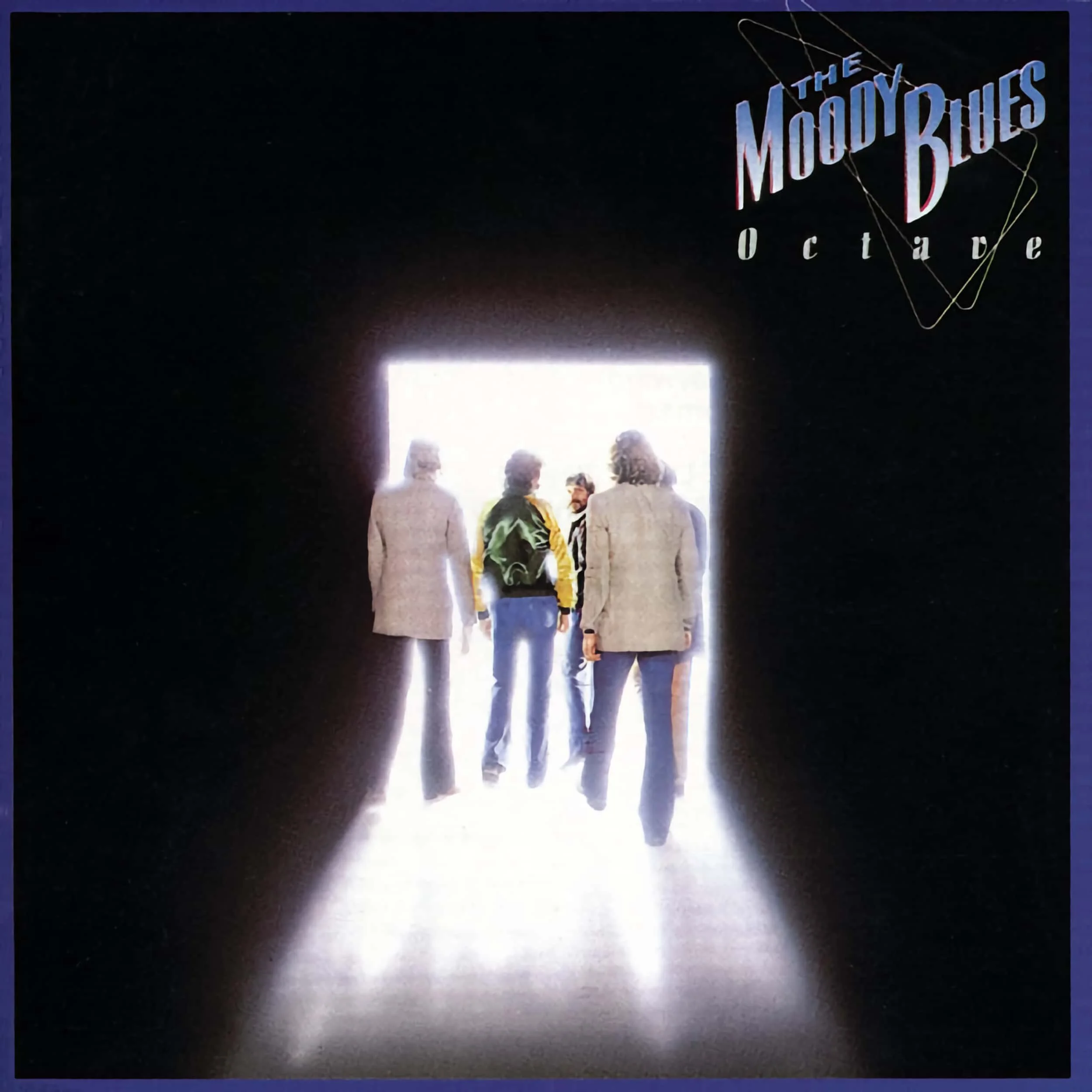
As it pertains to album artwork, I also consider Octave to be the best from The Moody Blues’ entire catalogue and that’s saying something for they’ve always had well-designed artistic album covers. This one, however, done by the legendary John Kosh, is as captivating as the music is. The doorway to somewhere else concept is hardly new, but it hasn’t aged and is still as vinyl canvas-worthy today as it was upon its initial release. 

When listening to modern releases, or remastered reissues, we usually experience a loud reproduction of the music contained within. That isn’t the case with the Lossless Apple Music stream. While not presented as a Hi-Res Lossless stream, or an Apple Digital Master, the mastering, on this particular release, allows the listener to turn the volume up to their preferred setting. Subsequently, you’ll be met with a full-bodied sound that is thoroughly enjoyable. Could it be better? Perhaps, and there are examples such as when listening to Top Rank Suite where I’d love to hear the brass elements come alive a little more, but it’s a minor quibble and doesn’t detract from the overall experience of the album. It’s also possible that that aspect could be corrected in the mix rather than mastering stages. 

Delving deeper, I note that the Expanded Edition has the 2008 publishing trademark whereas the standard version is listed as 1978. It’s incredibly frustrating when this happens and I do wish that the record label and Apple Music would offer a more detailed explanation of which edition is derived from which master because both versions are noticeably different. They’re both lovely, in their own right, but you’ll find that you prefer one over the other and it would simply be nice to know more details about a particular release. 

I prefer the standard edition, as will be shown below, as I feel it’s more luscious and dare I say more analogue with a warm and enveloping sound signature. That said, give both a listen and see which you prefer as I can’t tell you which is better (a terrible metric, by any standards) as they both have their pluses and minuses. Additionally, while I’m not overly keen on bonus songs, the Expanded Edition does contain five additional live tracks that may be of interest to you.

Steppin’ In A Slide Zone has a slow atmospheric build with a killer guitar intro and riff throughout. Once the energetic styling of the song enters the mix, it becomes a classic rock tune and sets the tone for the entire album; a great opener. 

Under Moonshine is, by comparison, more mellow with a style more reminiscent of The Moody Blues’ earlier recordings with a delicate lead vocal, dreamy harmonies, and symphonic elements that take you on a musical journey. 

Had To Fall In Love is one of the very best ballads I have ever heard. Yes, dear reader, I love a good ballad and the soulful vocal performance, melded with the musical backing, is utterly perfect making Had To Fall In Love one of The Moody Blues’ greatest recordings and one of the best ballads from the 70s. Magnificent!

I’ll Be Level With You is a raw rocker with an upbeat styling that while considerably different to Had To Fall In Love, becomes a value-added tune within the context of the album. While you’re unlikely to seek out I’ll Be Level With You on its own, Octave wouldn’t be the same without it. Plus, the guitar work and solo towards the end are thoroughly enjoyable and always encourage me to get out my air guitar. 

Driftwood is a beautiful ballad. 

Top Rank Suite, and its upbeat rhythm and jazz styling, is addictively good. No, it isn’t the greatest song on Octave, and may well be considered the weakest track on the album, but the light-hearted musical styling makes this one fun song to listen to. 

I’m Your Man has a mellow blues-based styling but as good as the musical elements are, it’s the smooth vocal that ensures I’m Your Man is a standout track. 

Survival is hypnotic, symphonic, and captivating. A hidden gem? I truly believe so, but I’d go one step further and declare it a trademark tune and a timeless classic recording.

One Step Into The Light is another standout track with a beautiful melody and lush instrumentation. 

The Day We Meet Again is the perfect closer to an exceptional album. It’s simply incredible and is a sonic pleasure for the ears. While ballads are certainly a trademark of The Moody Blues, this one leaves you both in a contemplative mood as well as being interested in spinning the album again. Such a song is a rarity but when they exist, it results in a cohesive album experience; one worthy of The Moody Blues. 

Overall, Octave is an exceptional addition to The Moody Blues' discography, featuring a mix of upbeat rockers and moving ballads. While some may lament various elements of Octave, it’s clear that the band were at the top of their game with each member contributing their own unique talents to the mix and direction of this 1978 masterpiece. 

Katy Perry – Prism (Album Review)

2 Comments

Katy Perry – Prism (Album Review)

Prism, Katy Perry’s fourth studio album, and her third within the mainstream popular music genre, is full of electrifying dance-pop rhythms, infectious hooks, and catchy melodies. Add to that her meaningful lyrics and you’ve got a truly captivating album that’s a landmark release of the pop music genre. 

While it would be easy to assume that Perry reached her creative peak, following the exceptional Teenage Dream, Perry didn’t sit on her laurels instead choosing to head back to the studio just over two years later to record an album with a somewhat more serious tone; one that also showcased artistic growth. 

What didn’t increase, however, is the dynamic range of Perry’s recording. Prism is mastered, as many modern recordings are, too loud. That doesn’t mean that it doesn’t sound good, or that you won’t be drawn into the music, but it does mean you’re more likely to experience fatigue and may find yourself turning the volume down. 

Despite that, I find that the lossless Apple Music stream, an Apple Digital Master, manages to smooth out the presentation of the album just enough that it can be turned up to moderate levels without hearing distracting artifacts.

Alongside the stereo mix of Prism, on Apple Music, is a Dolby Atmos stream that is not only thoroughly enjoyable but more immersive than the stereo edition. You’ll be met with more depth and an overall bolder soundstage and the presentation isn’t so different to the original stereo mix that you’ll wonder if it is the same album; an issue that plagues many surround mixes when they are created post-album release.

While some may wonder if you can still appreciate the stereo mix, following listening to the album in surround sound, the answer to that is an unequivocal yes. That is because the surround mix is complementary; ensuring that the core of the album remains intact while simultaneously adding nothing to the mix that wasn’t already there. 

Roar was the lead single from Prism, but while this mid-tempo power pop tune is empowering, it isn’t the greatest song from the album. Like many instant hits, the more you listen to it the more it loses its lustre. It’s as if the substance of the song is merely surface deep and perhaps that is all a pop song needs, but I do question if Roar will ultimately be timeless. 

Controversially, you may also wish to check out Sara Bareilles' Brave, from her album The Blessed Unrest, as there’s quite an interesting correlation between the two songs. 

Legendary Lovers has a fantastic Middle Eastern-inspired rhythm that will infuse itself with your soul. The combination of styles, with pop influences, is masterful and Legendary Lovers quickly becomes one of the best tunes from Prism

Birthday is cringeworthy! 

Okay, so its upbeat styling will appeal to many but it's too cliché to be taken seriously. Of course, that is probably the point of the song and perhaps I’m simply listening incorrectly and not allowing myself to groove out and have a good time. 

Nah, it’s just not my kinda song!

Walking On Air has a dance-pop groove that will light up any dance floor. While there’s already a fair bit of vocal processing applied, I can’t help but wonder what the results of turning Autotune to its highest settings would have had on the song. It may well have ruined it, but I have a feeling it would have been even more sonically impressive than it already is.

Unconditionally is a stunning power ballad that showcases Perry’s vocal prowess. While the verses are a slow build, that soaring chorus draws you in and becomes not only one of the best songs from the album but one of Perry’s greatest musical achievements. 

Dark Horse (feat. Juicy J) is a mashup of styles but its edginess, combined with the hypnotic intensity, ensures that Dark Horse is a standout recording. The collaboration with Juicy J was also well-chosen as there isn’t another rapper that I feel would have been better suited.

Interestingly, and in another case of appropriation by Perry et al, Flame lodged a copyright claim that Dark Horse was derived from his song Joyful Noise, from the 2008 album Our World Redeemed. The court concluded that this was indeed the case and damages were awarded.

Having listened to Joyful Noise, there is no doubt in my mind that elements were borrowed and while I appreciate both songs, this is one case whereby if Perry et al had officially credited Flame, as a co-writer, legal action wouldn’t have been required after the fact. Of course, it can be argued that the borrowed elements were utilised unintentionally, for music tends to get stuck in our feeble human minds, but that still doesn’t constitute innocence as it relates to copyright laws. 

This Is How We Do flows perfectly from Dark Horse, primarily because of a similar memorable infectious dance-pop rhythm. However, This Is How We Do is much more upbeat, thereby making it a perfect musical contrast to the previous tune. While you’ll likely seek This Is How We Do out on its own, for it’s that good, this is one example that showcases the importance of album sequencing as when done well it ensures the album experience remains paramount. 

International Smile is a fun little tune but the chorus is incredibly trite.

Ghost is another exceptional mid-tempo ballad; arguably a Perry trademark thereby making Ghost one of the best tunes on the album.

Love Me is toe-tapping head-bopping bliss. Perry’s vocal delivery here is particularly appealing and while Love Me was never going to set the charts on fire, it’s a thoroughly compelling upbeat pop tune with a great message for those of you who appreciate lyrical interpretation; particularly lyrics that are empowering. 

This Moment has a pop-disco vibe that I can easily get behind. In many respects, This Moment is the song that is most likely to be compared to Firework, for it has a similar sonic styling despite being a little more laid back by comparison.

Double Rainbow is a lovely romantic tune.

By The Grace Of God is a beautiful closing tune that’s filled with emotions; some of which are more sombre than those heard throughout Prism. Yet, despite this, By The Grace Of God encourages listeners to play the album again. However, as much as I appreciate the verses and the bridge, the chorus is a little over-produced as I feel it would have been stronger had there been fewer musical elements brought into the mix. 

While some will forever peg Perry as nothing more than bubblegum pop, Prism showcases artistic maturity that goes beyond the disposable aspect as this album is not only one of the best released in 2013 but is one of Perry’s greatest musical achievements. 

2 Comments

Billy Joel – 52nd Street (Album Review)

Billy Joel – 52nd Street (Album Review)

Following The Stranger was always going to be an insurmountable task for once perfection is reached, it’s often difficult to replicate what made the previous work so successful. That isn’t to suggest that 52nd Street, Billy Joel’s sixth studio album, didn’t give it a good shot, for it’s an excellent album when listened to without contrast, it just falls a little short when directly compared to Joel’s 1977 opus.

While the songs on 52nd Street aren’t as strong and don’t present Joel’s vocals as eloquently as had been heard the year before, I find that the production quality is the element that causes 52nd Street to be viewed differently. If it were any other artist, 52nd Street would be a landmark release, but we all know how capable a vocalist Joel is and his prowess simply wasn’t captured, within each song, on this record. Despite that, it’s still one of my favourite albums from 1978, I just wish there was a little more spit and polish applied to the recording and mastering of this classic album.

Where The Stranger was sonically lush, 52nd Street is hollower by comparison. As an Apple Digital Master, and Hi-Res Lossless version, it’s fair to say I expected more and can only put down the average sonic presentation to the recording style and processes. Granted, not every Apple Digital Master is a home run, but I find more often than not; they are. Yes, the style of music is slightly different with fewer rock and blues influences, replaced with a touch of jazz, but the problem is that you’ll be listening to your speakers rather than being enveloped in the soundstage. I liken it to Meat Loaf’s Bat Out Of Hell; another masterpiece that was poorly recorded. 

Some may even suggest this underproduced feel adds to its appeal, but I know how I like my Billy Joel albums to sound and this is one example whereby the version provided to Apple Music isn’t flawless. Even adding a touch of EQ doesn't completely address these issues for it amplifies the problems in a different direction. For instance, adding a little bass and reducing the treble slightly results in a muddier midrange but doesn’t correct the flatness of the recording.

Does a better edition exist, particularly on a physical medium? Perhaps, but as I don’t have another version to compare it to, at this point in time, that comparison will have to wait for a future update.

Lamenting the sonic quality, however, I find it interesting to note the music falls into line with the album’s artwork as the rawness of the sound is visually represented. It’s one of those moments where you can forgive recording elements and look compellingly into the artwork and see correlations with the music. Subsequently, when looking at 52nd Street as an entire package, it makes sense that it’s a little underproduced if we consider the music against the album artwork.  

Big Shot has never been my favourite tune as I feel it starts too abruptly and Joel’s nasally vocal can be grating on the senses. That said, if I have the album on in the background, and don’t pay particular attention to this aspect, it’s thoroughly enjoyable.

Honesty is an incredible ballad that has stood the test of time for it sounds as fresh with modern ears as it would have when initially released. It is Joel 101 and most certainly a highlight from 52nd Street; a beautiful song! 

My Life has a great toe-tapping head-bopping rhythm. The piano work, Joel’s vocal (particularly the echo applied), and the rock-solid backbeat ensure that My Life is an exceptional tune. While Joel has never needed backing vocalists, Chicago’s Peter Cetera and Donnie Dacus are valued additions to My Life as their backing harmonies are exquisite.

Zanzibar is one of the more obscure tracks on 52nd Street for its somewhat off-beat nature and stylistic shifts throughout shouldn’t work, yet they do. It may take a few listens to fully appreciate Zanzibar, but when you let the music flow, rather than analyse it, you’ll find it’s much more enjoyable. 

It should also be noted that the great Freddie Hubbard recorded the trumpet solos further linking the jazz influence to the overall style of the song and album. In fact, I think it would have been wonderful had Hubbard been included on other songs throughout as I feel the combination of styles would have taken 52nd Street to another level entirely. 

However, the fade-out on the second solo begins too early. Thankfully, an unfaded version of Zanzibar exists on My Lives, thereby allowing Hubbard’s brilliance to become even more prominent on this classic tune. 

Yes, sometimes less is more, but that is most certainly not the case here; although, I do understand why the second solo’s length was reduced as keeping it in would have not only detracted from the flow of the album but would have exceeded the ideal play length of the vinyl record.

Stiletto is one of the greatest songs of all time! That introduction, the beat, the rhythm, the jazziness. I love everything about Stiletto and the shifting styles, while risky from a fluidity perspective, is utterly perfect. A hidden gem if there ever was one. 

Rosalinda’s Eyes is a little underwhelming, particularly after Stiletto. It’s a solid tune, but you’re unlikely to seek it out on its own. 

Half A Mile Away picks up the tempo and brings us back to the brass-driven rhythm that works particularly well with Joel’s vocal recordings. Half A Mile Away may not have been a hit but it’s a great tune that should have achieved more recognition, if for no other reason than that incredible vocal performance. 

Until The Night is another beautiful ballad by Joel and it would have been the perfect final tune as I don’t feel 52nd Street closes the album out well. The shift in vocal pitch, throughout, is a highlight as it lifts the listener’s attention through the more sombre elements of the song, but in all aspects Until The Night is a perfect song and another hidden gem that deserves more recognition than it often receives. 

52nd Street, despite being the title track, is atrocious. It really should have been left off the album as it does nothing to encourage the listener to spin the record again and is one of the all-time worst closing tracks, on any record, by any artist, let alone one of such stature as Joel. 

Overall, while it can be suggested that 52nd Street is the most unique of all of Joel’s albums, in that it doesn’t conform to a natural progression from his previous releases, it simultaneously offers music lovers an album filled with infectious melodies, intricate arrangements, and insightful lyrics. Yes, I’m critical about certain elements and while it isn’t his greatest album, I’ll be damned if I don’t admit to thoroughly enjoying it every time I listen to it. Let’s put it this way, Joel’s catalogue of music is enhanced by the presence of 52nd Street and, sometimes, that is all that is needed. 

Dances With Wolves – Original Motion Picture Soundtrack (Composer: John Barry) [Album Review]

Comment

Dances With Wolves – Original Motion Picture Soundtrack (Composer: John Barry) [Album Review]

Released in 1990, to correspond with the film’s release, the Dances With Wolves Original Motion Picture Soundtrack, composed by John Barry, perfectly captures the spirit and emotion of the film. From the sweeping, epic overtures to the more intimate and introspective moments, the music transcends a film score and becomes a simply sensational piece of classical music that you’ll find yourself listening to time and time again. 

As one of the greatest soundtracks ever recorded, I’ve lost count of how many times I’ve played it since its release, but it would have to be hundreds if not thousands of times. You see, Dances With Wolves, unlike other soundtracks, is so remarkable that it can be appreciated in both the foreground and background as it seamlessly integrates into just about any situation. 

As you may have guessed, Dances With Wolves is my favourite soundtrack of all time and while the film is epic in its own right, I can’t recall the last time I saw it. It would have to be a couple of decades. It simply didn’t make as much of an impact on me as John Barry’s score did. 

In fact, I am so enamoured by this soundtrack that I’m not ashamed to admit that I have two copies. One on CD the other on vinyl. Most of the time, I find myself gravitating to the standard CD release for this is the edition that I listened to back in the 90s as it was the perfect studying accompaniment whereby the 54-minute runtime seemed to match my level of peak concentration and permitted a six-minute break before getting back to work. 

Depending on which region of the world you reside in, you’ll likely find that you’ll come across one of two different cover art designs. Perhaps that is another reason why I own two copies as the vinyl counterpart offers me the alternative cover art; of course, that’s just a convenient excuse, but I can think of far worse justifications. 

The CD booklet is rather basic but in all honesty, there isn’t a need for extraneous elements. Although, the vinyl reissue as I’ll come to later, could be a little more complete. That said, it would be nice to have had the orchestra members credited for John Barry may be the maestro but his orchestra isn’t mentioned and they’re the ones that turn his masterpieces into audible reality. Granted, this aspect isn’t uncommon, but it is one element that I feel needs addressing. 

Sonically, the CD is as magnificent and expansive as the film that accompanied it. It’s a pleasure to listen to for its clarity and dynamic range never cease to amaze. Of course, that is before we put the Original Recordings Group (ORG) 2014 reissue on the turntable.  

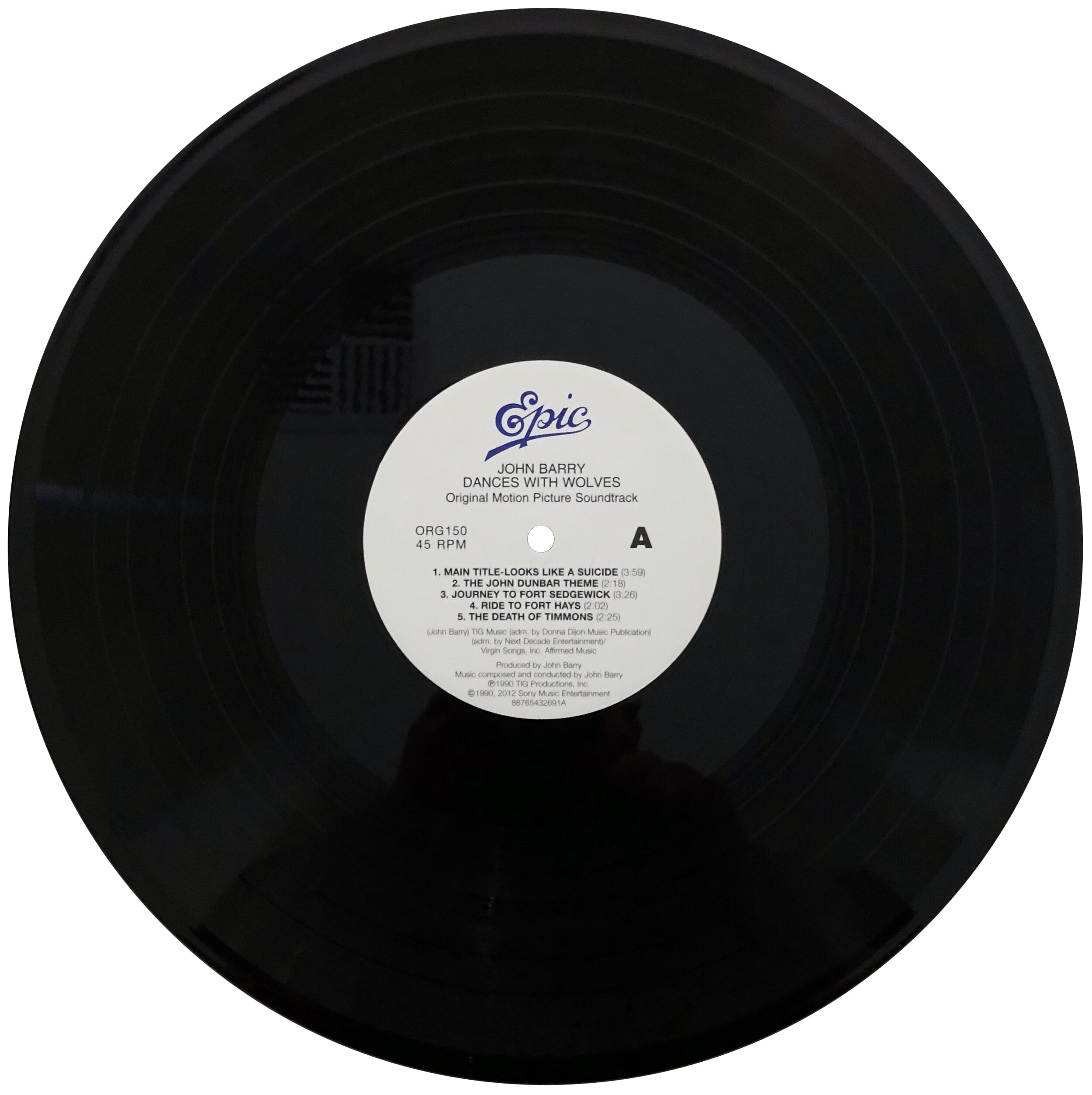
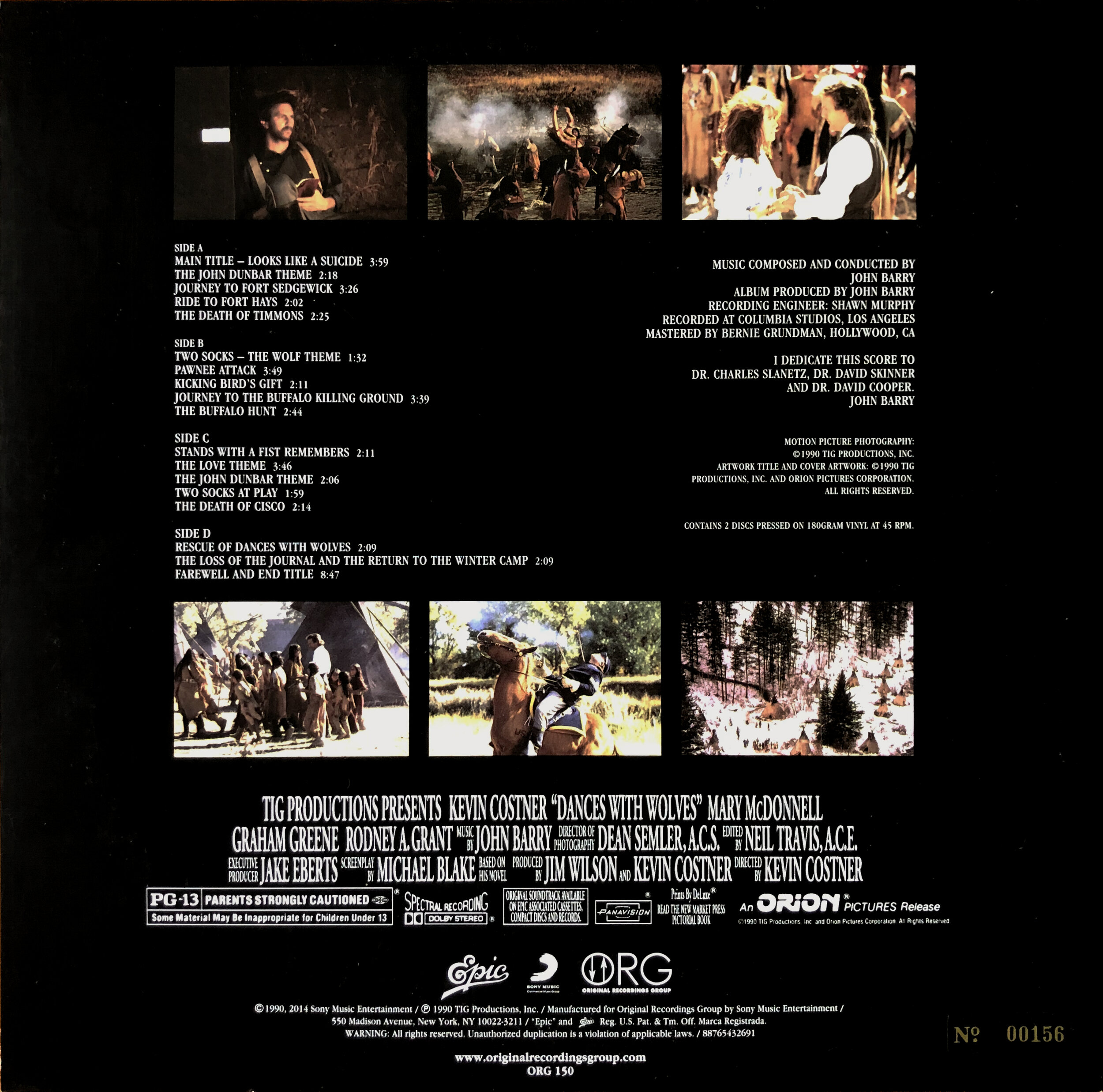
Towards the end of 2014, I heard that Original Recordings Group (ORG) were to release a limited, numbered, edition of this beloved soundtrack and I simply couldn’t resist. For those of you who are interested, I’m fortunate enough to own number 156 out of 2500. The number, of course, isn’t essential, but it adds further uniqueness to my collection. This particular repressing would also mark the first time the Dances With Wolves soundtrack would be reissued on vinyl, since the original 1990 release. 

ORG are renowned for their sonic quality and this is no exception having been pressed and delivered at 45rpm. That, of course, means that the soundtrack is presented across four sides and is as luscious as one could hope for. Naturally, as classical music fans will note, vinyl isn’t the epitome of sonic reproduction as pops and clicks do manage to creep in in even the most arduously cleaned record playback chain. It’s simply the nature of the format and while it sounds utterly incredible, the CD release becomes sonically superior by default of not having surface noise to contend with.

Some may not mind, of course, as life has a level of surface noise that often can’t be avoided, but the ORG releases, despite being intricately reproduced, are rather expensive and if a CD at the fraction of the cost remains superior, for this listener, then one must naturally question if classical music on vinyl is a worthy endeavour. 

If you can tolerate a few minor sonic blemishes, however, for the advantage that is offered with the analogue sound, then I would suggest sourcing a copy of the ORG vinyl reissue.

Additionally, ORG releases hold their value over time but the minute you put a value on your collection, a little bit of the magic disappears for it is no longer about the way the music touches your soul. Trust me, as someone who has added their collection to Discogs over the years, it seldom results in a greater appreciation of the music itself for it commodifies that which we love. 

If there is one disappointment to note regarding the ORG reissue, it is that despite being a gatefold design, nothing is printed on the inner gatefold. It is like looking into a void for it’s black and empty. Naturally, you’ll notice that I haven’t included this element in the selection of photographs above, but if you take a glance at the CD images, you’ll see the inner design of the CD booklet that I wish had been reproduced on the vinyl counterpart. It’s a missed opportunity and is particularly disappointing as it is promoted as a premium product.

Purists will argue that it perfectly replicates the artwork from the original vinyl release and I wouldn’t disagree with them but I would add that the original release, issued on a single LP, had no gatefold. Hence, while it may be accurate, it could have also been expanded. In every other way, however, the ORG vinyl reissue is visually stunning and worthy of having in my collection.

Turning our attention to streaming, things begin to get a little more complicated. Both the CD release and ORG vinyl reissue have the original 18-track, 53-minute, score but Apple Music et al have three editions. Two seemingly identical replicas and one with an expanded runtime and sequencing. 

Seriously, why do record labels do this? The original release is perfect and the bonus tracks from a 2004 reissue program detract from the flow of the recording. Yes, after 30+ years of listening to this soundtrack, I know it inside and out so any deviation will always be a shock to the system, but while many of the additional tracks blend in adequately, songs such as Fire Dance offer a considerably different tone thereby creating the aforementioned distraction. I’d also add that just because it may have worked well within the context of the film, that doesn’t mean that it will work well when presented chronologically on the soundtrack. The number of soundtracks that have been ruined by extraneous content never ceases to amaze me. Watching a film, and listening to the score, in my mind, are two entirely different processes. They should complement each other but a soundtrack need not replicate the film experience.  

While I may be lamenting the different versions, and don’t even get me started on the 25th Anniversary double CD edition, one thing that we should be grateful for is that this soundtrack is still readily available. As fans of original motion picture soundtracks will note, few survive past their initial release and when added to streaming services, tracks are often missing due to contractual issues. A frustrating aspect; certainly!

What isn’t at all frustrating is the music contained within this release. Regular readers will note, I generally divulge into a discussion of the individual songs, on any given album, but as it pertains to classical scores, I feel it is best to let the music speak for itself for this body of work is exceptional and worthy of inclusion in every music collection; particularly one with a classical or film score focus. 

Comment

Bonnie Tyler – Natural Force (Album Review)

Bonnie Tyler – Natural Force (Album Review)

There are classic 70s albums and then there are underrated masterpieces such as Bonnie Tyler’s second studio album, Natural Force. 

For those unaware of Tyler’s musical style, her unique Welsh vocal presentation is addictively good. You’ll hear a feminine gentleness along with a guttural extension that constantly amazes you. Her uniqueness is her strength, but the huskiness that has become a trademark may have never come about had Tyler not undergone surgery to remove nodules present on her vocal cords. Subsequently, Tyler has a vocal delivery that is like no other but ensures she is amongst the greatest vocalists of all time.

Released in 1978, Natural Force achieved modest success, particularly within the US, but with a different cover and album title. I can’t begin to understand why the cover art was changed for US audiences as I consider the international album artwork to be one of the greatest album covers of the 70s. The album title change is less of a shift as it adorns the song It's A Heartache for its title track, but other than some beancounter at the record label, stateside, trying to make a name for themselves, I can’t see why this was required. Thankfully, this practice isn’t as prevalent as it once was.

Despite the shift in artwork, the track listing remained the same. That is until the CD releases added Don’t Stop The Music and It’s About Time. Usually, I’m not a fan of bonus tracks, as they can be questionable at best, but as it pertains to these additions, I consider them utterly perfect as they blend in with the other songs seamlessly. It’s as if they should have always been there but were omitted due to the ideal runtime of the vinyl record. 

Additionally, there is now the Expanded Edition, a streaming/digital download exclusive, that includes the German 7” Version of Don’t Stop The Music. While I could lament its inclusion, as it’s somewhat repetitious, you’ll see why I’m not going to, later in this review. 

While not necessarily paramount to the appreciation of Natural Force, I find it fascinating that Tyler didn’t pen a single tune. Granted, not all musicians or vocalists express their art by writing lyrics, but Tyler sings with such conviction that you’d assume she’d be personally invested in the message. Instead, the songs are primarily written by co-producers Ronnie Scott and Steve Wolfe with a cover of Stevie Wonder’s Living For The City and (You Make Me Feel Like) A Natural Woman by Gerry Goffin, Carole King, and Jerry Wexler, along with the rocking upbeat tune Yesterday Dreams by Brian Cadd. While we shouldn’t ignore Tyler’s incredible vocal prowess, it is important to acknowledge these songwriters for if the songs weren’t exceptional, Tyler wouldn’t have been able to imbue life into them.

Sonically, the Apple Music stream is the direct counterpart to the CD release and subsequently should sound the same when played back via the same stereo system. While it isn’t an Apple Digital Master, it need not be for the cd-equivalent stream is simply magnificent with a full-bodied sound and a spacious stereo image that ensures immersion is paramount to the experience. Could it be better? Perhaps, but if a remastering was to change the sonic presentation of the album, not necessarily for the better, I’d then suggest that it isn’t worth doing for the current stream isn’t significantly flawed in any way.

It’s A Heartache is one of the best-selling singles of all time and for good reason; it’s exceptional! Tyler’s raspy, yet smooth, vocal is stunning and the rhythm is so addictive to the senses that you’ll be experiencing it long after the song has ended as it has the potential to create a thoroughly enjoyable earworm within the listener’s mind. While It’s A Heartache is Tyler’s song and no one does it better, you really should check out Rod Stewart’s version for it’s complementary to Tyler’s and is thoroughly enjoyable.

Blame Me is an incredible song with so much raw emotion that it will leave you in awe. Plus, the musicality, while taking a slight backseat, is incredibly complementary to the vocal element, particularly with regard to the reserved nature of the guitar solo that is ever-present, yet not all-encompassing.  

Living For The City is a great rock tune. It has attitude. It has pizzazz. Most importantly, however, it has a rhythm that immediately connects with the listener’s soul and the extension on Tyler’s notes is, again, masterful. As for how Tyler’s interpretation compares to Stevie Wonder’s original recording, it’s significantly better. Wonder’s original, by comparison, sounds like a demo whereas Tyler’s rendition is a full realisation of what Living For The City always should have been. 

If I Sing You A Love Song was the last of the five singles released, from Natural Force, but it ultimately failed to set the charts on fire. That isn’t uncommon as the more singles that are released the less attention they tend to receive. It’s the nature of the music industry but it's disappointing when you consider just how magnificent If I Sing You A Love Song is. It’s a hidden gem, if there ever was one, and is one of the most spectacular recordings of not only the 70s, but in all of recorded music history. Hence, it was deserving of much more recognition than it received at the time and I can only hope you will enjoy it as much as I do for this is one song that needs to be heard and shared. Magnificent!

Heaven, not to be confused with the song Heaven from Tyler’s 1998 release All In One Voice, is a fun upbeat tune that will have you toe-tapping and head-bopping throughout. It isn’t the greatest song on the album, however, and is therefore surprising that it was chosen as the lead single. 

Yesterday Dreams is a great little rocker.

Hey Love (It’s A Feelin’) was the fourth single released from Natural Force but as with If I Sing You A Love Song, it failed to garner the attention it deserved. We music-loving fans have a truly limited attention span, don’t we? Of course, if the record label doesn’t push a release, it quickly disappears from the social consciousness. Nevertheless, Hey Love (It’s A Feelin’) is an incredible vocal-ballad-styled tune and is a core reason why Natural Force is such an incredible release. 

(You Make Me Feel Like) A Natural Woman will forever be Aretha Franklin’s tune, but the covers that have been done over the years, including this one, are exceptional. Tyler performs it masterfully and there’s little doubt that her raspy vocal adds emphasis to the song, thereby making it bolder than it otherwise would have been. If you’re interested, may I suggest you also check out the renditions by Carole King, Mary J. Blige, and Celine Dion for they too are worthy of appreciation.

Here I Am as the third single was a solid choice, particularly for the era, but was it single-worthy? There are better songs that could have been issued as a single, for Here I Am hardly has Top 10 written on it. Don’t get me wrong, it’s a great tune that enhances Natural Force, for the album wouldn’t be the same without it, but if I had been alive when this single was released, I doubt I would have picked it up.  

Baby Goodnight slows the tempo, thereby highlighting Tyler’s magnificent vocal as she traverses this delicate ballad. It’s such a good song and, in my opinion, should have been released as a single. 

Don’t Stop The Music has a 70s rock/disco vibe that may slightly age the song but there is no doubt just how exceptional Don’t Stop The Music is. It’s another song from Natural Force that I would have flagged for a single release for I truly believe it would have followed It’s A Heartache to the top of the charts. 

It’s About Time is a raw rocking tune; it works so incredibly well and while it was never meant to be included on the album, before the release of the CD and Expanded Editions, it flows seamlessly ensuring that it is a value-added addition for fans. 

Don’t Stop The Music (German 7” Version) isn’t presented in the German language, as one may assume from the titling of the song, but it is merely the edit that was released in Germany. How different is it from the original? Not different enough to make it worthy of inclusion. Don’t get me wrong, it’s a great edit/mix, with a slightly different vibe, but for all intents and purposes, it’s the same song. That said, sometimes I catch myself wondering if I prefer this version to the original and to be completely honest, there are times when I do prefer the German 7” Version as it’s a little less bombastic than the original. Regardless, it’s a great closer to the Expanded Edition of Natural Force and it encourages me to play the album again.

Natural Force is one of the best albums released in the 70s and is a landmark release from 1978 that showcases Tyler in her prime; captivating audiences with her powerful vocal and rock-infused musical styling. Full of energetic rock anthems, and emotion-filled ballads, Natural Force will appeal to just about any classic rock fan and music lover alike.

ABBA – Arrival (Album Review)

2 Comments

ABBA – Arrival (Album Review)

Arrival, ABBA’s fourth studio album from 1976, is a seminal recording and in many ways can be considered a pinnacle moment of ABBA’s career as it signified a change in style from the more whimsical to a more thoughtful and highly polished musical style. 

More than anything, however, Arrival is an entertaining listen. Yes, many of the songs have been played to the point of exhaustion yet, and perhaps this is ABBA’s gift to music lovers the world over, we seemingly never tire of listening to these outstanding tunes. With timeless classics such as Dancing Queen, Money, Money, Money, and Knowing Me, Knowing You, Arrival is difficult to ignore for it’s akin to a greatest hits release. 

As with the best recordings from any era, as ABBA’s music continues to age gracefully, a new batch of fans come along to enjoy it and while I wasn’t born until 1979, my childhood musical memories are so intertwined with Arrival that I, with a healthy dose of bias and nostalgia, consider it to be their greatest musical achievement. 

Turning to music, throughout a somewhat troubled childhood, was a great escape that I’m sure many of us have experienced. Subsequently, I found myself playing the cassette so much that even today, when listening to a crystal clear stream of the album, I still hear the blemishes that were present on the tape from being overplayed and subsequently beginning to wear out. It’s incredible how music triggers certain memories, isn’t it?

Speaking of the cassette format, considering its recent resurgence in nostalgic popularity, I remember reading, or hearing, that a pre-recorded cassette has approximately 250 solid plays in it before audible degradation started to naturally occur. That is, of course, provided your tape deck didn’t chew the tape. Naturally, I’ve no evidence to back up this proposed number, and we could most likely suggest the number was arbitrarily selected to push the sales of the Compact Disc, but my copy was played often enough, well exceeding that number, that I’m still surprised the tape remained listenable. It is only now, with hindsight in mind, that I recall being fascinated by the possibility that each play was damaging the tape. It was as if it were a live performance, slightly different each time the music was played, but never twice the same. Perhaps this organic uniqueness is what has driven the vinyl, and now the cassette, resurgence for no two copies are identical, meaning that each and every album, and each subsequent listen, is unique to you, the individual. 

Keeping our attention on the formats with a finite lifespan, the vinyl reissue of Arrival which was included in the 2020 reissue of the ABBA vinyl box set, The Studio Albums, is simply exquisite. While I was also fortunate to have owned the 2011 vinyl reissue, it was an ear-piercing mess. Yes, the majority of vinyl records are pressed from a digital source, in the modern era, but that alone doesn’t dictate sonic quality for a well-mastered original source, regardless of the technological medium used, will always offer a superior sound quality. Subsequently, if you care about how your music sounds, stay clear of the 2011 reissues. 

The truth is that ABBA’s catalogue, as exceptional as it is, isn’t the last word in sonic perfection and, in most cases, is let down by questionable mastering decisions. Hence, when a version is worthy of note, it is worth celebrating and that is certainly the case for the 2020 reissue, from the aforementioned boxset, as it sounds as good as you’re ever likely to hear.

While a half-speed master, pressed at 45rpm, was made available in 2016 I’m glad I didn’t pick it up as I’m tiring of single albums being pressed across three or more sides of a record. Seriously, Arrival in its original tracking has a runtime of 33 minutes, yet the half-speed master was delivered across four sides. It’s utterly ridiculous and while the discussion regarding the sonic benefits of 45rpm vinyl releases goes beyond the scope of this review, a well-mastered 33rpm record will, and does, sound incredible. 

While picking apart the mastering styles and various editions that change the overall presentation of ABBA’s music, it is important to remember that ABBA has a unique sound that is based primarily on applying techniques for radio-play and the chosen musical style of the era. Assuming that their music should be audiophile-grade will lead to disappointment, but a little further refinement will always be appreciated and that comes across in spades with the 2020 The Studio Albums vinyl box set.  

The visual reproduction of the albums, while consistent over the years, has also been stepped up via The Studio Albums box set, resulting in artwork that is pleasing, collectable, and reminiscent of the original releases. It truly is a pleasure to own.

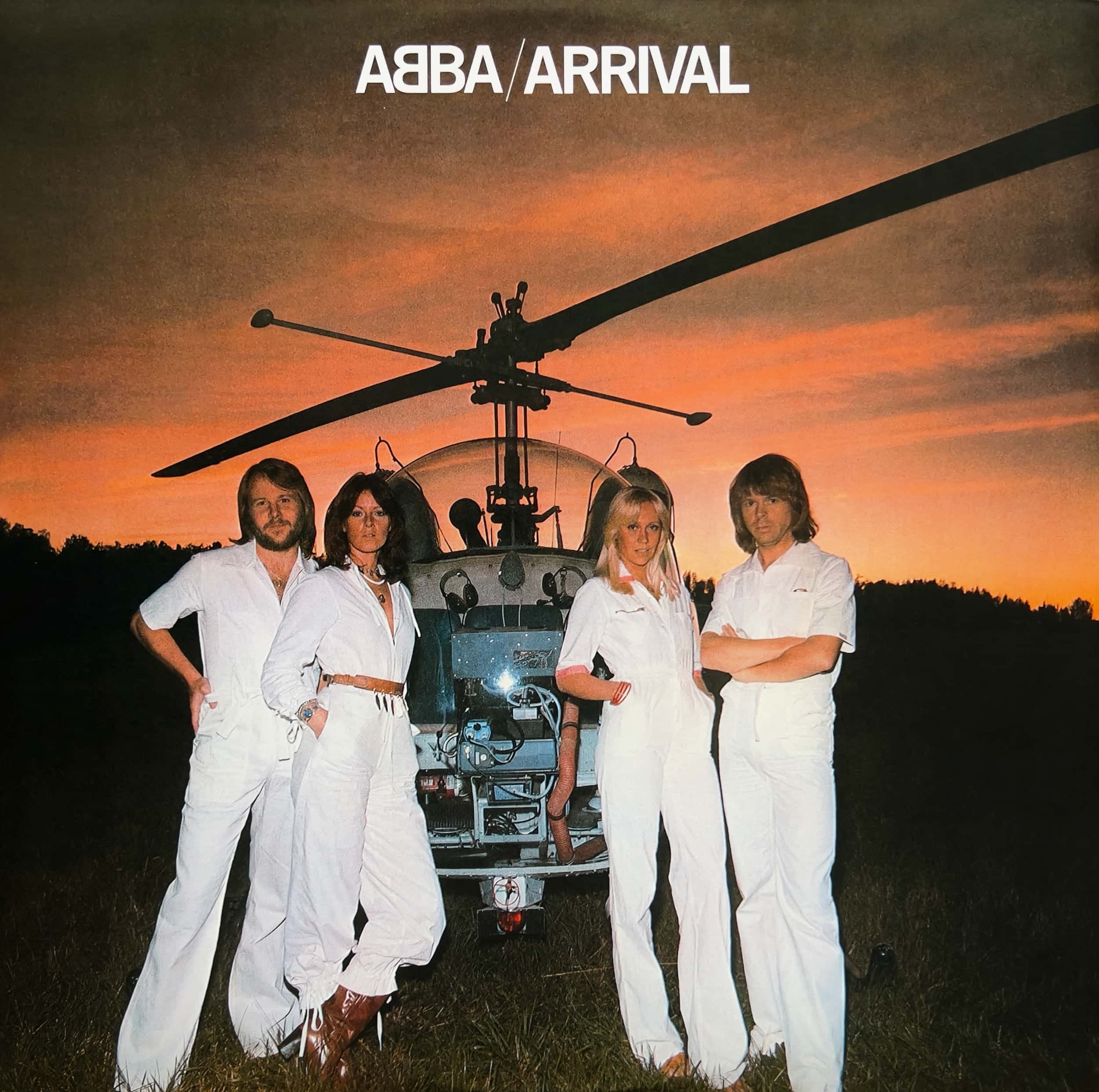
The cover artwork, for Arrival, is iconic and while the photograph of the band was taken while they were situated within the Bell 47 helicopter, it conjures up the imagination, doesn’t it? I remember as a young boy pondering if ABBA was otherworldly, for their music was uniquely exciting and the artwork that adorned this early cassette ensured my imagination ran wild. 

Interestingly, and I never realised this until much later in life, Arrival would be the first time the mirrored AB logo would be utilised as all previous releases used a different typeface with their first two albums highlighting the band members’ names. Yes, their earlier albums have all received updated artwork, when they were reissued, in order to bring the logo design in line with the rest of ABBA’s catalogue, but Arrival was the first to showcase this now iconic logo.

Of course, as much as I adore the vinyl reissue, you can’t necessarily take it everywhere with you. That’s where streaming services come in to fill the void. Apple Music and the lossless stream, an Apple Digital Master, is a little more dynamically compressed, than the 2020 vinyl reissue, resulting in slight mid-range muddiness and a little excess harshness in the treble range. As a result, I don’t experience as much enjoyment from the stream as I do from the record but the trick to appreciating the stream is not to compare the two. Easier said than done, I know, but by compartmentalising the vinyl edition as being an experience that requires a specific time and place, I find that the Apple Music stream becomes far more palatable. 

As it pertains to the stream, the Bonus Track version, containing Fernando and Happy Hawaii, of Arrival is the only available release. Fernando I can tolerate, it’s a great song even if not applicable to the original album structure, but Happy Hawaii is an atrocity that should have never been tacked onto the back end of such an incredible album. Thankfully, streaming offers something a physical medium can’t; the ability to exclude particular songs from one’s virtual library thereby meaning that the tracking of Arrival can replicate the vinyl counterpart. Yes, I acknowledge that many CD players have a programme function that allows music lovers to do essentially the same thing, but you have to do it every time you want to play the CD whereas with Apple Music you set it and forget it.

Of course, Arrival has had so many different track listings, depending on region and format, that it can be incredibly frustrating to choose a preferred version. Considering I’m a fan of the vinyl reissue from The Studio Albums, which mimics the original vinyl release out of Sweden, I’ve decided to compile a Playlist within Apple Music that specifically looks at the core Arrival tracks. Subsequently, if you’re after Fernando, may I suggest you check out ABBA Gold, or take a listen to it via its original Swedish language version on Frida ensam, thereby leaving Arrival unaltered.

When I Kissed The Teacher is one of those classic, near cringeworthy tunes, that is remarkably good. In fact, it’s a little surprising that the censorship mob haven’t tried to have it cancelled for the risqué lyrics, telling the story of a student’s crush, and subsequent kiss with a teacher, would be right up their alley. That aside, it’s a fantastic song and Agnetha’s vocals are particularly appealing, thereby resulting in a perfect opening tune. The only negative aspect I can point to is that depending on the edition you are listening to, When I Kissed The Teacher can be incredibly shrill. Thankfully, my preferred vinyl edition and the Apple Music stream roll the treble off slightly, thereby making it a pleasurable listen. 

Dancing Queen is likely ABBA’s most well-known and successful tune. Its unmistakable entrance ensures that this disco-pop tune has become a landmark release from the Swedes. While the musical aspects are paramount to the success of Dancing Queen, Agnetha and Frida’s intertwining vocals are most certainly the highlight; absolutely stunning!

My Love, My Life slows the tempo down to a ballad’s pace and Agnetha once again stuns. While some may disagree, Arrival represents some of the very best vocal recordings and mixes in ABBA’s illustrious career. My Love, My Life is, subsequently, one of the most beautiful songs ABBA ever recorded and it’s severely underrated.

Dum Dum Diddle is catchy with a chorus structure that will have you singing along; even if you don’t know what a Dum Dum Diddle is. Don’t worry, fellow ABBA fan, I have no idea either but I’ll play my make-believe fiddle as I Dum Dum Diddle my way through this incredible song. While it has been said that it tells of a story of a woman scorned by her lover’s admiration of his violin, I’d prefer not knowing the context and instead prefer the nonsensical lyrics to become another musical layer in the mix that need not be unpacked. Basically, I just want to enjoy this folk-pop tune and not thinking about the lyrics too much allows me to do just that. 

Knowing Me, Knowing You is a beautifully lush tune. Frida’s performance here, much like Agnetha’s, on the songs where she’s lead vocalist, is exceptional. Knowing Me, Knowing You is a perfect song; absolutely flawless!

Money, Money, Money is another highlight and the musical style is unique, to say the least. It doesn’t often happen, but Money, Money, Money leaves me somewhat speechless as I simply can’t find the words to review this song. Perhaps it’s simply a case of needing to listen to it for yourself as it’s an experience. 

That’s Me continues the piano tuning from Money, Money, Money thereby making the album even more fluid than it already is. While That’s Me was never going to set the charts on fire, and was only ever released as a single in Japan, it’s a masterful song and is one of my all-time favourite ABBA tunes. 

Why Did It Have To Be Me? shifts the style of the album while encompassing a mix of musical styles and influences that ensure Why Did It Have To Be Me? quickly becomes a hidden gem in ABBA’s back catalogue.

Tiger is a sensational tune. The heavier sound signature works well and it’s another severely underrated masterpiece from ABBA. Of course, when you’re a band that has so many incredible songs, even those that are exceptional are bound to get buried and it’s therefore imperative that we all venture beyond ABBA Gold

Arrival is a beautiful, primarily, instrumental closer. The harmonious vocals are similarly stunning but overall there really isn’t much to be said about it. Yes, it closes the album out nicely, permitting contemplation, but I’d argue that it subsequently doesn’t encourage me to play the album again as it’s too relaxed. It’s a double-edged sword, of course, for Arrival wouldn’t be the same album without its namesake.

As a body of work, Arrival is a landmark release, featuring some of the group's most iconic hits. The blending of styles, with a touch of flamboyance and maturity, makes Arrival one of ABBA's greatest studio albums and is amongst the very best records released in 1976. 

2 Comments