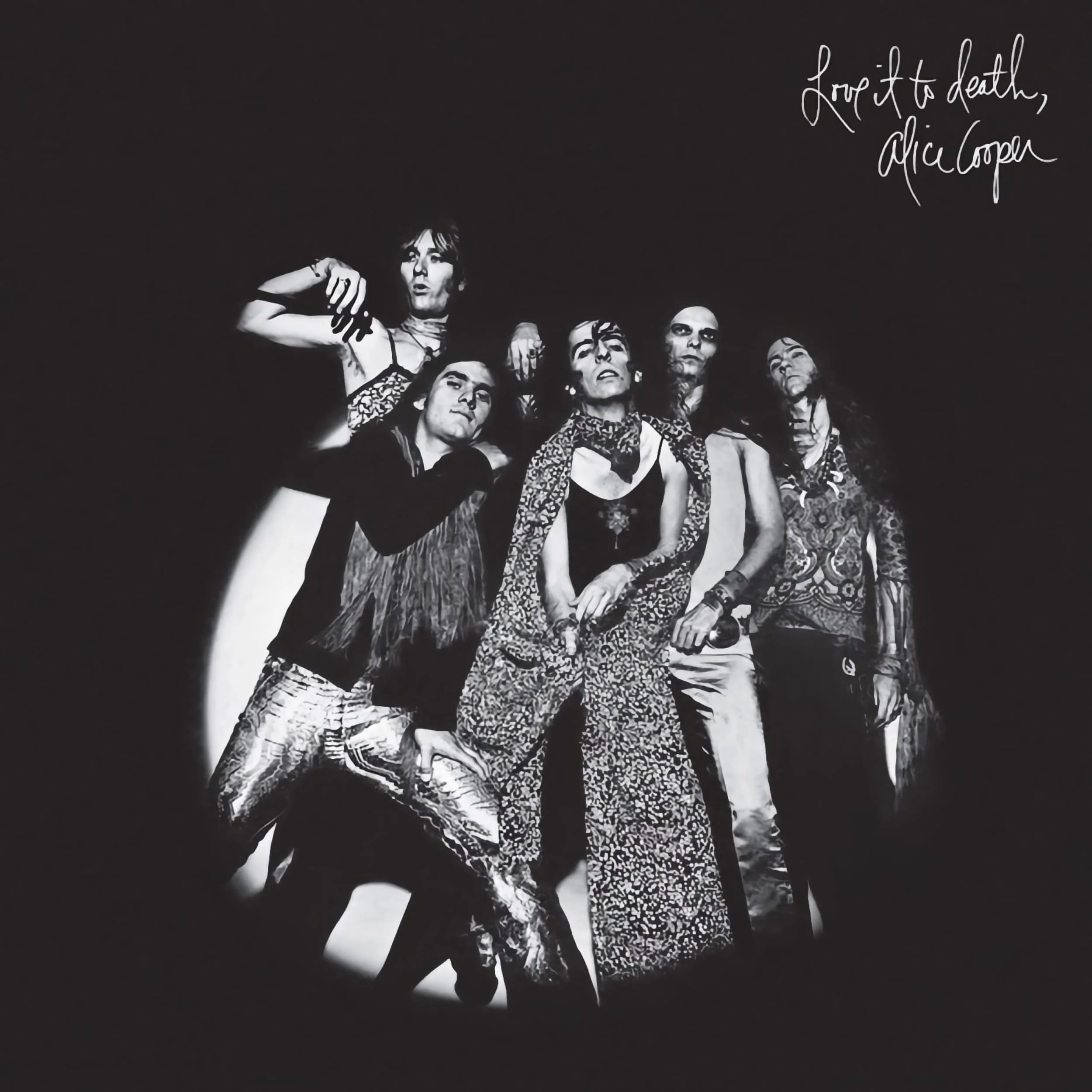
When thinking of the origins of Alice Cooper, one’s mind naturally turns to Love It To Death, as it’s arguably the one release, early in their career, that most aligns with the Alice Cooper band’s renowned musical style. No, for newcomers to Alice Cooper, this wasn’t their first or even second release, and while Pretties For You and Easy Action are compelling in their own right, neither had the perfect amount of balance and cohesion necessary to be a landmark release.
Released in 1971, Love It To Death was the first of two Alice Cooper albums released that year. While Killer built further upon the tightness that producer Bob Ezrin and the band would achieve on Love It To Death, there’s an experimental edge to this release that is difficult to ignore. Fans of the band’s first two albums will hear correlations, but the stylistic shift signified a type of music that, up until this point, had yet to be conceived, thereby making it, for the time, at least, extraordinarily unique.
Many classic albums launch with impressive album artwork, and Love It To Death is no exception. Featuring a striking black and white photograph of the band, the album’s artwork is far from controversial as the original uncensored cover art shows Alice with his thumb sticking out of his pants. It was deemed obscene at the time, and reissues, from 1972 to approximately the mid-2000s, contained the edited version sans the controversial thumb. Thankfully, as it pertains to modern reissues, including those on streaming platforms, the album artwork has been returned to its core origins. While one may ponder what the big deal was, for there are many more disturbing album artworks that can be discussed, the outrage undoubtedly added to the mystique of the band. While I usually prefer artwork, in all forms, to be free of censorship, I must admit that I prefer the artwork minus the thumb as I feel it’s less visually distracting.
From an audible perspective, while the recording and mix are done rather nicely, the mastered edition, on Apple Music, is a little muffled in places. Yes, it adds a patina and character to the overall recording, and is anything but shrill; however, there’s a greater sonic presentation to be heard, should the veil be lifted.
While there are different masterings of this classic release, two of the core ones have been limited to singular releases thus far. Steve Hoffman’s Audio Fidelity mastering has been limited to a numbered edition CD (HDCD, more specifically) release and the latest vinyl reissue, mastered by Kevin Gray, has similarly been restricted to that of a singular 2025 reissue and has yet to make it to any digital format, as the stream indicates a publishing date of 2004.
While it goes beyond the scope of this review, I’ve never understood artificially limiting reissues, especially when done by some of the most respected remastering engineers. If they’re that good, and many times they are, then why not permit it to be heard by a broader audience? While I have no answers to that question, it does compel me to pick up the 2025 vinyl reissue as it’s receiving significant praise from fans who have already added it to their collection. Until then, however, the Dolby NR-sounding digital stream will have to suffice.
Caught In A Dream opens the album in a lively manner, with a rock and roll energy that is not only highly compelling but utterly addictive. You’ll find yourself grabbing an air guitar and rocking out to this killer tune. Despite being released as a single, it failed to set the charts on fire following the success of “I’m Eighteen”, and despite being one of the best songs from the Alice Cooper band era, “Caught In A Dream” has, unfortunately, never quite received the accolades it deserves.
I'm Eighteen is, without a doubt, the album’s most notable track as it’s a mainstay of Cooper’s live performances and continues to be admired by fans the world over. For a song that was first released over five decades ago, it has most certainly come of age like a fine wine and appeals to each new generation, longing for independence, amidst internal conflict, as one attempts to carve out their own legacy of non-conformity within societal expectations.
In many respects, it was “I’m Eighteen” that put Alice Cooper on the map, as the single performed well enough on the charts to garner confidence from their record label (Straight Records | Warner Bros.) in relation to releasing a full album. Naturally, it helps if the band and the production team act as fans and request airplay via radio stations, but had that not been done, there’s a possibility that Alice Cooper would have been a mere footnote in the history of recorded music.
Long Way To Go is a high-energy number in a similar vein to the album’s opener. It sees the Alice Cooper band incorporate Ezrin’s tight song structure, and while there are bound to be those that dislike this approach, preferring the jam-style and overall looseness of their early recordings, “Long Way To Go” proves that sometimes less is more…that is, until the epic that is “Black Juju” comes along.
Black Juju is a true masterpiece in every sense of the word. Despite its extended length, and being a throwback to the albums that came before this one, “Black Juju” remains tight, somewhat haunting, and highly compelling. No, it was never going to be released as a single, for it isn’t the kind of song that could have been truncated, but it’s a piece of audible art that is amongst the greatest exploration of musical talent you’re ever likely to hear. Whether it’s the layers of instrumental wonder or Cooper’s divinely emotive vocals, “Black Juju” is amongst the greatest the band ever recorded, and while it does act as somewhat of a detour to the album’s linear structure, it is an extraordinary composition nonetheless.
Is It My Body returns the album to its core rock and roll vibe, with a touch of hard rock. It may not be a standout, unlike some of the other songs from Love It To Death, but it doesn’t need to be because this tune is quintessentially Alice Cooper; one that will see you toe-tapping and head-bopping along.
Hallowed Be My Name is a killer tune with a haunting introduction that creates the backbone of the song. It’s succinct, fun, and is another that ensures Love It To Death is an exceptional album experience whilst simultaneously helping to further define Alice Cooper’s signature sound.
Second Coming is one of my all-time favourite Alice Cooper band tunes. Its style reminds me fondly of Cooper’s solo-era recordings from around 1978’s From The Inside. “Second Coming”, however, is one of the songs that I feel is too short. Yes, it leaves you wanting more and can be seen as more of a lead-in for “Ballad Of Dwight Fry”, but it’s moments like this that I really wish the two songs had been connected as one. Yes, if listening via the album’s linear structure, as one would do more often than not on vinyl, the blend is seamless, but if one wishes to put “Second Coming” on repeat, for instance, in the digital era, it’s a little more problematic. First world problems, I know, but the two songs in conjunction form a masterful composition and lead into the closing track in an utterly perfect manner that showcases just how extraordinary Ezrin was in the production chair.
Sun Arise is a cover of the Rolf Harris original, but this interpretation by the Alice Cooper band breathes new life into the song and is a wonderful closing number for Love It To Death, as it permits contemplation and will likely encourage you to spin the record again.
From start to finish, Love It To Death is a quintessential Alice Cooper band release that laid the groundwork for their renowned hard rock style. While it escapes much of the psychedelic experimental stylings heard on their original releases, the amalgamation of styles delivers a uniqueness that has been inspirational for countless musicians. It, subsequently, wouldn’t be far-fetched to suggest that had it not been for Love It To Death, the Punk, Hard Rock, and Heavy Metal scenes would be considerably different had this record never seen the light of day. So, dear reader, let’s give the record another spin and love it till death do us part, for this landmark release is one of the greatest albums of all time.