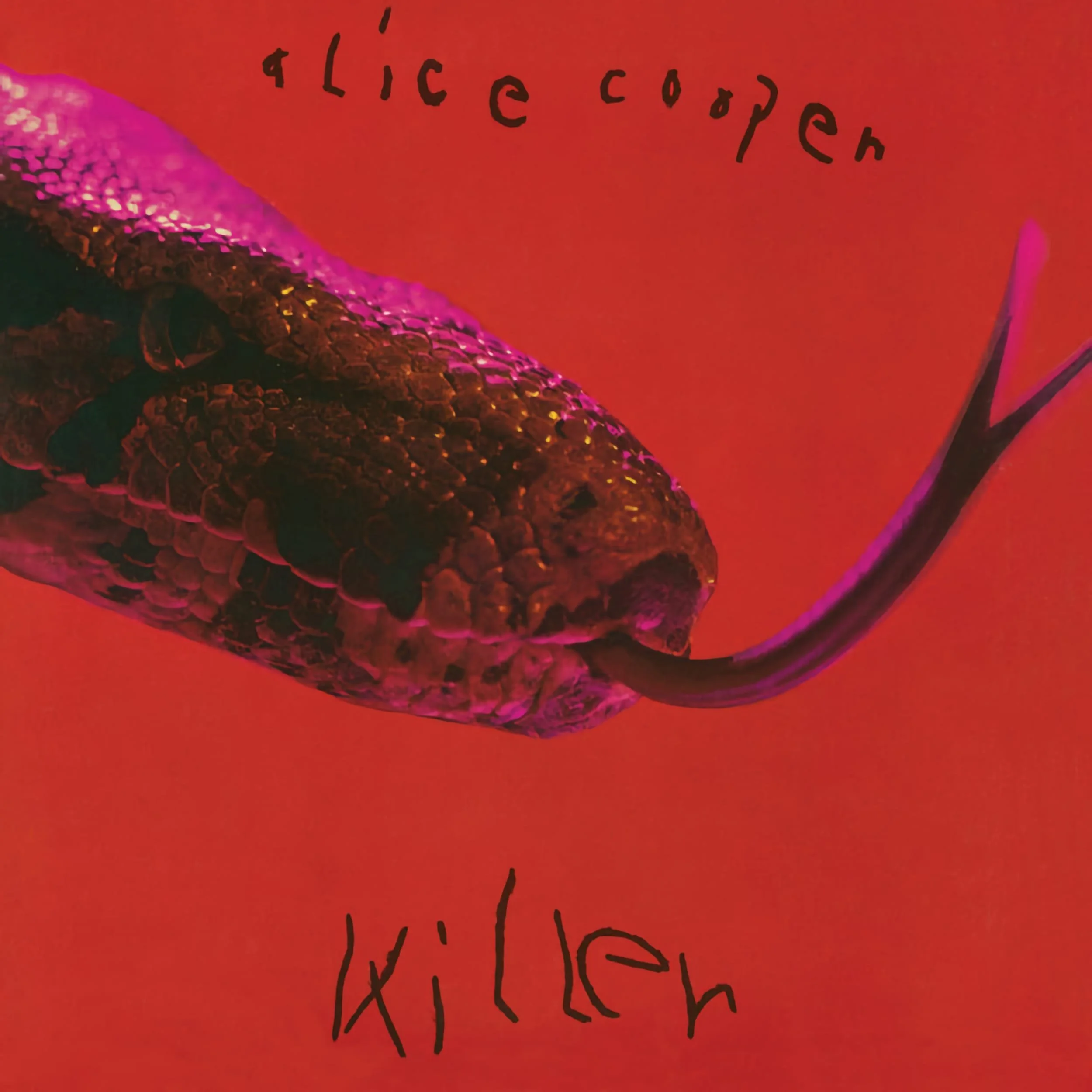
Released in November 1971, eight months after Love It To Death, Killer not only built upon the success of that breakout album but also became a defining statement of early-‘70s hard rock along with the Alice Cooper band’s musical, theatrical, and conceptual ambitions. Despite the short timeframe between releases, Killer presents a considerably different Alice Cooper as this, their fourth studio album, feels like a more deliberate and darker collection of songs that remain fan favourites to this day.
Bob Ezrin once again proved his worth in the production chair, encouraging even greater tightness and songwriting while ensuring a production standard that has defined the band, the era, and his career. He is, in many respects, the most influential person as it pertains to Alice Cooper’s metamorphosis and subsequent growth in popularity. Yes, the band was extraordinary, but Ezrin made them legendary.
Speaking of things that are legendary, Killer’s cover art is one of the most striking from the era. While not laced in controversy, as Love It To Death was, the inner gatefold, depicting Alice’s hanging, has often received varied opinions. When you contrast it to Alice Cooper’s shock rock approach, however, it’s perfectly aligned with the band’s theatrics. While many of these aspects are lost in modern streaming and digital solutions, given the lack of detailed liner notes, Killer is from an era when the visual accompaniment was often as important, if not more so, than the music contained within the record.
Alongside the striking album artwork, and the incredible song selection, is a mature-sounding record. As you listen to the mix, you’ll come to appreciate the delicate nature of the recording, for this wasn’t merely a thrown-together rock and roll album, but a finely tuned audible spectacle. Despite being remastered for the album’s 50th Anniversary (but released in 2023), I still maintain that the 2004 CD-quality lossless Apple Music stream is the go-to edition, over the newer release.
Warner Music has, thankfully, kept the legacy release alongside the remaster on Apple Music, thereby allowing fans to choose their preferred edition. This is, naturally, a good thing as both releases are notably different to each other. We’re not talking about a remix, but upon initial listens, I feel the 2023 remaster is a little less dynamic and a tad more bloated in the mid to low-end of the audible spectrum. Some may naturally appreciate this boost, for it’s aligned with modern mastering techniques, but tone controls can achieve the same result and can be dialled in, specifically, to one’s subjective preference.
The bottom line, as it pertains to sound quality, is that I implore you to listen for yourself as both versions are readily available. It really is a subjective preference, and one isn’t “better” than the other. So, dear reader, take a listen to the 2023 remaster, or the legacy 2004 CD-quality stream, as we take a look at the songs that make up this classic release.
Under My Wheels sets the tone for the record with a screeching rock and roll vibe from the very first note. Perfectly suited to the era, and Alice Cooper’s style, the brass instrumentation sets it apart in a memorable manner. The only negative aspect is it’s too darn short; punk rock, anyone?
Be My Lover is a spectacular glam rock number, one that is semi-autobiographical as it talks of the groupies that associate themselves with musicians. Ah, what it would be like to be a rock and roll star. While most of us will never know, we can live vicariously through this killer tune; thank you, Michael Bruce!
Halo Of Flies is filled with an eerie musical bed that ideally positions itself as a prog rock masterpiece. Despite its length and ambitious composition, “Halo Of Flies” remains unruly and is one of the best songs that the Alice Cooper band ever composed.
Desperado was perfectly tracked and is the ideal song to follow “Halo Of Flies” for it, too, is one of the greatest songs Alice Cooper (band, or solo) has ever recorded. Despite being written as a homage to Jim Morrison, the correlation simply escapes me. Yes, I prefer listening to vocals as another instrument within the mix, rather than a storytelling device, but even when perusing the lyrics, I fail to see the association. Nevertheless, it’s a great tune and is even greater when performed live.
You Drive Me Nervous picks up the tempo, and as the song progresses, there are moments when you’ll hear the influence the Alice Cooper band had on the legendary Australian rockers Skyhooks. That correlation aside, “You Drive Me Nervous” is short, punchy, and playful; a hallmark of a perfect opening tune for the second half of the record.
Yeah, Yeah, Yeah has a charm to it, and while it flows perfectly from “You Drive Me Nervous”, this album-only tune is unlikely to be anyone’s favourite. Still, Killer wouldn’t be the same without it, and every song does not need to be an elaborate composition for an album to be considered top-tier.
Dead Babies adds a little controversy to the record; that is, if you only focus on the song’s title and fail to comprehend the lyrics. Despite that, this song remains one of the most compelling and heart-wrenching tales told via music. The musical bed is haunting, as are the sound effects, but Cooper’s vocal delivery, in particular, is one of the greatest in his entire career.
Killer flows seamlessly from “Dead Babies” with a similar tonality that closes the album perfectly by permitting reflection as well as encouraging you to spin the record again. Its multilayered experimental nature, with a touch of prog-rock, results in a musical dreamscape that is amongst the most creative of the era and genre. A minor quibble, however, is that closing sci-fi element. It adds no value to the song and, at best, is grating to the senses.
Overall, Killer is (pun intended) a killer record that has not only stood the test of time, but remains one of Alice Cooper’s most beloved. As a fan favourite, it has endured because it has a little bit of everything. From the ballad-styled approach of “Desperado” to the theatrical and progressive styling of songs such as “Halo Of Flies” and “Dead Babies”, Killer showcases a band on the precipice of greatness, for this is a highly enticing album experience and one of the very best from 1971.