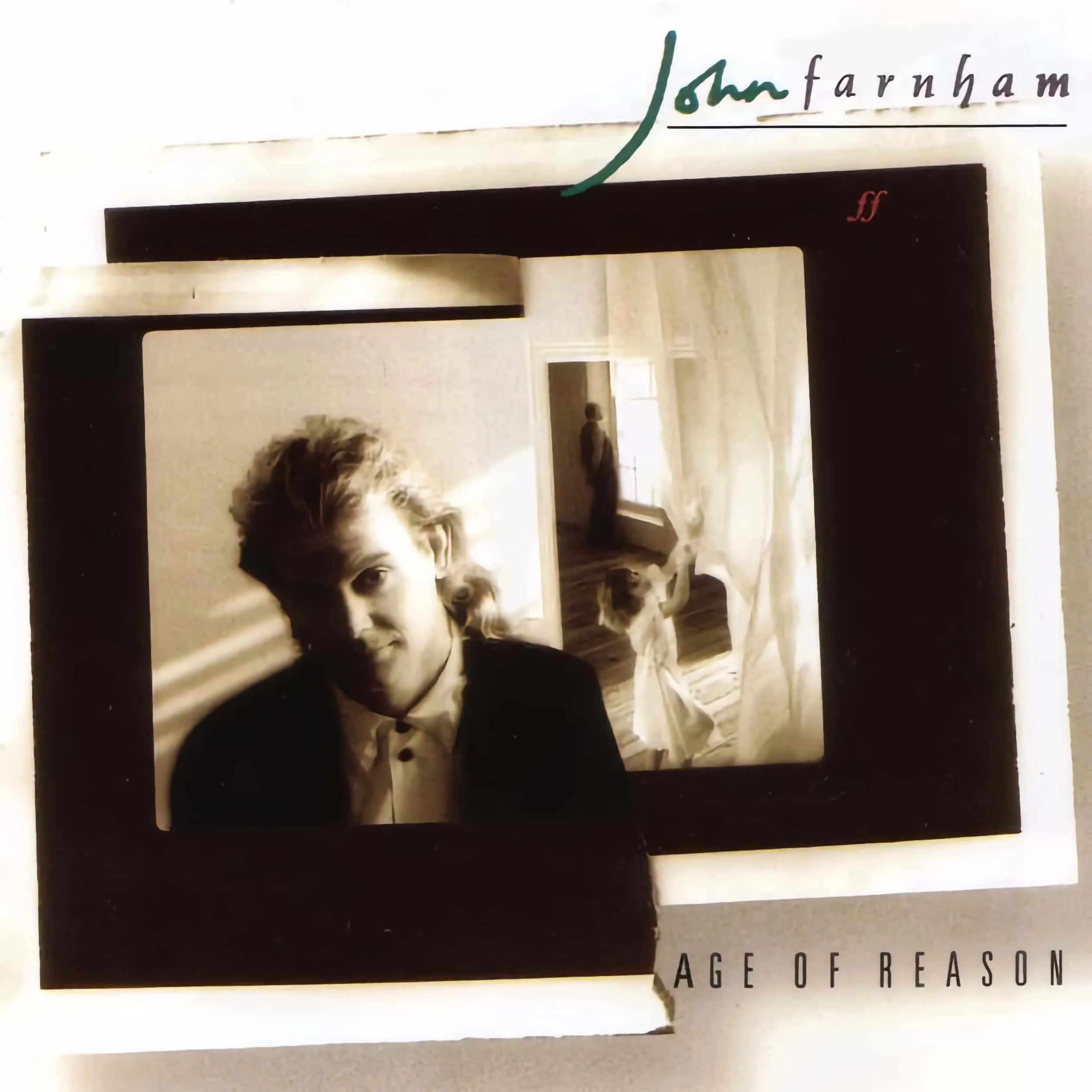
Following the remarkable comeback success of Whispering Jack (1986) was never going to be an easy task, but Farnsy, as he’s affectionately known, not only came back with a comparable follow-up, he, in many ways, blew it away with an album that proved, in this maturer rendition of himself, that he was a lasting power within the Australian Music scene.
Naturally, many people consider Age Of Reason as John Farnham’s second album, but just as the world isn’t merely 2026 years old, Farnham’s career well and truly predated his most successful era (1986 through to the mid-90s) with an impressive twelve studio albums being released before Age Of Reason in 1988. Of course, most fans know the corny old-time hits, which most certainly include Sadie (The Cleaning Lady), but the majority of his earlier releases have been out of print for decades and unavailable on streaming services, hence the confusion.
For those looking for a little more Farnsy in their life, particularly before he was a household name and one of Australia’s greatest musicians, you might also wish to take a listen to The Little River Band’s 1983 release, The Net,1985’s Playing To Win, and No Reins (from 1986), as he was the lead singer during that era of the band. Yet, and perhaps even more intriguing, his releases with the Little River Band are not part of those core 12 studio albums I mentioned earlier. Hence, what Age Of Reason represents is the middle point of, arguably, the most successful rise in popularity that the Australian Music scene has ever witnessed.
Upon its release, Age Of Reason rose to the top of the charts and became not only the most successful Australian release of 1988, but would remain in the number one position for eight weeks with sales, as of 2026, reaching in excess of 845,000 units. Yes, these numbers are considerably less than Whispering Jack, but as longtime readers and music lovers will note, sales at the cash register are rarely a true indicator of musical brilliance. However, in this case, the album’s success is most certainly representative, as Age Of Reason would also go on to win three ARIA Awards in 1988.
As one of the very first albums I owned, on cassette, Age Of Reason is notably infused with my soul and has stood the test of time, despite wearing out that initial tape. When searching for a replacement copy, in the 90s, I was surprised to find that the CD release featured two bonus tracks. While Farnham’s covers of When The War Is Over (from Cold Chisel’s Circus Animals) and It’s A Long Way To The Top (If You Wanna Rock ’N’ Roll) [from AC/DC’s High Voltage] are splendid, neither fundamentally enhance Age Of Reason and it can, therefore, be suggested that the core 10-track linear structure is the ideal way to appreciate this classic album.
For modern-day music collectors, all CD releases still include these bonus songs, but I was over the moon when Sony Music Australia decided to repress a vinyl release in 2017, sans the bonus material. Of course, the album’s tracking is but one aspect, for if the repressed record failed to set the turntable on fire, its release would be a disappointment for many fans. So, how does it sound? Well, it sounds like digital pressed to vinyl. Granted, there’s no way to tell which master was used or how this reissue was created, but it’s clean with a decent dose of clarity. It could be a touch warmer, particularly in the mid to low-end of the audible spectrum, as it lacks a little of the smoothness and warmth I’d ideally expect to hear.
Compared to the CD-quality Lossless Apple Music stream, the repress doesn’t quite live up to the hype. It isn’t that it’s bad, per se, but the streaming counterpart is noticeably more dynamic and permits the raising of the volume with no listening fatigue or sonic degradation. The vinyl record, however, sounds lovely at modest volume levels but quickly becomes fatiguing and sonically compromised as the volume is turned up.
Yes, dear reader, you read that correctly, I prefer the digital counterpart as it not only sounds right, but is detailed, warm and full-bodied, and is capable of playing consistently well at all volume levels. It isn’t often that that happens, for vinyl is usually a format with a full-bodied presentation, but that is not the case for this particular release.
What the vinyl reissue gets right, however, is the beautifully reproduced album artwork. Yes, the cover art is a little soft, but from memory, it always was, and the album’s liner notes are presented with full lyrics on the printed inner sleeve with production details on the rear of the record. About the only criticism the packaging deserves, and it really isn’t that big of a deal, is that the reissue isn’t presented in a gatefold presentation. Truth be told, it doesn’t need to be, but it would have been nice to have an exact replica of the album’s original vinyl release.
Age Of Reason is a quintessential title track, one that is instantly recognisable from the very first clock tick and note to the last. While it’s no You’re The Voice, Age Of Reason has a similar resilience in both lyrical intent and overall styling. Musically, it’s expansive, expressive, and the soundstage is so well-developed that you’ll find yourself drawn in and captivated by what can only be described as a textbook-perfect recording; one that, if you had the chance to witness, was a highlight of Farnham’s live performances.
Blow By Blow kicks things up a little with a rock-fuelled edge that, despite being sonically different to the album’s opener and title track, flows seamlessly and is another of Farnham’s stadium-filling pop-rock numbers. Of particular note is Bill Harrower’s killer saxophone, for despite only being used sparingly, it becomes a trademark element of the song, one that I look forward to hearing upon each play.
Listen To The Wind shifts the tempo downwards for a more elegant performance that showcases Farnham’s remarkable vocal prowess. His vocals are vulnerable, and while there may be a tad of production trickery going on here, this presentation is amongst his most unique as it sits atop the magnificent musical bed. David Hirschfelder is incredible on keyboards, but one thing you’ll notice when listening to the album is that each song amplifies one of the musicians, and it just so happens that I feel this is Hirschfelder’s most memorable contribution to the album.
Two Strong Hearts continues the slower tempo, but with a more upbeat styling. It’s a great song, it truly is, but it’s also one that, after hearing it so often, you can tire of. It’s the chorus that, as catchy as it is, becomes a notorious earworm that is inescapable. Even so, Two Strong Hearts is thoroughly enjoyable, especially if you haven’t listened to the song recently.
Burn Down The Night returns the album to its pop-rock edge, but this time it’s edgier than the other songs on the album. That isn’t a bad thing, however, as the grit and overall intensity of the tune ensure the album avoids becoming a monotony of ballad-styled numbers. Plus, Farnham was just as good a rocker as he was an adult-contemporary pop icon, and in some cases, his rock numbers trump his most delicate and considered compositions.
Beyond The Call is an underrated masterpiece. As the opening tune for the second half of the record, it’s the perfect counterpart to the album's opener. Perhaps most perplexing is the fact that when this song was released as a single, it failed to enter the Top 40. Truthfully, I’ve never understood the music-buying public, and while many would have purchased the album, and therefore not bothered with the single, it’s such a powerful tune, with an incredible musical presentation, that this is one song that I would have assumed would have risen to the top of the charts. As with several other songs from Age Of Reason, Beyond The Call was another that was spectacular when performed live.
We're No Angels is a beautiful tune with a thoroughly pleasing contemplative element that brings awareness to humanity’s flaws. Add to that a magnificent composition, one which perfectly highlights Farnham’s diverse vocal styling, and you’ve got what can best be described as one of Farnham’s greatest recordings.
Don't Tell Me It Can't Be Done is another of Farnham’s pop-rock masterpieces, which has a killer guitar riff and semi-solo that will have air guitarists in seventh heaven, for Brett Garsed is amongst the greatest, and most underrated, guitarists of all time. His style is complementary to the song, rather than being a standout, but don’t let that diminish his contributions, for much of the album’s rock edge can be attributed to his guitar licks. If nothing else, Don’t Tell Me It Can’t Be Done can be seen as a motivational anthem and sometimes we all need a little motivation in our lives.
The Fire is a solid number, one that flows well within the album’s linear structure, but it’s not a standout. Of course, for an album to resonate, it isn’t merely up to a few hit songs, but the entire body of work, and in this instance, The Fire works exceedingly well as an album-only number, one that will see you toe-tapping and head-bopping throughout.
Some Do, Some Don’t is far from the strongest tune on the album and in some ways could be considered a misstep, but despite the campy styling, it gets me playing the record again, every time I hear it. That said, I could also see The Fire as the closing tune and, in many ways, would have allowed for greater contemplation of the album, particularly if you decided not to listen to the album again.
From the emotional balladry to romantic pop to the anthemic rock numbers, Age Of Reason showcases Farnham’s vocal versatility, skill, and general appeal, as his broad styling and highly compelling music will appeal to just about anyone. While Age Of Reason may be of its era, the 80s production cues haven't dated the record, meaning that old and new fans alike will find something to enjoy upon listening to this classic release.