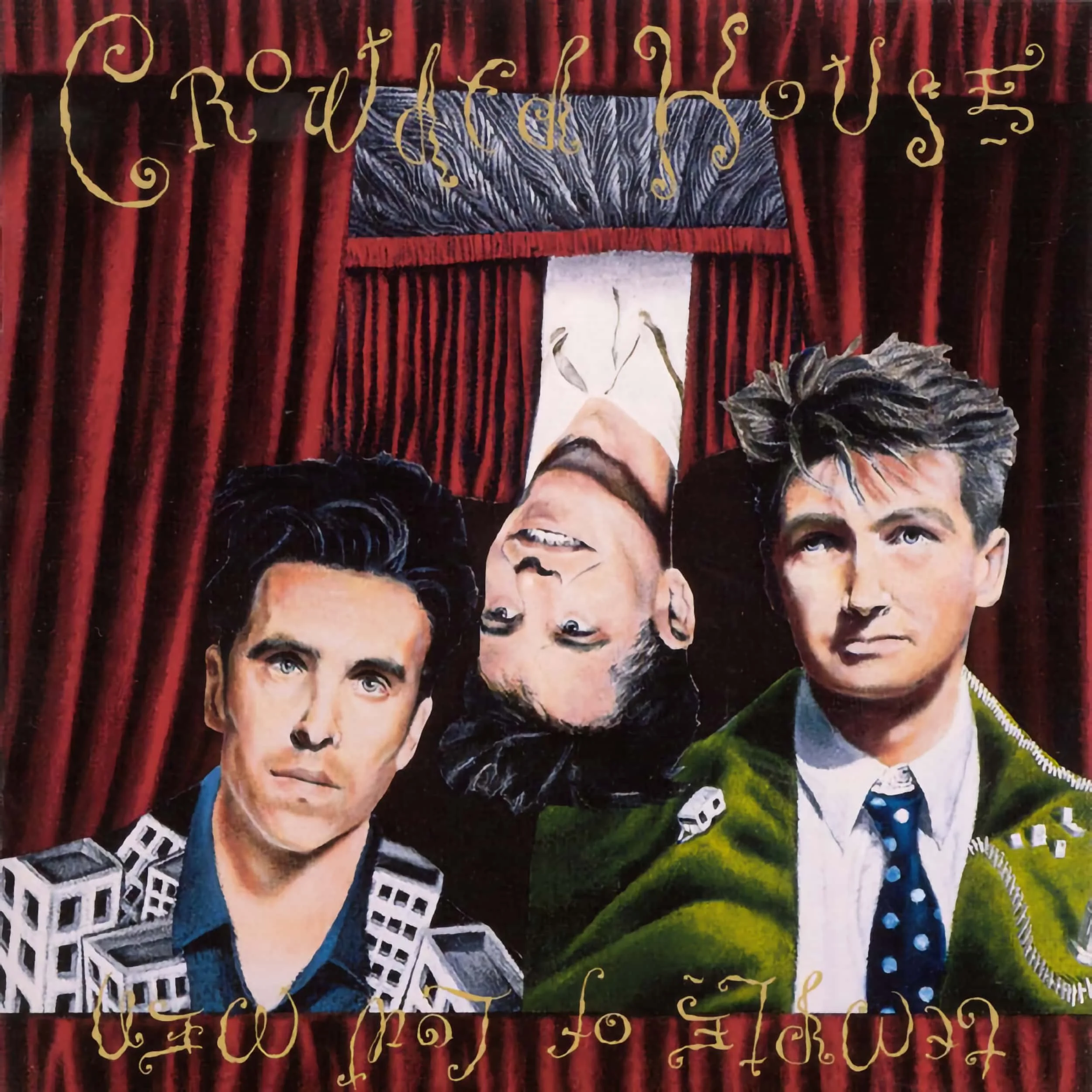
Released in 1988, Crowded House’s second studio album, Temple Of Low Men, became an astounding success in both Australia and New Zealand, hitting #1 and 2 respectively, while also charting well worldwide. While this may be hotly debated, Temple Of Low Men, despite its more sombre musical tone, is Crowded House’s greatest release with ten incredible songs that flow so seamlessly together that you’d think you were listening to a greatest hits album. From the songwriting, to the emotive storytelling, to the musical extravaganza, Temple Of Low Men set the bar so high that it has become a timeless classic.
While Crowded House was most certainly a band billed with three members, it’s important to note the influence of Mitchell Froom in the production chair, for he not only produced their greatest releases but played keyboards throughout. In many respects, he could be considered the fourth member of the band and along with a masterful mix by Bob Clearmountain and a beautiful original mastering by Bob Ludwig, the band and entire production team produced a sonic masterpiece that sounds just as good today as when it was first released…that is, if you have a copy of the original CD release, or a repress, with the original mastering.
Yes, dear reader, as much as I laud streaming, particularly Apple Music, the CD, despite being a tad on the bright side, offers a far better representation of the album than the Lossless Apple Music stream. Unlike their self-titled debut, this landmark release isn’t delivered as an Apple Digital Master, which further complicates matters because it’s unclear which mastering Apple is delivering. The publishing date is listed as 1988, rather than 2016, when the latest remastering/reissue of the album was released in a Deluxe offering. Interestingly, that Deluxe Edition is available on Apple Music, but that too has the original release date as the published date, which is, naturally, erroneous for that particular reissue. That particular edition, however, does seem to have a nicer tonality and is a little closer to the CD’s sonic presentation, but not by much.
Adding to the frustration, for modern streaming and digital download audiences, is the fact that Qobuz has access to a Hi-Res Audio 24-bit/96 kHz version, but the publishing date is 2021 and, to my knowledge, the album wasn’t remastered again in that year. As many music lovers with an interest in attaining the highest quality recordings will testify, Hi-Res is not always better, as it comes down more to the mastering, or remastering, and how that was undertaken. Hence, my go-to remains the European repressed CD, with the original mastering, for it simply sounds right and doesn’t cause additional frustration in determining which version I’m currently listening to.
Where the CD particularly excels is in soundstage and overall sonic detail. There isn’t a single concealed musical element, unlike the lossless streaming counterpart that sounds less lively and dull by comparison. Yes, the treble is reigned in via the stream, but reducing the treble range by a single point on your stereo system will achieve a much better result overall, as it removes a little of the digital glare in the top end but doesn’t dull the rest of the sonic presentation, as is the case with the lossless Apple Music stream.
So, can the Lossless Apple Music stream still be thoroughly enjoyed? Yes, particularly if you haven’t heard an original edition. However, if you’re after a sonic representation that best suits the album, the era, and the overall recording, then I’d suggest you track down a legacy release.
I Feel Possessed is a stunning album opener that sets the overall tone of the record from its very first moments. As you listen, you’ll be captivated by the mix, for the layers of musical elements are thoroughly satisfying and immediately meld with your soul in this otherworldly-styled tune.
Kill Eye shifts the tone considerably to a more aggressive and forward presentation that takes a few moments for the senses to adjust to. As with the album’s opener, and so much of Crowded House’s music, Kill Eye is a musical wonderland where each repeat listen is rewarding as different elements are heard within the mix while never detracting from the song itself. It is, however, the dullness via Apple Music that conceals much of this wonder, and it’s a shame because Kill Eye is a sweeping grind-driven masterpiece.
Into Temptation slows the tempo and returns the album to a more melodic styling, only this time the shift isn’t as noticeable as Into Temptation is the perfect follow-up to Kill Eye. The highlight here, besides the highly compelling musical styling, is Neil Finn’s incomparable vocal extension and control, as every ounce of emotion is not only clearly heard but also felt. Into Temptation is an astonishingly good song and one of the very best Crowded House has ever recorded.
Mansion In The Slums is an all-time favourite. The vibe, the lyrical context, and the earworm-worthy styling ensure that Mansion In The Slums is not only highly compelling but is one of the deeper cuts that make Temple Of Low Men such an extraordinary release.
When You Come is one of the better-known songs from the album, as it was released as a single. Despite not hitting the top of the charts, When You Come is the ideal counterpart to the album’s most well-known tune, and closer, Better Be Home Soon. As such, the melody will encapsulate you and is an ideal midpoint for the record. For those who have the cassette or vinyl releases, When You Come also signifies the closing of side one, and while you’re likely to play the second half of the album, I couldn’t think of a better song to close out the first half of the record.
Never Be The Same is, in the same context as the perfect opener/closer, an exceptional song to launch the second half of Temple Of Low Men with. Compared to the moodiness of the other songs, Never Be The Same is a little more upbeat in its musical styling, but it’s the wistful nature of the lyrics that are both reflective yet progressive. The result is that Never Be The Same is amongst the most intriguing songs Crowded House has ever released.
Love This Life is another of Finn’s remarkably reflective tunes, for he truly is a master songwriter. The uplifting, yet sombre aspect, is a contrast that plays out perfectly well in regards to both lyrical context and musical styling. While not released as a single, Love This Life is a hidden gem and another reason why Temple Of Low Men is as rewarding a musical experience as it is.
Sister Madly is a fun little number in much the same manner as Nothing Too Serious was for Icehouse. The quirkiness works perfectly, for the catchy, energetic styling results in a playful rhythm-driven vibe that adds a lighter tone and balances out the record.
In The Lowlands is another of those highly sought-after hidden gems. The mix and overall soundstage are remarkably engaging, for you’ll find yourself toe-tapping and head-bopping along to what can be considered an upbeat number in every aspect other than lyrical context. Nevertheless, and this is a core strength of Crowded House, even within their more sombre, more thought-provoking tunes, they’re musically engaging, and In The Lowlands is no exception.
Better Be Home Soon is a simply beautiful Crowded House tune, one that has become a trademark for the band. Seriously, nothing more needs to be said other than to take a listen, particularly if you haven’t already, and you’ll quickly see why Better Be Home Soon is Temple Of Low Men’s Don’t Dream It’s Over.
From Nick Seymour’s magnificent album artwork, to the incredible collection of songs contained within the record, to the recording, mix, and mastering quality (particularly of original releases), Temple Of Low Men is a landmark release that is not only one of the greatest albums Crowded House ever released, but it's one of the very best albums from the 80s and in all of Australian recorded music history. It’s reflective, thought-provoking, but most importantly, it’s unforgettable.